THE CLASSIC COLLECTION✦The Pentateuch of printingCLASSIC FREE BOOKS
The Pentateuch of printing
William Blades
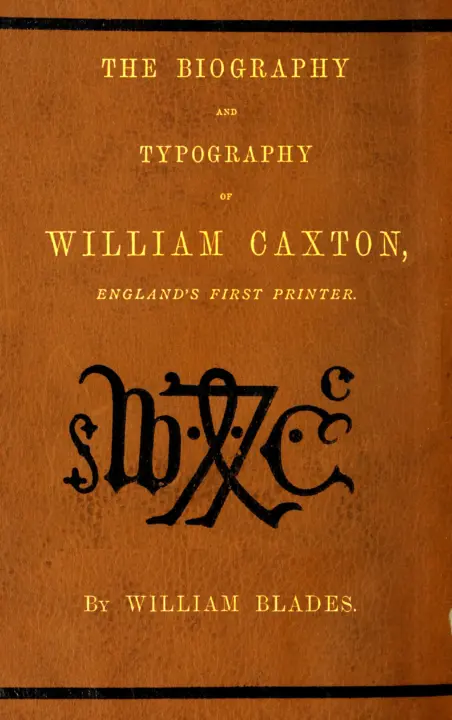
THE CLASSIC COLLECTION · 1861
"The biography and typography of William Caxton, England's first printer" by Blades is a historical and bibliographical study written in the late 19th century. It charts Caxton’s life and career alongside a meticulous analysis of his printed output, types, devices, and working methods, situating him within the rise of printing in England and the Low Countries. Drawing on company records, embassies, and court circles, it follows Caxton from Kentish origins through mercantile Bruges to Westminster, while also cataloguing his editions and discussing their rarity and features.
The opening of the volume sets the scope: a revised reprint that condenses earlier scholarship and adds notes on Caxton’s printer’s device and punctuation, while underscoring printing’s civilizational impact. It then outlines the plan—first a documentary life of Caxton, then detailed descriptions of his books by type, with appendices from Mercers’ and Bruges records. The narrative begins with Caxton’s birth in the Weald of Kent amid strong Flemish influence, a dialect anecdote about “eyren/eggs,” and a sober weighing of name variants to suggest a likely Causton connection. It proceeds to his 1438 apprenticeship to the wealthy mercer Robert Large, depicting London apprentice life, Large’s household and will, and vivid city scenes—dearth, pageantry, religious persecution, and civic unrest—culminating in Caxton’s departure abroad. In Bruges he emerges as a prosperous merchant, then Governor of the English Nation (Merchant Adventurers), mediating trade disputes, enforcing measures, and corresponding with London while treaties lapsed and were renewed; he begins translating the Recuyell under Duchess Margaret’s patronage and likely moves toward printing with Colard Mansion. A broad survey follows of 15th‑century bibliophilia—royal and ducal libraries in France and Burgundy, Louis de Bruges’s collection, English patrons—and of the book trades’ guild structure at Bruges and Antwerp. Finally, an initial technical chapter contrasts manuscripts and early print, explaining materials, binding habits, blank leaves, one‑page printing, signatures, hand‑painted initials, undated colophons, and typeforms that closely imitated contemporary handwriting.
Introduction adapted from the source catalogue; source summaries may be automatically generated.
Free to read · English · 119,581 words · No account needed
MAKE TIME FOR A GOOD BOOK
On by default. Untick to stop anonymous reading totals. Each page counts after 10 seconds in view. How this works.
Anonymous counting is on unless you have switched it off.
~Finiunt sex p’elegantissime epistole /
quarum tris a summo Pontifice Sixto
Quarto et Sacro Cardinalium Collegio
ad Jllustrissimum Uenetiarum ducem
Joannem Mocenigum totidemqz ab ipso
Duce ad eundem Pontificem et Cardina-
les / ob Ferrariense bellum susceptum / con-
scripte sunt / Jmpresse per willelmum Cax-
ton / et diligenter emendate per Petrum
Camelianu Poetar’ Laureatum in West-
monasterio~
Beneath this is a Latin quatrain, beginning
~Eloquii cultor,~
followed by
~Jnterpretatio magnarum litterarum punctatarum parua-
rumque.~
The Text ends with 23 lines on the verso of the same leaf.
REMARKS.--These six letters passed between the Sacred College of Cardinals on one side and the Doge of Venice on the other, the subject being the necessity of closing the war with the City of Ferrara.
Petrus Carmelianus, the editor of these letters, is noticed by Mr. Gairdner, in his preface to the “Memorials of King Henry the Seventh,” published in 1858, for the Master of the Rolls, as having been in England from the time of Edward the Fourth. He may, therefore, have personally employed Caxton to print his “Sex Epistolæ.” The title “Brixiensis” sometimes attached to his name shows that he was a native of the town of Brescia. He seems to have taken an interest in educational matters, as verses by him to John Anwykyl and to William Waynflete, Bishop of Winchester, are prefixed to the “Compendium totius grammaticæ,” printed at Oxford about 1482-83. Some more of his poetry is printed in the Oxford “Phalaris” of 1485. Tanner assigns to Carmelianus the following promotions--Rector of St. George’s, Southwark, 1490; Prebend of York, 1498; Archdeacon of Gloucester, 1511; Prebend of London, 1519. Being in such favour, no wonder that he waxed rich, and that when, in 1522, “an annual grant was made by the Spirituality for the King’s personal expenses in France for the recovery of the Crown,” the name of “Mr. Petrus Carmelianus” appears among the “Spiritual Persons” for the handsome sum of £333 6s. 8d. In the Calendar of State Papers, where he is called “Latin Secretary of King Henry the Seventh,” mention is made of a letter sent to him from Ferdinand and Isabella of Spain, thanking him for his services, and promising him favour and reward. On the projected marriage of Prince Charles of Castile with the Princess Mary of England he wrote a poem in Latin, printed by Pynson about 1514, of which a unique copy is in the Grenville Library (see Archæologia, vol. xviii.) In the same library is a manuscript poem on the birth of the Prince of Wales (1486), another copy, beautifully illuminated, being among the royal MSS. in the British Museum. Both are evidently in the handwriting of Carmelianus, the latter being his presentation copy to the king. The argument of this poem is so characteristic of the age that it is worth noting. Almighty God, compassionating the miserable state of England lacerated with civil war, convoked a meeting of the Saints in Heaven to ask their opinions as to how the long-standing dispute between the Houses of York and Lancaster might be composed. The saints reply that, if the Omniscient Deity cared for any of their counsels, no one was better qualified to state how the wars might be terminated than King Henry the Sixth (already in heaven), who knew the country and the causes of dissension, and they recommended that he should be appealed to. Henry is accordingly called upon to reply to the Supreme Being, and proposes that the two houses should be united so as to be one house, for which an opportunity then offered by the marriage of the Earl of Richmond with the Princess Elizabeth. The Deity approves and decrees its execution, the marriage takes place, and the poem terminates with an exhortation to England to rejoice on account of the prince’s birth. Carmelianus died August 18th, 1527; John de Giglis, Bishop of Worcester, in 1497, his contemporary and countryman, also employed Caxton to print Indulgences.
Your reading position is saved on this browser. Take it to another device with a library code. Reading pages adapt to text, rather than matching a printed edition.
William Blades
William Blades
William Blades
BEHIND THE BOOK
This eBook is for the use of anyone anywhere in the United States and most other parts of the world at no cost and with almost no restrictions whatsoever. You may copy it, give it away or re-use it under the terms of the Project Gutenberg License included with this eBook or online at www.gutenberg.org. If you are not located in the United States, you will have to check the laws of the country where you are located before using this eBook. Read the source licence.
The original source file, including credits and licence, is retained by this library. Request an original-format copy at no charge. Please include the book title and Project Gutenberg identifier #78654.
KEEP YOUR CURIOSITY GOING
Cécile Tormay

Moritz Busch
John L. Ransom
Frances Wright
Cécile Tormay

Mabel Potter Daggett