THE CLASSIC COLLECTION✦An outlaw’s diary: the CommuneCLASSIC FREE BOOKS
An outlaw’s diary: the Commune
Cécile Tormay
THE CLASSIC COLLECTION · 1866
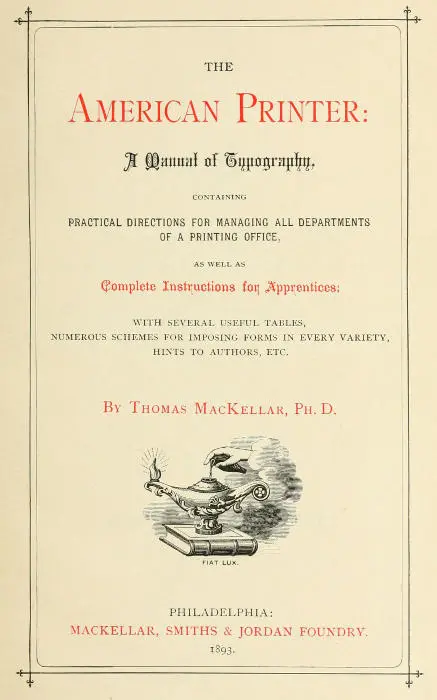
"The American Printer: A Manual of Typography" by Thomas MacKellar is a manual focused on the art and craft of typography, likely written in the late 19th century. This comprehensive guide serves not only as a resource for printers and publishing professionals but also provides historical context for the development of printing techniques and technologies. It encompasses practical directions for managing various departments of a printing office, along with useful instructions for apprentices. The opening of the manual establishes its purpose and utilizes a preface to set the tone for the comprehensive coverage of the printing profession. It outlines the book's intent to provide practical information based on personal experience and industry best practices while referencing a variety of typographical works. The text begins with a historical overview of the discovery of printing, mentioning notable figures such as Laurentius Koster and Johannes Gutenberg, and it lays the groundwork for understanding the evolution of printing methods. This context aims to equip readers with essential knowledge regarding the art of typography and the operations of printing offices, making the manual valuable for authors, publishers, and aspiring printers.
Introduction adapted from the source catalogue; source summaries may be automatically generated.
Free to read · English · 108,321 words · No account needed
MAKE TIME FOR A GOOD BOOK
On by default. Untick to stop anonymous reading totals. Each page counts after 10 seconds in view. How this works.
Anonymous counting is on unless you have switched it off.
Rectus in curiâ.—Upright in the court; with clean hands.
Redolet lucernâ.—It smells of the lamp; it is a laboured
production.
Reductio ad absurdum.—A reducing a position to an absurdity.
Regina.—Queen.
Regium donum.—A royal donation (a grant from the British crown to the Irish Presbyterian clergy.)
Regnant populi.—The people rule.
Rencontre.—An encounter.
Renaissance.—New birth: applied to the revival of the classic arts in the fifteenth and sixteenth centuries.
Requiescant in pace.—May they rest in peace.
Requiescat in pace.—May he rest in peace.
Rerum primordia.—The first elements of things.
Res angusta domi.—Narrow circumstances at home; poverty.
Res integra.—An entire matter.
Respice finem.—Look to the end.
Respublica.—The commonwealth.
Restaurateur.—A tavern-keeper who provides dinners, &c.
Résumé.—An abstract or summary.
Resurgam.—I shall rise again.
Revenons à nos moutons.—Let us return to our subject.
Rex.—King.
Rouge.—Red colouring for the skin.
Rouge et noir.—Red and black (a kind of game.)
Rus in urbe.—The country in town.
Ruse contre ruse.—Diamond cut diamond: trick for trick.
Ruse de guerre.—A stratagem of war.
Salle.—Hall.
Salus populi suprema lex est.—The welfare of the people is in
the supreme law.
Salvo pudore.—Without offence to modesty.
Sanctum sanctorum.—Holy of Holies.
Sang-froid.—Coolness; self-possession.
Sans.—Without.
Sans cérémonie.—Without ceremony.
Sans peur et sans reproche.—Without fear and without reproach.
Sans souci.—Without care; free and easy.
Sans tâche.—Stainless.
Sans-culottes.—Without breeches: a term applied to the rabble
of the French Revolution.
Sartor resartus.—The cobbler mended.
Satis, superque.—Enough, and more than enough.
Satis verborum.—Enough of words; you need say no more.
Sauve qui peut.—Save himself who can.
Savant.—A learned man.
Savoir-faire.—Ability; skill.
Scandalum magnatum.—Scandal of the great.
Scienter.—Knowingly.
Scilicet.—That is to say; to wit.
Scire facias.—Cause it to be known.
Scripsit.—Wrote it.
Sculpsit.—Engraved it: placed after the engraver’s name in
prints.
Secundum artem.—According to rule.
Selon les règles.—According to rule.
Semper fidelis.—Always faithful.
Semper idem.—Always the same.
Semper paratus.—Always ready.
Senatûs consultum.—A decree of the senate.
Seriatim.—In order; successively.
Si quæris peninsulam amœnam, circumspice.—If thou seekest a beautiful peninsula, behold it here.
Sic in originali.—So it stands in the original.
Sic itur ad astra.—Such is the way to immortality.
Sic passim.—So everywhere.
Sic semper tyrannis.—So be it ever to tyrants.
Sic transit gloria mundi.—Thus passes away the glory of the
world.
Sicut ante.—As before.
Similia similibus curantur.—Like things are cured by like.
Simplex munditiis.—Of simple elegance.
Your reading position is saved on this browser. Take it to another device with a library code. Reading pages adapt to text, rather than matching a printed edition.
BEHIND THE BOOK
This eBook is for the use of anyone anywhere in the United States and most other parts of the world at no cost and with almost no restrictions whatsoever. You may copy it, give it away or re-use it under the terms of the Project Gutenberg License included with this eBook or online at www.gutenberg.org. If you are not located in the United States, you will have to check the laws of the country where you are located before using this eBook. Read the source licence.
The original source file, including credits and licence, is retained by this library. Request an original-format copy at no charge. Please include the book title and Project Gutenberg identifier #56817.
KEEP YOUR CURIOSITY GOING
Cécile Tormay

Moritz Busch
John L. Ransom
Frances Wright
Cécile Tormay

Mabel Potter Daggett