THE CLASSIC COLLECTION✦An outlaw’s diary: the CommuneCLASSIC FREE BOOKS
An outlaw’s diary: the Commune
Cécile Tormay
THE CLASSIC COLLECTION · 1866
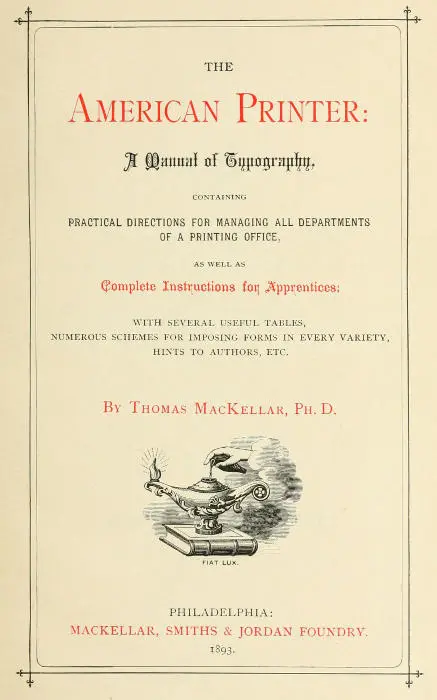
"The American Printer: A Manual of Typography" by Thomas MacKellar is a manual focused on the art and craft of typography, likely written in the late 19th century. This comprehensive guide serves not only as a resource for printers and publishing professionals but also provides historical context for the development of printing techniques and technologies. It encompasses practical directions for managing various departments of a printing office, along with useful instructions for apprentices. The opening of the manual establishes its purpose and utilizes a preface to set the tone for the comprehensive coverage of the printing profession. It outlines the book's intent to provide practical information based on personal experience and industry best practices while referencing a variety of typographical works. The text begins with a historical overview of the discovery of printing, mentioning notable figures such as Laurentius Koster and Johannes Gutenberg, and it lays the groundwork for understanding the evolution of printing methods. This context aims to equip readers with essential knowledge regarding the art of typography and the operations of printing offices, making the manual valuable for authors, publishers, and aspiring printers.
Introduction adapted from the source catalogue; source summaries may be automatically generated.
Free to read · English · 108,321 words · No account needed
MAKE TIME FOR A GOOD BOOK
On by default. Untick to stop anonymous reading totals. Each page counts after 10 seconds in view. How this works.
Anonymous counting is on unless you have switched it off.
3. All words in logue or logy; as, epilogue, astrology; from λόγος, (logos,) a discourse.
4. Ic, ick, ics are also Greek terminations, generally of
adjectives.
5. Words in meter are all of Greek origin, coming from the verb μετρῶ, (metro,) I measure, in combination with some other word.
6. Most words into which the terminations agogue, asis, esis, or ysis enter are also of Greek origin; such as demagogue, emphasis, parenthesis, analysis, &c.
II. But the main source whence we have derived words, with the exception of the Saxon, is the Latin, as will appear from an inspection of the following list:—
1. Words ending in ance, ancy, or ant, and ence, ency, or ent, come from Latin words ending respectively in ans, antia, or ens, entia; as, abundance, from abundantia; infancy, from infantia; abundant, from abundans; absence, from absentia; excellency, from excellentia; and excellent, from excellens.
2. Words in al have their Latin representatives in alis; as,
corporal, from corporalis.
3. Verbs in ate mostly come from Latin verbs of the first conjugation; as, moderate, from modero.
4. Words in ator are generally the same in both languages; as, orator, senator, moderator.
5. The termination id comes mostly from Latin words ending in idus; as, acid, from acidus; but sometimes words of this ending are of Greek origin; as, oxide, (more correctly, oxyd,) from ὀξὺς, (oxys;) and, indeed, most scientific words of this ending; as, carotid, from καρώτιδες, &c.; rhomboid, from ῥομβοειδής.
6. Il or ile is likewise from the Latin termination of adjectives in ilis; as, docile, from docilis; civil, from civilis.
7. The Latin termination osus has its English representative in ious or ous; as, copious, from copiosus; numerous, from numerosus. But sometimes the English ending ous comes from a Latin word in ax; as, capacious, from capax.
8. The Latin ending io has its English corresponding word in ion; as, nation, from natio; oration, from oratio.
9. The endings ne, re, and te after a vowel are also for the greater part of Latin origin; as, fortune, from fortuna; aquiline, from aquilinus; culture, from cultura; pure, from purus; complete, from completus, &c.
10. Words in ty come from Latin words in tas; as, equality, from æqualitas; bounty, from bonitas; rarity, from raritas, &c.
11. The termination ude is also of Latin origin, coming from words in udo; as, fortitude, from fortitudo; elude, from eludo.
12. So also is uous, by inserting the letter o; as, ambiguous, from ambiguus; continuous, from continuus, &c.
Your reading position is saved on this browser. Take it to another device with a library code. Reading pages adapt to text, rather than matching a printed edition.
BEHIND THE BOOK
This eBook is for the use of anyone anywhere in the United States and most other parts of the world at no cost and with almost no restrictions whatsoever. You may copy it, give it away or re-use it under the terms of the Project Gutenberg License included with this eBook or online at www.gutenberg.org. If you are not located in the United States, you will have to check the laws of the country where you are located before using this eBook. Read the source licence.
The original source file, including credits and licence, is retained by this library. Request an original-format copy at no charge. Please include the book title and Project Gutenberg identifier #56817.
KEEP YOUR CURIOSITY GOING
Cécile Tormay

Moritz Busch
John L. Ransom
Frances Wright
Cécile Tormay

Mabel Potter Daggett