THE CLASSIC COLLECTION✦An outlaw’s diary: the CommuneCLASSIC FREE BOOKS
An outlaw’s diary: the Commune
Cécile Tormay
THE CLASSIC COLLECTION · 1866
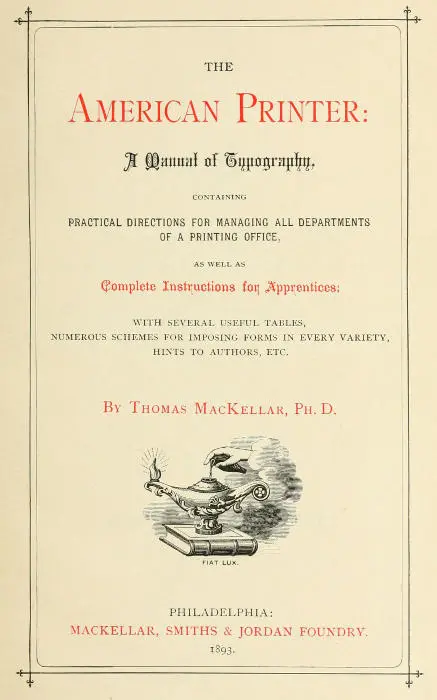
"The American Printer: A Manual of Typography" by Thomas MacKellar is a manual focused on the art and craft of typography, likely written in the late 19th century. This comprehensive guide serves not only as a resource for printers and publishing professionals but also provides historical context for the development of printing techniques and technologies. It encompasses practical directions for managing various departments of a printing office, along with useful instructions for apprentices. The opening of the manual establishes its purpose and utilizes a preface to set the tone for the comprehensive coverage of the printing profession. It outlines the book's intent to provide practical information based on personal experience and industry best practices while referencing a variety of typographical works. The text begins with a historical overview of the discovery of printing, mentioning notable figures such as Laurentius Koster and Johannes Gutenberg, and it lays the groundwork for understanding the evolution of printing methods. This context aims to equip readers with essential knowledge regarding the art of typography and the operations of printing offices, making the manual valuable for authors, publishers, and aspiring printers.
Introduction adapted from the source catalogue; source summaries may be automatically generated.
Free to read · English · 108,321 words · No account needed
MAKE TIME FOR A GOOD BOOK
On by default. Untick to stop anonymous reading totals. Each page counts after 10 seconds in view. How this works.
Anonymous counting is on unless you have switched it off.
Sine die.—Without naming a day.
Sine invidiâ.—Without envy.
Sine qua non.—An indispensable requisite.
Siste, viator.—Stop, traveller.
Sobriquet.—A nickname.
Soi-disant.—Self-styled; pretended.
Soirée.—An evening party.
Souvenir.—Remembrance; a keepsake.
Spartam nactus es, hanc exorna.—You have got something good; make the most of it you can.
Spectas et spectaberis.—You will see and be seen.
Spes mea Christus.—Christ is my hope.
Spolia opima.—The richest booty.
Stans pede in uno.—Standing on one foot.
Statu quo, or in statu quo.—In the same state.
Stet.—Let it stand.
Suaviter in modo, fortiter in re.—Gentle in manner, resolute
in deed.
Sub judice.—Under consideration.
Sub rosâ.—Under the rose; privately.
Sub silentio.—In silence.
Subpœna.—Under a penalty: a summons to attend a court as a
witness.
Succedaneum.—A substitute.
Sui generis.—Of its own kind; peculiar.
Summum bonum.—The chief good.
Supersedeas.—A writ to stay proceedings.
Super visum corporis.—Upon a view of the body.
Suppressio veri, suggestio falsi.—A suppression of the truth is the suggestion of a falsehood.
Supra.—Above.
Suum cuique.—Let every one have his own.
Table d’hôte.—An ordinary at which the master of the hotel
presides.
Tabula rasa.—A smooth or blank tablet.
Tædium vitæ.—Weariness of life.
Tale quale.—Such as it is.
Tant mieux.—So much the better.
Tant pis.—So much the worse.
Tapis.—The carpet.
Tartuffe.—A nickname for a hypocritical devotee, derived from the principal character in Molière’s comedy so called.
Te judice.—You may judge.
Tempora mutantur, et nos mutamur in illis.—The times are changed, and we are changed with them.
Tempus edax rerum.—Time the devourer of all things.
Tempus fugit.—Time flies.
Tempus omnia revelat.—Time reveals all things.
Teres atque rotundus.—Smooth and round; polished and complete.
Terra firma.—Solid earth; a safe footing.
Terra incognita.—An unknown country.
Terre tenant.—A person in actual possession of the land.
Tertium quid.—A third something; a nondescript.
Tête-à-tête.—A conversation between two parties.
Tirade.—A tedious and bitter harangue.
Ton.—The fashion.
Torso.—The fragmentary trunk of a statue.
Tort.—A wrong; an injury.
Tot homines, quot sententiæ.—So many men, so many minds.
Totidem verbis.—In just so many words.
Toties quoties.—As often as.
Toto cœlo.—By the whole heavens; diametrically opposite.
Toto corde.—With the whole heart.
Toujours prêt.—Always ready.
Tour à tour.—By turns.
Tout bien ou rien.—The whole or nothing.
Tout ensemble.—The whole.
Tria juncta in uno.—Three united in one.
Tu quoque, Brute!—And thou too, Brutus!
Tuebor.—I will defend.
Your reading position is saved on this browser. Take it to another device with a library code. Reading pages adapt to text, rather than matching a printed edition.
BEHIND THE BOOK
This eBook is for the use of anyone anywhere in the United States and most other parts of the world at no cost and with almost no restrictions whatsoever. You may copy it, give it away or re-use it under the terms of the Project Gutenberg License included with this eBook or online at www.gutenberg.org. If you are not located in the United States, you will have to check the laws of the country where you are located before using this eBook. Read the source licence.
The original source file, including credits and licence, is retained by this library. Request an original-format copy at no charge. Please include the book title and Project Gutenberg identifier #56817.
KEEP YOUR CURIOSITY GOING
Cécile Tormay

Moritz Busch
John L. Ransom
Frances Wright
Cécile Tormay

Mabel Potter Daggett