THE CLASSIC COLLECTION✦An outlaw’s diary: the CommuneCLASSIC FREE BOOKS
An outlaw’s diary: the Commune
Cécile Tormay
THE CLASSIC COLLECTION · 1866
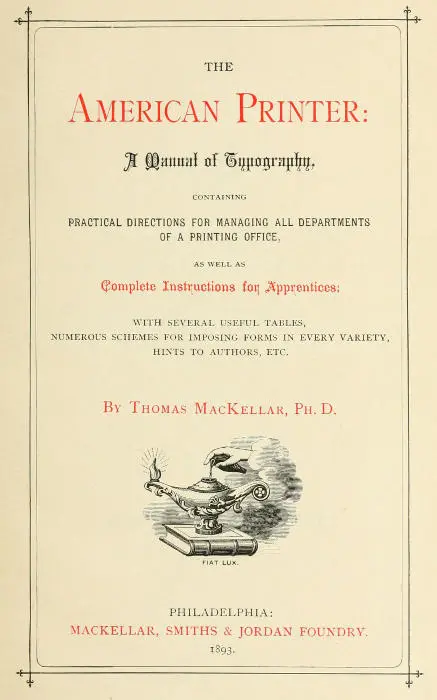
"The American Printer: A Manual of Typography" by Thomas MacKellar is a manual focused on the art and craft of typography, likely written in the late 19th century. This comprehensive guide serves not only as a resource for printers and publishing professionals but also provides historical context for the development of printing techniques and technologies. It encompasses practical directions for managing various departments of a printing office, along with useful instructions for apprentices. The opening of the manual establishes its purpose and utilizes a preface to set the tone for the comprehensive coverage of the printing profession. It outlines the book's intent to provide practical information based on personal experience and industry best practices while referencing a variety of typographical works. The text begins with a historical overview of the discovery of printing, mentioning notable figures such as Laurentius Koster and Johannes Gutenberg, and it lays the groundwork for understanding the evolution of printing methods. This context aims to equip readers with essential knowledge regarding the art of typography and the operations of printing offices, making the manual valuable for authors, publishers, and aspiring printers.
Introduction adapted from the source catalogue; source summaries may be automatically generated.
Free to read · English · 108,321 words · No account needed
MAKE TIME FOR A GOOD BOOK
On by default. Untick to stop anonymous reading totals. Each page counts after 10 seconds in view. How this works.
Anonymous counting is on unless you have switched it off.
Post mortem.—After death.
Postulata.—Things assumed.
Præcognita.—Things previously known.
Præmonitus, præmunitus.—Forewarned, forearmed.
Preux chevalier.—A brave knight.
Primâ facie.—On the first view.
Primum mobile.—The primary motive, or moving power.
Primus inter pares.—Chief among equals.
Principia, non homines.—Principles, not men.
Principiis obsta.—Resist the first innovations.
Pro aris et focis.—For our altars and our hearths.
Pro bono publico.—For the public good.
Pro et con (for contra).—For and against.
Pro formâ.—For form’s sake; according to form.
Pro hâc vice.—For this turn or occasion.
Pro loco et tempore.—For the place and time.
Pro patriâ.—For our country.
Pro ratâ.—In proportion.
Pro re natâ.—For a special emergency.
Pro tanto.—For so much.
Pro tempore.—For the time-being.
Probatum est.—It has been tried and proved.
Procès-verbal.—A written statement.
Prochein ami.—The next friend.
Procul, O procul este, profani!—Far, far hence, O ye profane!
Pronunciamento.—A public declaration.
Propagandâ fide.—For extending the faith.
Protégé.—A person taken charge of, or patronized; a ward, &c.
Prudens futuri.—Thoughtful of the future.
Pugnis et calcibus.—With fists and heels; with all the might.
Punica fides.—Punic faith; treachery.
Quære.—Query; inquiry.
Quamdiu se bene gesserit.—So long as he shall conduct himself
properly.
Quantum.—The due proportion.
Quantum libet.—As much as you please.
Quantum meruit.—As much as he deserved.
Quantum sufficit.—A sufficient quantity; enough.
Quare clausum fregit.—An action for damages to real estate.
Quare impedit.—Why he hinders.
Quasi dicas.—As if you should say.
Quelque chose.—A trifle.
Qui capit, ille facit.—He who takes it makes it.
Qui pense?—Who thinks?
Qui tam?—Who as well? the title given to a certain action at
law.
Qui transtulit sustinet.—He who brought us hither still
preserves us.
Qui va là?—Who goes there?
Qui vive?—Who goes there? hence, on the qui-vive, on the
alert.
Quid-nunc?—What now? a newsmonger.
Quid pro quo.—One thing for another; “tit for tat.”
Quid rides?—Why do you laugh?
Quis separabit?—Who shall separate us?
Quo animo?—With what intention.
Quo jure?—By what right?
Quo warranto.—By what warrant or authority.
Quoad hoc.—To this extent.
Quod avertat Deus?—Which may God avert!
Quod vide.—Which see.
Quodlibet.—A nice point; a subtlety.
Quondam.—Former.
Quorum.—Of whom: a term signifying a sufficient number for a
certain business.
Quos Deus vult perdere, prius dementat.—Those whom God wishes to destroy, he first deprives of understanding.
Ragout.—A highly-seasoned dish.
Rara avis.—A rare bird; a prodigy.
Re infectà.—The business being unfinished.
Recte et suaviter.—Justly and mildly.
Your reading position is saved on this browser. Take it to another device with a library code. Reading pages adapt to text, rather than matching a printed edition.
BEHIND THE BOOK
This eBook is for the use of anyone anywhere in the United States and most other parts of the world at no cost and with almost no restrictions whatsoever. You may copy it, give it away or re-use it under the terms of the Project Gutenberg License included with this eBook or online at www.gutenberg.org. If you are not located in the United States, you will have to check the laws of the country where you are located before using this eBook. Read the source licence.
The original source file, including credits and licence, is retained by this library. Request an original-format copy at no charge. Please include the book title and Project Gutenberg identifier #56817.
KEEP YOUR CURIOSITY GOING
Cécile Tormay

Moritz Busch
John L. Ransom
Frances Wright
Cécile Tormay

Mabel Potter Daggett