THE CLASSIC COLLECTION✦An outlaw’s diary: the CommuneCLASSIC FREE BOOKS
An outlaw’s diary: the Commune
Cécile Tormay
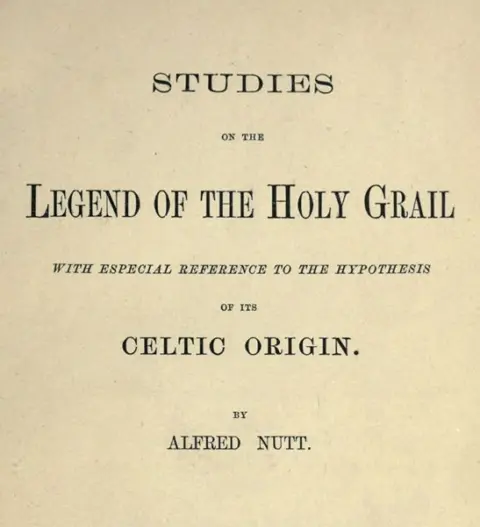
THE CLASSIC COLLECTION · 1888
"Studies on the Legend of the Holy Grail" by Alfred Trübner Nutt is a scholarly publication written in the late 19th century. This work examines the various forms and origins of the Holy Grail legend, with a strong emphasis on its connections to Celtic traditions and influences. The book serves as both a study of the Grail Romance cycle and an investigation into the historical, literary, and mythical aspects of the legend. The opening of the scholarly work introduces the author’s intent to explore the different iterations of the Grail legend and their relationships to one another. It begins with a dedication to J. F. Campbell, highlighting the significance of Celtic tradition in Nutt's interpretation. The introduction outlines the structure of the studies, noting that the work does not aim for exhaustiveness but rather focuses on specific aspects of the Grail narrative. Nutt emphasizes the challenges historians face in tracing the origins of the Grail stories, navigating through various manuscripts and forms of the legend, while preparing to delve into the particulars of significant texts that have shaped the legend's evolution.
Introduction adapted from the source catalogue; source summaries may be automatically generated.
Free to read · English · 125,175 words · No account needed
MAKE TIME FOR A GOOD BOOK
On by default. Untick to stop anonymous reading totals. Each page counts after 10 seconds in view. How this works.
Anonymous counting is on unless you have switched it off.
=Grand St. Graal.=--(1) The writer salutes all who have faith in the Holy Trinity. He does not name himself for three reasons: lest his declaration that he received the story from God Himself be a stumbling block; lest his friends pay less honour to the book if they know the author; lest if he have made any blunder all the blame fall upon him.
(2) In the year 717 after the Passion of Christ, as the writer lies in his hut in one of the wildest parts of White Britain, on Good Friday Eve and doubts of the Trinity, Christ appears to him and gives him a little book not larger than a man's palm, and this book will resolve all his doubts; He Himself has written it, and only he who is purified by confession and fasting may read it. On the morrow the writer opens it and finds therein four sections, headed each as follows: This is the book of thy lineage; here begins the book of the Holy Grail; here is the beginning of the terrors; here begin the marvels. As he reads lightning and thunder come and other wonders. On Good Friday, as he is celebrating the service, an angel raises him in spirit to the third heaven, and his doubts concerning the Trinity are set at rest. When his spirit returns to his body he locks up the book; but on Easter Sunday, when he would read further, finds it gone; a voice says he must suffer to have the book back again, must go to the plains of Walescog, follow a wonderful beast to Norway, and there find what he seeks. He obeys, the beast leads him first to a hermit's, then past the pine of adventures to a knight's castle, on the third day to the queen's lake and a nunnery. After exorcising a hermit possessed of the devil, he finds the book, and on his return Christ commands him to make a fair copy before Ascension Day. He sets to work at once, on the fifteenth day after Easter.[43] The book begins as follows: Few believe on Christ at His crucifixion, among whom is Joseph of Arimathea, as the Holy Scripture of the Grail testifies. He is in all things a good man. He lives in Jerusalem with his wife and a son, Josephes (not the same Josephes who so often quotes the Scripture, but not less learned than he), he it was who passed his father's kin across sea to White Britain, since called England, without rudder or sail, but in the fold of this shirt. Joseph, having much loved the Lord, longs after His death to possess somewhat having belonged to Him; goes to the house of the Last Supper, and carries off the dish wherein He had eaten. Having been a knight of Pilate's for seven years, he craves a boon of him, which is Christ's body. Pilate grants it; Joseph descends the body from the Cross, places it in a sepulchre, and, fetching the dish from his house, collects in it the blood flowing from the body,[44] and finishes laying the body in the tomb. The Jews hear of this, are angered, seize Joseph, throw him into prison in the most hideous and dirtiest dungeon ever seen, feed him at first on bread and water, but when Christ is found to have arisen, Caiaphas, Joseph's jailor, lets him starve. But Christ brings the holy dish that Joseph had sent back to his house with all the blood in it. Joseph is overjoyed. Christ comforts him, and assures him he shall live and carry His name to foreign parts. Joseph thus remains in prison. Meanwhile his wife, though often pressed to marry, refuses until she shall have had sure tidings of her husband; as for his son he will only marry Holy Church. (3) Forty years go by; after Christ's death Tiberius Cæsar reigned ten years, then Caius, one year; then Claudius, fourteen years; then Noirons, in whose reign S.S. Peter and Paul were crucified, fourteen years; then Titus, and Vespasian, his son, a leper. The freeing of Joseph befalls in the third year of Titus' reign and in this wise: Titus has vainly sought a leech to heal Vespasian. At last a strange knight from Capernaum promises his help and tells how he in his youth had been healed of the leprosy by a prophet. The Emperor on hearing this sent to Judea to seek out that prophet; his messenger comes to Felix, and orders him to have proclamation made for aught Christ has touched; hereupon an old woman, Marie la Venissienne, brings the cloth upon which the Saviour's likeness had painted itself when she wiped His face. The messenger returns to Rome with this cloth and the mere sight of it heals Vespasian, who straightway resolves to avenge Christ's death. He goes to Jerusalem, Joseph's wife appears before him, accuses the Jews of having made away with her husband; none of the Jews know where he is save Caiaphas, who reveals the secret on condition that he is to be neither burnt or slain. Vespasian himself goes down into the prison and finds it as light as though one hundred candles had burnt in it. He tells Joseph who he is, whereat the latter wondered, not thinking he had been longer than from Friday to Sunday, not once had it been dark. A voice tells Joseph not to fear, and that he will find the Holy Vessel at his home. Joseph returns to Jerusalem with Vespasian, and points out to him the abettors of Christ's death, whom Vespasian has burnt. Caiaphas is set adrift in a boat. (4) The night before Vespasian returns to Rome, Christ appears to Joseph and commands him to go forth and fill foreign lands with his seed; he must be baptised, and must go forth without money or aught but the dish; all heart can want or wish he shall have, all who accompany him must be baptised likewise. Joseph is baptised by St. Philip, then Bishop of Jerusalem, as is also Vespasian, concerning whom the story is now silent. (5) Joseph preaches to his friends and relatives and converts seventy-five of them. They leave Jerusalem and come to Bethany, where the Lord appears to Joseph, promises him aid as once to the Jews in the wilderness, commands him to make a wooden ark for the dish, which he is to open when he wants to speak to Him, but no one is to touch it save Joseph and his son Josephes; Joseph does as commanded, his troop is miraculously fed, and on the eleventh day they come to the town of Sarras, between Babilone and Salavandre, whence the Saracens have their name, and not from Sara. (6) Joseph and his seventy-five companions enter the city and go to the Temple of the Sun, to the seat of judgment, where the Saracens are assembled with their lord, Evalach the Unknown: he had been a man of prowess in his youth, but was now old; seven days before, the Egyptians had beaten his army, and the council is now devising how vengeance may be taken therefor. Joseph is greatly joyed at these events, and when the council advises peace assures the King of victory, but he must destroy his images and believe on Him who died on the Cross. Evalach asks how one who could not save himself could save another. Joseph, in answer, tells of Christ's birth, life, death, descent into hell, resurrection, ascension, and of the sending of the Holy Ghost. Evalach cannot understand either the Incarnation or the Trinity, and although Joseph explains that the Virgin conceived by the overshadowing of the Holy Ghost through her ear, and that her virginity was no more hurt than is water when a sunbeam enters it, remains stubborn and calls his learned men to his aid, but Joseph confounds these, and Evalach lodges the Christians for the night and gives them good beds. (7) Evalach dreams of a tree-stock whence spring three equal trunks and though three yet are truly one, also of a room with a secret door of marble, through which a child passes without opening it; a voice tells him this is a type of the miraculous conception of Christ. (8) Meanwhile, Joseph, unable to sleep, prays for comfort and adjures the Lord by all His mercies to help Evalach; he is told by a voice he shall be sent for to explain the King's dream. Joseph then goes to sleep with his wife, Helyab, but not as lustful folk do, for there was nothing between them till the Lord commanded the begetting of Galahad, and then, so full of love to the Saviour were they that they had no desire. From Galahad came the high race which honoured the land of White Britain, now called England. (9) The morrow morning Joseph and his company worship before the ark (now the place wherein they were had been called the Spiritual Palace by Daniel) when a soft sweet wind comes and the Holy Ghost descends and Christ speaks and urges all to love Him; He tells Josephes to draw near and take charge of His flesh and blood; Josephes opens the door of the ark and sees a man all in red, and with him five angels, each six winged, all in red, each with a bloody sword in his left, and in their rights severally, a cross, nails, lance, sponge, and scourge; Josephes sees Christ nailed to the Cross, and the blood running down from His side and feet into the dish; he would enter the ark but angels restrain him. Joseph, wondering at his son's state, kneels before the ark and sees therein an altar covered with white cloths, under which is a red samite one, covering three nails, a lance head all bloody, and the dish he had brought, and in the middle of the altar an exceeding rich vessel of gold and precious stones; seven angels issue from the ark with water and watering pot (2), gold basins and towels (2), and gold censers (3), an eighth carrying the holy dish, a ninth a head so rich and beautiful as never mortal eye saw, a tenth a sword, three more with tapers, lastly Jesus. The company of angels go over the house sprinkling it with holy water, because it had heretofore been dwelt in by devils. Christ tells Josephes he is to receive the sacrament of His flesh and blood, and be made sovran shepherd over His new sheep; bishop's vestments are brought out of the ark. Josephes is seated in a chair, which afterwards made a Saracen King's eyes fly out of his head, is consecrated, an angel keeps the holy oil wherewith all Kings of Britain were anointed till the time of Uther Pendragon, of whom none of the many that have told his history have rightly known why he was so called; the meaning of the episcopal vestments is explained to Josephes, and his duties set forth. (10) Josephes then goes into the ark and celebrates the sacrament using Christ's words only, whereat bread and wine become flesh and blood, and in place of the bread a child, which, though as bidden, he divides into three parts yet is eaten as one whole; an angel puts patina and chalice into the dish; Joseph and his company receive the sacrament in the form of a child; Christ bids Josephes celebrate the sacrament daily; tells him that he and Joseph are to go with Evalach's messengers now nigh at hand. Leucans, Josephes' cousin, is appointed guardian of the ark. (11) Joseph and his son go before the King and overcome all the heathen clerk's objections; Josephes tells Evalach he will be given over to his enemies for three days, and shall only escape by believing on Christ; the heathen idols are smashed by a devil at the compelling of Josephes' two angels. A messenger brings the news that King Tholomes has entered and is capturing the land, and he will not rest till he be crowned at Sarras. Josephes tells the King this ill-hap is to mind him of his lowly origin, he is son of a shoemaker in an old city of France, Meaux, and was one of a tribute of one hundred youths and one hundred maidens claimed by Augustus Cæsar from France, as here dwelt a prouder folk than elsewhere, and the two daughters of the Count of the Town, Sevain, were among the tribute, and Evalach was among their servants. When Felix was named Governor of Syria by Tiberius he had taken Evalach with him, and held him in high honour until one day, angry with Felix's son, Evalach slew him and had to fly, after which he entered the service of Tholome Cerastre, King of Babylon, who had given him the land he now ruled. Josephes further explains the King's dreams, and when the latter declares himself willing to believe, asks for his shield, upon which he fixes a red cross and tells him to look on it in his need and pray to God and he shall be saved. (12) Evalach marches with his army against Tholomes, is joined by his brother-in-law, Seraphe (whom he thought hated him most of any man in the world) at the Queen's entreaty; numerous combats ensue between the two armies; Seraphe performs prodigies of valour; Evalach is taken prisoner, and in his need looks on the shield, sees thereon Christ crucified, prays to God for help, a White Knight appears, overcomes Tholomes, who is taken prisoner, and Evalach's army is victorous. (13) Meanwhile Josephes, remaining in Sarras, has been counselling Queen Sarraquite, secretly a Christian, since her mother was cured of a bloody flux, and since Christ appeared to her when she was afraid of the hermit her mother had led her to for baptism because he had such a long beard; she dares not avow her faith for fear of her husband. Josephes tells her of the battle which has taken place and of the White Knight. (14) Evalach and Seraphe return; the King asks at once after the Christians, and learns that he owes his victory to the Lord to whom also Seraphe owed his strength in battle; the shield is uncovered, a man with a wounded arm is healed by it, and then the cross vanishes; Seraphe turns Christian, is baptised and receives the name Nasciens, he is straightway healed of his wounds, exhorts Evalach to believe, and tells of Tholomes' death. Evalach is baptised, and re-christened Mordrains, or Slow-of-Belief. After baptising the town and destroying all images, Josephes leaves three of his companions in charge of the Grail Ark, and goes with the rest to Orcanz, turns out of an image a devil who had slain Tholomes, and converts more of the heathen folk. (15) Meanwhile Mordrains has ordered his people to be baptised or to leave his land; many take the latter course and are met outside the town by a devil who wounds them grievously, whereupon Josephes hurries to their aid, but is met by an angel with a lance and smitten through the thigh for having left his baptising work to trouble himself about contemners of God's law, and the mark of the wound should stay with him all his life, and the iron spear head remain in the wound so that ever after he limped, and he had later to smart for it, as the tale will show in due season. Many more people are converted, Bishops are left in the land and holy relics at Sarras. (16) Josephes brings Mordrains, Sarraquite, and Nasciens to the holy shrine, and shows them the vessel wherein is Christ's blood. Nasciens thinks he has never seen aught to match it, and he gives it a name that since it has never lost. For, says he, nothing he had seen before but somewhat displeased him (li degraast), but this pleases him (li grée) entirely; he further tells how once when a young man, hunting, as he stood deep in thought a voice made itself heard, saying "Thou shall't never accomplish what thou thinkest on until the wonders of the Grail are disclosed," and he knows now this must be the Grail as every wish of his heart is accomplished. And he draws nearer and lifts the vessel's lid and looks therein, but straightway falls to trembling, feeling he can no longer see. And he knew that the blindness was to punish his curiosity, and turning to Josephes tells him that the iron shall not be drawn out of that wound inflicted by the angel at Orcanz, nor he himself recover his sight until Josephes, wounded, himself comes to draw out the iron.
Your reading position is saved on this browser. Take it to another device with a library code. Reading pages adapt to text, rather than matching a printed edition.
BEHIND THE BOOK
This eBook is for the use of anyone anywhere in the United States and most other parts of the world at no cost and with almost no restrictions whatsoever. You may copy it, give it away or re-use it under the terms of the Project Gutenberg License included with this eBook or online at www.gutenberg.org. If you are not located in the United States, you will have to check the laws of the country where you are located before using this eBook. Read the source licence.
The original source file, including credits and licence, is retained by this library. Request an original-format copy at no charge. Please include the book title and Project Gutenberg identifier #42205.
KEEP YOUR CURIOSITY GOING
Cécile Tormay

Moritz Busch
John L. Ransom

Maurice Baring
Frances Wright
Cécile Tormay