THE CLASSIC COLLECTION✦An outlaw’s diary: the CommuneCLASSIC FREE BOOKS
An outlaw’s diary: the Commune
Cécile Tormay
THE CLASSIC COLLECTION · 1888
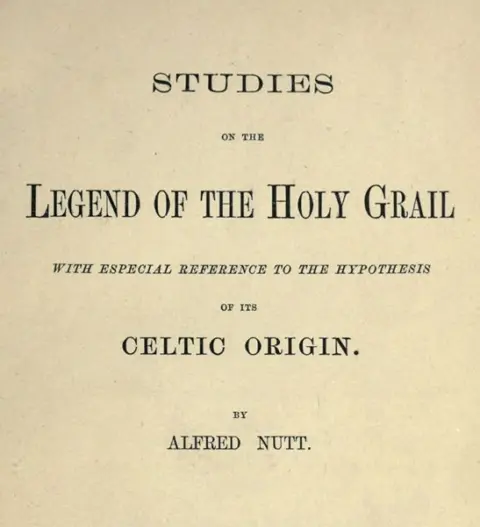
"Studies on the Legend of the Holy Grail" by Alfred Trübner Nutt is a scholarly publication written in the late 19th century. This work examines the various forms and origins of the Holy Grail legend, with a strong emphasis on its connections to Celtic traditions and influences. The book serves as both a study of the Grail Romance cycle and an investigation into the historical, literary, and mythical aspects of the legend. The opening of the scholarly work introduces the author’s intent to explore the different iterations of the Grail legend and their relationships to one another. It begins with a dedication to J. F. Campbell, highlighting the significance of Celtic tradition in Nutt's interpretation. The introduction outlines the structure of the studies, noting that the work does not aim for exhaustiveness but rather focuses on specific aspects of the Grail narrative. Nutt emphasizes the challenges historians face in tracing the origins of the Grail stories, navigating through various manuscripts and forms of the legend, while preparing to delve into the particulars of significant texts that have shaped the legend's evolution.
Introduction adapted from the source catalogue; source summaries may be automatically generated.
Free to read · English · 125,175 words · No account needed
MAKE TIME FOR A GOOD BOOK
On by default. Untick to stop anonymous reading totals. Each page counts after 10 seconds in view. How this works.
Anonymous counting is on unless you have switched it off.
Description of the leading forms of the Romance: Conte del Graal--Joseph d'Arimathie--Didot-Perceval--Queste del Saint Graal--Grand Saint Graal--Parzival--Perceval le Gallois--Mabinogi of Peredur--Sir Perceval--Diu Crône--Information respecting date and authorship of these works in the MSS.
The following are the forms in which the Legend of the Holy Grail has come
down to us:--
A.--=Le Conte del Graal=, a poem of over 60,000 verses, the major part of which (45,379 verses) was printed for the first time by Potvin: Le Conte del Graal, six volumes, 8vo. (vols. ii.-vi. containing our poem), Mons, 1866-71, from a MS. preserved in the Mons Library.[1] The portion of the poem which is not printed in full is summarised by Potvin in the sixth volume of his edition. The poem, so far as at present known, is the work of four men:
A I. Chrestien de Troyes, who carried the work down to verse 10,601.
A II. Gautier de Doulens, who continued it to verse 34,934.
A III. Manessier, who finished it in 45,379 verses.
A IV. Gerbert, to whom are due over 15,000 verses, mostly found interpolated between Gautier de Doulens and Manessier.
A MS. preserved in the Library of Montpellier[2] differs in important respects from the Mons one as far as Gautier de Doulens and Manessier are concerned. It intercalates 228 verses between verses 20,294 and 20,296 of the Mons MS., and gives a different redaction of verses 34,996-35,128 in agreement with the aforesaid intercalation. It likewise mentions two visits of Gawain to the Grail Castle. The intercalation in Gautier may be called A IIa, and the variant in Manessier A IIIa.
B.--=Joseph d'Arimathie, Merlin=, exists in two forms: (1) a fragmentary metrical version entitled in the sole existing MS. (Bibliothèque Nationale, No. 20,047. Fonds St. Germain, No. 1,987) Li R(o)manz de l'est (o)ire dou Graal, and consisting of 4,018 verses, 3,514 for the Joseph, the remainder, for about one-fifth of the Merlin. First printed by Francisque Michel: Le Roman du St. Graal. Bordeaux, 1841. Secondly by Furnivall: Seynt Graal or the Sank Ryal. Printed for the Roxburghe Club, two volumes, 4to., London, 1861-63, where it is found in an appendix at the end of vol i. (2) A prose version of which several MSS. exist, all of which are fully described by E. Hucher: Le Saint-Graal, ou le Joseph d'Arimathie, three volumes, 12mo., Le Mans, 1875-78, vol. i., pp. 1-28. The chief are: the Cangé MS. (circa 1250) of which Hucher prints the Joseph, vol. i., pp. 209-276, and the Didot MS., written in 1301, of which Hucher prints the Joseph, vol. i., pp. 277-333. Hucher likewise gives, vol. i., pp. 335-365, variants from the Huth MS. (circa 1280).
These different versions may be numbered as follows:--
Your reading position is saved on this browser. Take it to another device with a library code. Reading pages adapt to text, rather than matching a printed edition.
BEHIND THE BOOK
This eBook is for the use of anyone anywhere in the United States and most other parts of the world at no cost and with almost no restrictions whatsoever. You may copy it, give it away or re-use it under the terms of the Project Gutenberg License included with this eBook or online at www.gutenberg.org. If you are not located in the United States, you will have to check the laws of the country where you are located before using this eBook. Read the source licence.
The original source file, including credits and licence, is retained by this library. Request an original-format copy at no charge. Please include the book title and Project Gutenberg identifier #42205.
KEEP YOUR CURIOSITY GOING
Cécile Tormay

Moritz Busch
John L. Ransom

Maurice Baring
Frances Wright
Cécile Tormay