THE CLASSIC COLLECTION✦A History of French Literature Short Histories of the Literatures of the World: II.CLASSIC FREE BOOKS
A History of French Literature Short Histories of the Literatures of the World: II.
Edward Dowden
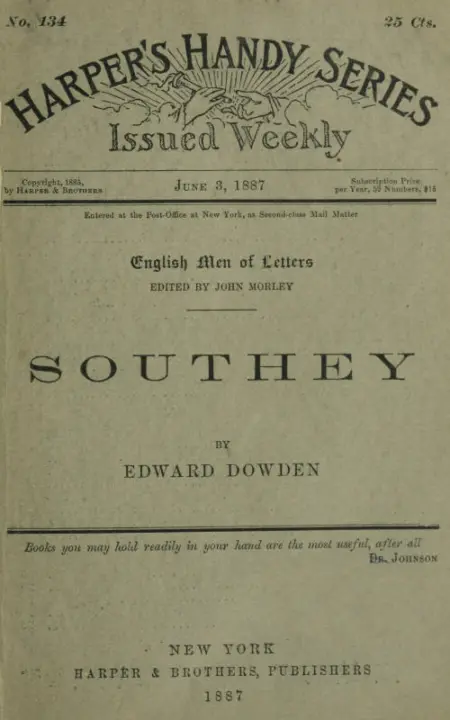
THE CLASSIC COLLECTION · 1885
"Southey" by Edward Dowden is a biographical account written in the late 19th century. The work delves into the life of Robert Southey, one of the prominent poets of the Romantic era and the poet laureate of England. The biography captures Southey's literary journey, influences, and personal experiences, emphasizing his dedication to literature and his role within the cultural tapestry of his time. At the start of the narrative, Dowden introduces readers to Southey's childhood, revealing how deeply entrenched he was in literature from a young age. The opening details Southey's family background, including his father's life as a linen-draper and the influence of his nurturing mother, as well as significant early experiences that shaped his literary aspirations. Through captivating anecdotes, we learn about his initial struggles with education, the personalities who impacted him, and the budding love of poetry that became a defining element of his identity. The beginning sets the stage for a deeper exploration of Southey’s character and contributions to literature in the subsequent chapters.
Introduction adapted from the source catalogue; source summaries may be automatically generated.
Free to read · English · 62,396 words · No account needed
MAKE TIME FOR A GOOD BOOK
On by default. Untick to stop anonymous reading totals. Each page counts after 10 seconds in view. How this works.
Anonymous counting is on unless you have switched it off.
“Thy life was a day; and sum it well, life is but a week of such days—with how much storm and cold and darkness! Thine was a sweet spring day—a vernal Sabbath, all sunshine, hope, and promise.”
“And that name
In sacred silence buried, which was still
At morn and eve the never-wearying theme
Of dear discourse.”
“Playful thoughts
Turned now to gall and esil.”
“No more great attempts, only a few autumnal flowers like
second primroses, etc.”
“They who look for me in our Father’s kingdom
Will look for him also; inseparably
Shall we be remembered.”
“Come, then,
Pain and Infirmity—appointed guests,
My heart is ready.”
From the day of his son’s death Southey began to step down from the heights of life, with a steadfast foot, and head still held erect. He recovered cheerfulness, but it was as one who has undergone an amputation seeks the sunshine. Herbert’s grave anchored him in Keswick. An offer of 2000l. a year for a daily article in the Times did not tempt him to London. His home, his books, his literary work, Skiddaw, Derwentwater, and Crosthwaite churchyard were too dear. Three years later came the unlooked-for birth of a second boy; and Cuthbert was loved by his father; but the love was chastened and controlled of autumnal beauty and seriousness.
When the war with France had ended, depression of trade was acutely felt in England; party spirit ran high, and popular passions were dangerously roused. In the spring of 1817, the Laureate saw to his astonishment a poem entitled Wat Tyler, by Robert Southey, advertised as just published. He had written this lively dramatic sketch in the full fervour of Republicanism twenty-three years previously; the manuscript had passed into other hands, and he had long ceased to think of it. The skulking rogue and the knavish publisher who now gave it to the world had chosen their time judiciously; this rebuke to the apostate of the Quarterly would be a sweet morsel for gossip-mongers to roll under the tongue, an infallible pill to purge melancholy with all true children of progress. No fewer than sixty thousand copies, it is said, were sold. Wat Tyler suited well with Southey’s nonage; it has a Bright rhetorical fierceness of humanity. The speech-making radical blacksmith, “still toiling, yet still poor,” his insulted daughter, her virtuous lover, the communist priest John Ball, whose amiable theology might be that of Mr. Belsham in his later days, stand over against the tyrant king, his Archiepiscopal absolver from oaths, the haughty nobles, and the servile minions of the law. There was nothing in the poem that could be remembered with shame, unless it is shameful to be generous and inexperienced at the age of twenty. But England in 1817 seemed charged with combustibles, and even so small a spark as this was not to be blown about without a care. The Prince Regent had been fired at; there were committals for treason; there were riots in Somersetshire; the swarm of Manchester Blanketeers announced a march to London; the Habeas Corpus was suspended; before the year was out, Brandreth and his fellows had been executed at Derby. Southey applied to the Court of Chancery for an injunction to restrain the publication of his poem. It was refused by Lord Eldon, on the ground that the publication being one calculated to do injury to society, the author could not reclaim his property in it. There the matter might have dropped; but it seemed good to Mr. William Smith, representing liberal Norwich, where Southey had many friends, to take his seat in the House of Commons one evening with the Quarterly Review in one pocket and Wat Tyler in the other, and to read aloud contrasted extracts showing how the malignant renegade could play the parts, as it suited him, of a seditious firebrand and a servile courtier. Wynn on the spot administered a well-deserved rebuke; Wilberforce wrote to Southey that, had he been present, his voice would also have been heard. Coleridge vindicated him in the Courier. Seldom, indeed, was Southey drawn into controversy. When pelted with abuse, he walked on with uplifted head, and did not turn round; it seemed to him that he was of a stature to invite bespattering. His self-confidence was high and calm; that he possessed no common abilities, was certain: and the amount of toil which went into his books gave him a continual assurance of their worth which nothing could gainsay; he had no time for moods of dejection and self-distrust. But if Southey struck, he struck with force, and tried to leave his mark on his antagonist. To repel this attack made in the House of Commons, was a duty. A Letter to William Smith, Esq., M.P., was written, as Wordsworth wished, with the strength of masculine indignation; blow after blow is planted with sure effect; no word is wasted; there is skill in the hard hitting; and the antagonist fairly overthrown, Southey, with one glance of scorn, turns on his heel, and moves lightly away. “I wish you joy,” wrote Walter Scott, “of your triumphant answer.... Enough of this gentleman, who I think will not walk out of the round again to slander the conduct of individuals.” The concluding sentences of the Letter give in brief Southey’s fearless review of his unstained career.
Your reading position is saved on this browser. Take it to another device with a library code. Reading pages adapt to text, rather than matching a printed edition.
BEHIND THE BOOK
This eBook is for the use of anyone anywhere in the United States and most other parts of the world at no cost and with almost no restrictions whatsoever. You may copy it, give it away or re-use it under the terms of the Project Gutenberg License included with this eBook or online at www.gutenberg.org. If you are not located in the United States, you will have to check the laws of the country where you are located before using this eBook. Read the source licence.
The original source file, including credits and licence, is retained by this library. Request an original-format copy at no charge. Please include the book title and Project Gutenberg identifier #61983.
KEEP YOUR CURIOSITY GOING
John L. Ransom

Herman W. Mudgett

Harriet Monroe
Daniel Dulany Addison
Charles Lanman

Harold Rosher