THE CLASSIC COLLECTION✦A History of French Literature Short Histories of the Literatures of the World: II.CLASSIC FREE BOOKS
A History of French Literature Short Histories of the Literatures of the World: II.
Edward Dowden
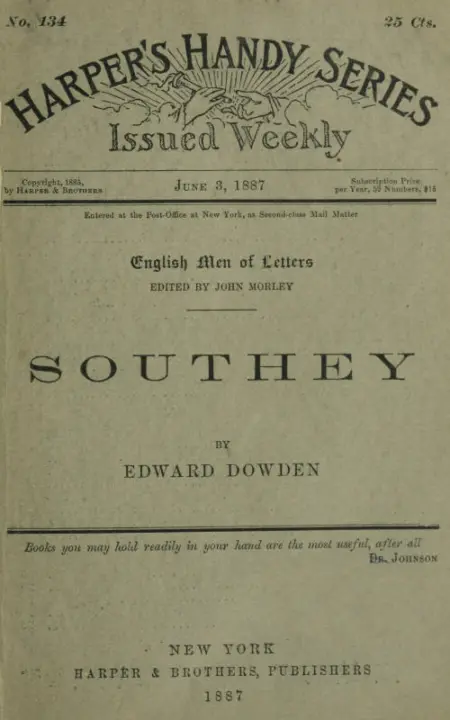
THE CLASSIC COLLECTION · 1885
"Southey" by Edward Dowden is a biographical account written in the late 19th century. The work delves into the life of Robert Southey, one of the prominent poets of the Romantic era and the poet laureate of England. The biography captures Southey's literary journey, influences, and personal experiences, emphasizing his dedication to literature and his role within the cultural tapestry of his time. At the start of the narrative, Dowden introduces readers to Southey's childhood, revealing how deeply entrenched he was in literature from a young age. The opening details Southey's family background, including his father's life as a linen-draper and the influence of his nurturing mother, as well as significant early experiences that shaped his literary aspirations. Through captivating anecdotes, we learn about his initial struggles with education, the personalities who impacted him, and the budding love of poetry that became a defining element of his identity. The beginning sets the stage for a deeper exploration of Southey’s character and contributions to literature in the subsequent chapters.
Introduction adapted from the source catalogue; source summaries may be automatically generated.
Free to read · English · 62,396 words · No account needed
MAKE TIME FOR A GOOD BOOK
On by default. Untick to stop anonymous reading totals. Each page counts after 10 seconds in view. How this works.
Anonymous counting is on unless you have switched it off.
“How far the writings of Mr. Southey may be found to deserve a favourable acceptance from after-ages, time will decide; but a name which, whether worthily or not, has been conspicuous in the literary history of its age, will certainly not perish.... It will be related that he lived in the bosom of his family, in absolute retirement; that in all his writings there breathed the same abhorrence of oppression and immorality, the same spirit of devotion, and the same ardent wishes for the melioration of mankind; and that the only charge which malice could bring against him was, that as he grew older, his opinions altered concerning the means by which that melioration was to be effected, and that as he learnt to understand the institutions of his country, he learnt to appreciate them rightly, to love, and to revere, and to defend them. It will be said of him that in an age of personality he abstained from satire; and that during the course of his literary life, often as he was assailed, the only occasion on which he ever condescended to reply was when a certain Mr. William Smith insulted him in Parliament with the appellation of renegade. On that occasion, it will be said, he vindicated himself, as it became him to do, and treated his calumniator with just and memorable severity. Whether it shall be added that Mr. William Smith redeemed his own character by coming forward with honest manliness, and acknowledging but is not of the slightest importance to me.”
One other personal strife is worthy of notice. When visiting London in 1813, he made the acquaintance of Byron. “Is Southey magnanimous?” Byron asked Rogers, remembering how he had tried his wit in early days on Thalaba and Madoc. Rogers could answer for Southey’s magnanimity, and the two poets met, Southey finding in Byron very much more to like than he had expected, and Byron being greatly struck by Southey’s “epic appearance.” “To have that poet’s head and shoulders,” he said, “I would almost have written his Sapphics.” And in his diary he wrote:—“Southey’s talents are of the first order. His prose is perfect.... He has probably written too much of poetry for the present generation; posterity will probably select; but he has passages equal to anything.” At a later date Byron thought Southey’s Roderick “the first poem of the time.” But when about to publish Don Juan, a work “too free for these very modest days,” what better mode of saucily meeting public opinion, and getting a first laugh on his side, than to dedicate such a poem to a virtuous Laureate, and show that he and his fellows, who had uttered nothing base, were yet political turncoats, not entitled by any superfine morality to assume airs of indignation against him and his reprobate hero? The dedication was shown about and laughed over though not yet printed. Southey heard of these things, and felt released from that restraint of good feeling which made him deal tenderly in his writings with every one to whom he had once given his hand. An attack upon himself would not alone have roused Southey; no man received abuse with more self-possession. Political antagonism would still have left him able to meet a fellow-poet on the common ground of literature. When distress fastened upon Leigh Hunt, whose Examiner and Liberal had never spared the Laureate, Mr. Forster did not hesitate to apply to Southey for assistance, which was declined solely because the circular put forward Leigh Hunt’s political services as those chiefly entitling him to relief. “Those who are acquainted with me,” Southey wrote, “know that I am neither resentful nor intolerant;” and after expressing admiration of Leigh Hunt’s powers, the letter goes on to suggest that his friends should draw up a circular in which, without compromising any of his opinions, the appeal might be made solely upon the score of literary merit, “placing him thus, as it were, within the sacred territory which ought always to be considered and respected as neutral ground.” Wise and admirable words! But there was one offence which was to Southey the unforgivable sin against the holy spirit of a nation’s literature. To entice poetry from the altar, and to degrade her for the pleasure of wanton imaginations, seemed to Southey, feeling as he did the sanctity of the love of husband and wife, of father and child, to be treason against humanity. Southey was, indeed, tolerant of a certain Rabelaisian freedom in playing with some of the enclosed incidents of our life. “All the greatest of poets,” he says, “have had a spice of Pantagruelism in their composition, which I verily believe was essential to their greatness.” But to take an extravagant fling in costume of a sans-culotte, and to play the part of “pander-general to the youth of Great Britain,” were different things. In his preface to A Vision of Judgment, Southey deplored the recent fall in the ethical spirit of English literature, “which for half a century had been distinguished for its moral purity,” and much of the guilt he laid on the leaders of “the Satanic School.” In the long-run the interests of art, as of all high endeavour, are invariably proved to be one with the interest of a nation’s morality. It had taken many lives of men to lift literature out of the beast. From prudential virtue and the lighter ethics of Addison it had risen to the grave moral dignity of Johnson, and from that to the impassioned spirituality of Wordsworth. Should all this be abandoned, and should literature now be permitted to reel back into the brute? We know that the title “Satanic School” struck home, that Byron was moved, and replied with brilliant play of wit in his Vision of Judgment. The laughers went over to Byron’s side. One who would be witty has certain advantages, if content to disregard honesty and good manners. To be witty was not Southey’s concern. “I saw,” he said, many years after, “that Byron was a man of quick impulses, strong passions, and great powers. I saw him abuse these powers; and, looking at the effect of his writings on the public mind, it was my duty to denounce such of them as aimed at the injury of morals and religion. This was all.” If continental critics find in what he set down a characteristic example of the bourgeois morality of England, we note with interest their point of view.[13]
Your reading position is saved on this browser. Take it to another device with a library code. Reading pages adapt to text, rather than matching a printed edition.
BEHIND THE BOOK
This eBook is for the use of anyone anywhere in the United States and most other parts of the world at no cost and with almost no restrictions whatsoever. You may copy it, give it away or re-use it under the terms of the Project Gutenberg License included with this eBook or online at www.gutenberg.org. If you are not located in the United States, you will have to check the laws of the country where you are located before using this eBook. Read the source licence.
The original source file, including credits and licence, is retained by this library. Request an original-format copy at no charge. Please include the book title and Project Gutenberg identifier #61983.
KEEP YOUR CURIOSITY GOING
John L. Ransom

Herman W. Mudgett

Harriet Monroe
Daniel Dulany Addison
Charles Lanman

Harold Rosher