THE CLASSIC COLLECTION✦A History of French Literature Short Histories of the Literatures of the World: II.CLASSIC FREE BOOKS
A History of French Literature Short Histories of the Literatures of the World: II.
Edward Dowden
THE CLASSIC COLLECTION · 1885
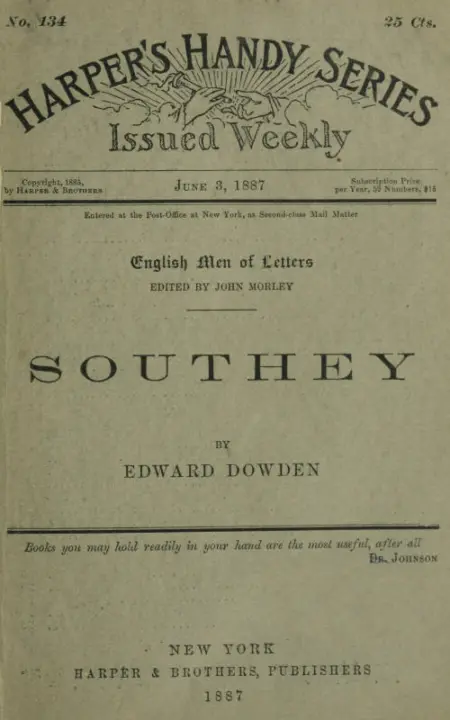
"Southey" by Edward Dowden is a biographical account written in the late 19th century. The work delves into the life of Robert Southey, one of the prominent poets of the Romantic era and the poet laureate of England. The biography captures Southey's literary journey, influences, and personal experiences, emphasizing his dedication to literature and his role within the cultural tapestry of his time. At the start of the narrative, Dowden introduces readers to Southey's childhood, revealing how deeply entrenched he was in literature from a young age. The opening details Southey's family background, including his father's life as a linen-draper and the influence of his nurturing mother, as well as significant early experiences that shaped his literary aspirations. Through captivating anecdotes, we learn about his initial struggles with education, the personalities who impacted him, and the budding love of poetry that became a defining element of his identity. The beginning sets the stage for a deeper exploration of Southey’s character and contributions to literature in the subsequent chapters.
Introduction adapted from the source catalogue; source summaries may be automatically generated.
Free to read · English · 62,396 words · No account needed
MAKE TIME FOR A GOOD BOOK
On by default. Untick to stop anonymous reading totals. Each page counts after 10 seconds in view. How this works.
Anonymous counting is on unless you have switched it off.
The alarm of 1809 passed away, and Herbert grew to the age of nine, active and bright of spirit, yet too pale, and, like his father, hanging too constantly over his books; a finely organized being, delicate in his sensibilities, and prematurely accomplished. Before the snow had melted which shone on Skiddaw that day when the children welcomed home their parents, Herbert Southey lay in his grave. His disease was an affection of the heart, and for weeks his father, palsied by apprehension, and unable to put hand to his regular work, stood by the bedside, with composed countenance, with words of hope, and agonized heart. Each day of trial made his boy more dear. With a trembling pride Southey saw the sufferer’s behaviour, beautiful in this illness as in all his life; nothing could be more calm, more patient, more collected, more dutiful, more admirable. At last, worn with watching, Southey and his wife were prevailed upon to lie down. The good Mary Barker watched, and it is she who writes the following lines:—“Herbert!—that sweetest and most perfect of all children on this earth, who died in my arms at nine years of age, whose death I announced to his father and mother in their bed, where I had prayed and persuaded them to go. When Southey could speak, his first words were, ‘The Lord hath given, and the Lord hath taken away. Blessed be the name of the Lord!’ Never can I forget that moment” (1816).
“I am perfectly resigned,” Southey wrote to Bedford on the most mournful of all days, “and do not give way to grief. Thank God I can control myself for the sake of others.” But next morning found him weak as a child, even weaker in body than in mind, for long anxiety had worn him to the bone, and while he tried to calm and console the rest, his limbs trembled under him. His first wild wish to fly from Keswick passed away; it was good to be there near the boy’s grave. Weak as he was, he flung himself upon his work. “I employ myself incessantly, taking, however, every day as much exercise as I can bear without injurious fatigue, which is not much.” “It would surprise you were you to see what I get through in a day.” “For the first week I did as much every day as would at other times have seemed the full and overflowing produce of three.” From his early discipline in the stoical philosophy some help now was gained; from his active and elastic mind the gain was more; but these would have been insufficient to support him without a heart-felt and ever-present faith that what he had lost was not lost for ever. A great change had indeed come upon him. He set his house in order, and made arrangements as if his own death were at hand. He resolved not to be unhappy, but the joyousness of his disposition had received its death-wound; he felt as if he had passed at once from boyhood to the decline of life. He tried dutifully to make head against his depression, but at times with poor success. “I employ myself, and have recovered strength, but in point of spirits I rather lose ground.” Still, there are hidden springs of comfort. “The head and flower of my earthly happiness is cut off. But I am not unhappy.” “When I give way to tears, which is only in darkness or solitude, they are not tears of unmingled pain.” All beloved ones grew more precious; the noble fortitude of his wife made her more than ever a portion of his best self. His uncle’s boy, Edward, he could not love more than he had loved him before; but, “as far as possible, he will be to me hereafter,” writes Southey, “in the place of my son.” And in truth the blessing of Herbert’s boyhood remained with him still; a most happy, a most beautiful boyhood it had been; he was thankful for having possessed the child so long; “for worlds I would not but have been his father.” “I have abundant blessings left; for each and all of these I am truly thankful; but of all the blessings which God has given me, this child, who is removed, is the one I still prize the most.” To relieve feelings which he dared not utter with his lips, he thought of setting about a monument in verse for Herbert and himself, which might make one inseparable memory for father and son. A page or two of fragmentary thoughts in verse and prose for this poetic monument exists, but Southey could not keep his imagination enough above his heart to dare to go on with it; to do so would have dissolved his heart anew. One or two of these holy scriptures of woe, truly red drops of Southey’s life-blood, will tell enough of this love passing the love of women.
Your reading position is saved on this browser. Take it to another device with a library code. Reading pages adapt to text, rather than matching a printed edition.
BEHIND THE BOOK
This eBook is for the use of anyone anywhere in the United States and most other parts of the world at no cost and with almost no restrictions whatsoever. You may copy it, give it away or re-use it under the terms of the Project Gutenberg License included with this eBook or online at www.gutenberg.org. If you are not located in the United States, you will have to check the laws of the country where you are located before using this eBook. Read the source licence.
The original source file, including credits and licence, is retained by this library. Request an original-format copy at no charge. Please include the book title and Project Gutenberg identifier #61983.
KEEP YOUR CURIOSITY GOING
John L. Ransom

Herman W. Mudgett

Harriet Monroe
Daniel Dulany Addison
Charles Lanman

Harold Rosher