THE CLASSIC COLLECTION✦A History of French Literature Short Histories of the Literatures of the World: II.CLASSIC FREE BOOKS
A History of French Literature Short Histories of the Literatures of the World: II.
Edward Dowden
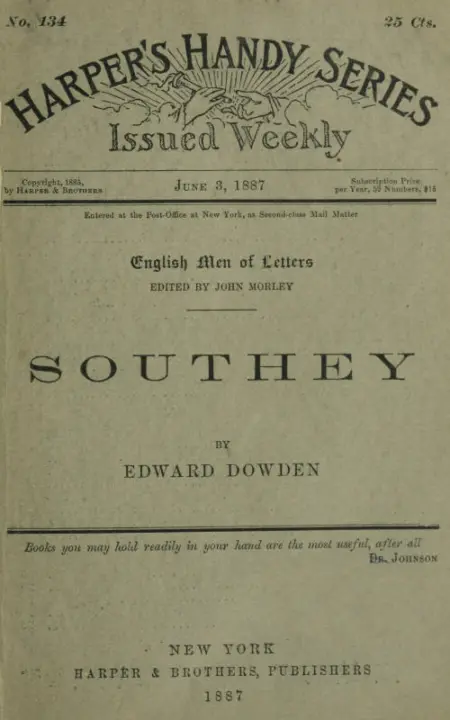
THE CLASSIC COLLECTION · 1885
"Southey" by Edward Dowden is a biographical account written in the late 19th century. The work delves into the life of Robert Southey, one of the prominent poets of the Romantic era and the poet laureate of England. The biography captures Southey's literary journey, influences, and personal experiences, emphasizing his dedication to literature and his role within the cultural tapestry of his time. At the start of the narrative, Dowden introduces readers to Southey's childhood, revealing how deeply entrenched he was in literature from a young age. The opening details Southey's family background, including his father's life as a linen-draper and the influence of his nurturing mother, as well as significant early experiences that shaped his literary aspirations. Through captivating anecdotes, we learn about his initial struggles with education, the personalities who impacted him, and the budding love of poetry that became a defining element of his identity. The beginning sets the stage for a deeper exploration of Southey’s character and contributions to literature in the subsequent chapters.
Introduction adapted from the source catalogue; source summaries may be automatically generated.
Free to read · English · 62,396 words · No account needed
MAKE TIME FOR A GOOD BOOK
On by default. Untick to stop anonymous reading totals. Each page counts after 10 seconds in view. How this works.
Anonymous counting is on unless you have switched it off.
Through pastoral Somerset, through Devon amid falling leaves, then over rough Cornish roads, the coach brought Southey—cold, hungry, and dispirited—to Falmouth. No packet there for Corunna; no packet starting before December 1st. The gap of time looked colourless and dreary, nor could even the philosophy of Epictetus lift him quite above “the things independent of the will.” After a comfortless and stormy voyage, on the fifth morning the sun shone, and through a mist the barren cliffs of Galicia, with breakers tumbling at their feet, rose in sight. Who has not experienced, when first he has touched a foreign soil, how nature purges the visual nerve with lucky euphrasy? The shadowy streets, the latticed houses, the fountains, the fragments of Moorish architecture, the Jewish faces of the men, the lustrous eyes of girls, the children gaily bedizened, the old witch-like women with brown shrivelled parchment for skin, told Southey that he was far from home. Nor at night was he permitted to forget his whereabouts; out of doors cats were uttering soft things in most vile Spanish; beneath his blanket, familiars, bloodthirsty as those of the Inquisition, made him their own. He was not sorry when the crazy coach, drawn by six mules, received him and his uncle, and the journey eastward began to the shout of the muleteers and the clink of a hundred bells.
Some eighteen days were spent upon the road to Madrid. Had Southey not left half his life behind him in Bristol, those December days would have been almost wholly pleasurable. As it was, they yielded a large possession for the inner eye, and gave his heart a hold upon this new land which, in a certain sense, became for ever after the land of his adoption. It was pleasant when, having gone forward on foot, he reached the crest of some mountain road, to look down on broken waters in the glen, and across to the little white-walled convent amid its chestnuts, and back to the dim ocean; there, on the summit, to rest with the odour of furze blossoms and the tinkle of goats in the air, and, while the mules wound up the long ascent, to turn all this into hasty rhymes, ending with the thought of peace, and love, and Edith. Then the bells audibly approaching, and the loud-voiced muleteer consigning his struggling team to Saint Michael and three hundred devils; and then on to remoter hills, or moor and swamp, or the bridge flung across a ravine, or the path above a precipice, with mist and moonlight below. And next day some walled city, with its decaying towers and dim piazza; some church, with its balcony of ghastly skulls; some abandoned castle, or jasper-pillared Moorish gateway and gallery. Nor were the little inns and baiting-houses without compensations for their manifold discomforts. The Spanish country-folk were dirty and ignorant, but they had a courtesy unknown to English peasants; Southey would join the group around the kitchen fire, and be, as far as his imperfect speech allowed, one with the rustics, the carriers, the hostess, the children, the village barber, the familiar priest, and the familiar pigs. When chambermaid Josepha took hold of his hair and gravely advised him never to tie it or to wear powder, she meant simple friendliness, no more. In his recoil from the dream of human perfectibility, Southey allowed himself at times to square accounts with common-sense by a cynical outbreak; but, in truth, he was a warm-hearted lover of his kind. Even feudalism and Catholicism had not utterly degraded the Spaniard. Southey thanks God that the pride of chivalry is extinguished; his Protestant zeal becomes deep-dyed in presence of our Lady of Seven Sorrows and the Holy Napkin. “Here, in the words of Mary Wollstonecraft,” he writes, “‘the serious folly of Superstition stares every man of sense in the face.’” Yet Spain has inherited tender and glorious memories; by the river Ezla he recalls Montemayor’s wooing of his Diana; at Tordesillas he muses on the spot where Queen Joanna watched by her husband’s corpse, and where Padilla, Martyr of Freedom, triumphed and endured. At length the travellers, accompanied by Manuel, the most vivacious and accomplished of barbers, drew near Madrid, passed the miles of kneeling washerwomen and outspread clothes on the river banks, entered the city, put up at the Cruz de Malta, and were not ill-content to procure once more a well-cooked supper and a clean bed.
Your reading position is saved on this browser. Take it to another device with a library code. Reading pages adapt to text, rather than matching a printed edition.
BEHIND THE BOOK
This eBook is for the use of anyone anywhere in the United States and most other parts of the world at no cost and with almost no restrictions whatsoever. You may copy it, give it away or re-use it under the terms of the Project Gutenberg License included with this eBook or online at www.gutenberg.org. If you are not located in the United States, you will have to check the laws of the country where you are located before using this eBook. Read the source licence.
The original source file, including credits and licence, is retained by this library. Request an original-format copy at no charge. Please include the book title and Project Gutenberg identifier #61983.
KEEP YOUR CURIOSITY GOING
John L. Ransom

Herman W. Mudgett

Harriet Monroe
Daniel Dulany Addison
Charles Lanman

Harold Rosher