THE CLASSIC COLLECTION✦Promoting good citizenshipCLASSIC FREE BOOKS
Promoting good citizenship
James Bryce, Viscount Bryce
THE CLASSIC COLLECTION · 1912
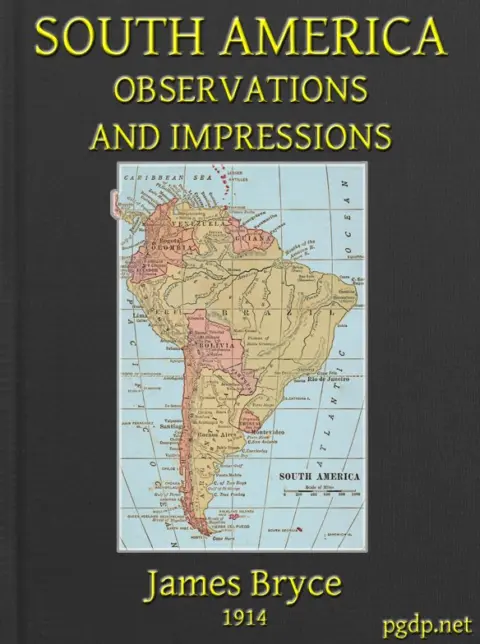
"South America: Observations and Impressions" by Viscount James Bryce is a travelogue written in the early 20th century. This work chronicles Bryce's journey through various countries in South America, including Panama, Peru, and Argentina, providing insights into the landscapes, people, and historical context of the regions explored. The focus of the book is on the author's personal observations and reflections, making it an engaging narrative for readers interested in travel literature and cultural studies. The opening of this travelogue sets the stage for Bryce's exploration of South America, beginning with his preface where he acknowledges the influences that sparked his interest in the continent. He articulates his desire to understand the social, economic, and historical realities of the seven republics he visited. Through vivid descriptions, he introduces the notion of geographical significance, specifically emphasizing the Ismuth of Panama and its pivotal historical role. This part of the text captures Bryce's intent to share firsthand experiences and impressions gained during his travels, highlighting both the unique aspects of South America and the complexities of its societies and natural landscapes.
Introduction adapted from the source catalogue; source summaries may be automatically generated.
Free to read · English · 174,009 words · No account needed
MAKE TIME FOR A GOOD BOOK
On by default. Untick to stop anonymous reading totals. Each page counts after 10 seconds in view. How this works.
Anonymous counting is on unless you have switched it off.
[93] The tops range from 4500 to 7000 feet.
[94] Sequoia gigantea of the Mariposa and Calaveras groves.
[95] Sequoia sempervirens.
[96] John White.
[97] Chapter XVI.
[98] How many Indians there are nobody knows, but the common (probably exaggerated) estimate puts them at nearly 2,000,000, half of these pagans in the Amazonian forests, while the mixed race is calculated at 1,700,000.
[99] Sir H. H. Johnson (The Negro in the New World) conjectures the pure blacks at about 2,720,000 and the mulattoes and quadroons at about 5,600,000. The rest of the population, that which may be described as white because it bears no conspicuous marks of any infusion of color, may approach 8,000,000. The Indians and half-breeds (Indian and white) would make up the rest of the non-European population. Of the pure blacks, from 20,000 to 30,000, living on the northeast coast, are either Mussulmans or heathen fetichists.
[100] M. Georges Clémenceau in his South America of To-day.
[101] Brazil would make a seventeenth, but it was in 1808 a possession of Portugal. The three island republics, Cuba, Hayti, and Santo Domingo, bring up the total number of independent Latin-American states to twenty.
[102] Whether the same can be said of some of the Central American
republics may be doubted.
[103] See above, Chapter IX.
[104] Though, no doubt, there is between the inhabitants of southern Mexico and their neighbours, the men of Guatemala and Honduras, no marked difference, just as there is not much between the men of Northern Peru and their neighbours in Ecuador.
[105] However, a North American friend tells me that he can usually tell a Venezuelan from a Colombian.
[106] Steps have recently been taken for smoothing down this controversy, and diplomatic relations between Chile and Peru seem likely to be now resumed. (Note to edition of February, 1913.)
[107] Britain, France, Germany, Italy, Russia, the United States, Belgium, Holland, and Portugal.
[108] The more usual estimates (e.g. that in the Statesman's Year Book for 1912) give 19 per cent of pure Spaniards, 43 per cent mestizos, and 38 per cent Indians, but enquiries made from many well-informed people in Mexico led me to believe that the proportion of Indians is much larger, and probably about that stated in the text.
[109] Brazil is believed to have nearly two millions of aborigines, most of them savages, Argentina perhaps fifty thousand, Chile one hundred twenty thousand (including the Fuegians). For the four northern republics and for the five of Central America no figures exist, but the bulk of their population, which may be roughly taken at nine millions, is Indian, and pure whites constitute a small minority, which is probably largest in Costa Rica, Colombia, and Panama.
[110] There are also eight or nine millions of negroes and mulattoes
(nearly all in Brazil).
[111] Chapters III-V.
[112] See Chapter V, p. 180.
Your reading position is saved on this browser. Take it to another device with a library code. Reading pages adapt to text, rather than matching a printed edition.
James Bryce, Viscount Bryce
James Bryce, Viscount Bryce
James Bryce, Viscount Bryce
BEHIND THE BOOK
This eBook is for the use of anyone anywhere in the United States and most other parts of the world at no cost and with almost no restrictions whatsoever. You may copy it, give it away or re-use it under the terms of the Project Gutenberg License included with this eBook or online at www.gutenberg.org. If you are not located in the United States, you will have to check the laws of the country where you are located before using this eBook. Read the source licence.
The original source file, including credits and licence, is retained by this library. Request an original-format copy at no charge. Please include the book title and Project Gutenberg identifier #45961.
KEEP YOUR CURIOSITY GOING
Wilfrid Scawen Blunt
Wilfrid Scawen Blunt

E. W. (Edgar Watson) Howe
Francis Greenleaf Allinson & Anne C. E. (Anne Crosby Emery) Allinson
Cyrenus Cole

John Martineau