THE CLASSIC COLLECTION✦Promoting good citizenshipCLASSIC FREE BOOKS
Promoting good citizenship
James Bryce, Viscount Bryce
THE CLASSIC COLLECTION · 1912
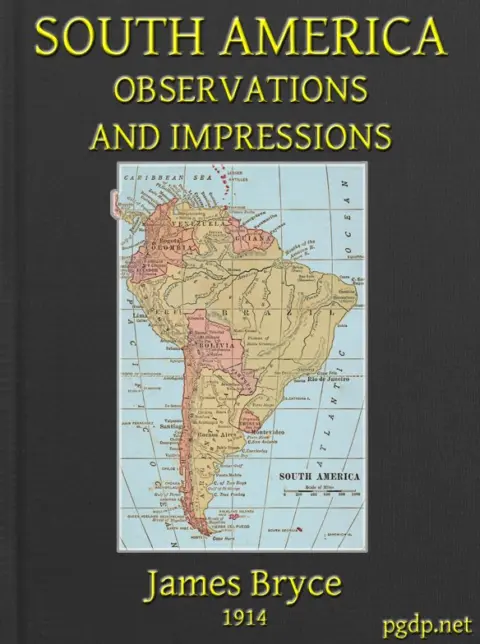
"South America: Observations and Impressions" by Viscount James Bryce is a travelogue written in the early 20th century. This work chronicles Bryce's journey through various countries in South America, including Panama, Peru, and Argentina, providing insights into the landscapes, people, and historical context of the regions explored. The focus of the book is on the author's personal observations and reflections, making it an engaging narrative for readers interested in travel literature and cultural studies. The opening of this travelogue sets the stage for Bryce's exploration of South America, beginning with his preface where he acknowledges the influences that sparked his interest in the continent. He articulates his desire to understand the social, economic, and historical realities of the seven republics he visited. Through vivid descriptions, he introduces the notion of geographical significance, specifically emphasizing the Ismuth of Panama and its pivotal historical role. This part of the text captures Bryce's intent to share firsthand experiences and impressions gained during his travels, highlighting both the unique aspects of South America and the complexities of its societies and natural landscapes.
Introduction adapted from the source catalogue; source summaries may be automatically generated.
Free to read · English · 174,009 words · No account needed
MAKE TIME FOR A GOOD BOOK
On by default. Untick to stop anonymous reading totals. Each page counts after 10 seconds in view. How this works.
Anonymous counting is on unless you have switched it off.
It is not my purpose to describe or discuss either the political institutions or the practical politics of the South American states. Even with a fuller knowledge of them than I was able to acquire in the short time at my disposal it would have been difficult for me to treat of them with the requisite freedom. But that which a traveller who has been the recipient of many courtesies may do without offence, and that which even a limited knowledge may qualify him to do, is to present a summary account of those physical, economic, and social features of the South American countries which are the basis of its political life, and constitute the conditions under which that life has to be carried on. Whoever has seen and understands these, realizing how altogether different they are from those of any European country, will find himself able to judge the troubled history and the present prospects of these states more fairly than those can do who apply to them a West European or a North American standard. The maxim, "To comprehend everything is to pardon everything," goes too far, but such truth as belongs to it is eminently applicable to these countries. One must know their conditions before attempting to pass judgment on their defects.
When republican governments sprang up on Central and South American soil as the authority of Spain was slowly swept away from one region after another, those governments were eagerly welcomed by European Liberals and still more effusively acclaimed by the people of the United States. The latter found in them a double source of satisfaction. Their appearance meant the disappearance of an old enemy, and their democratic institutions were a tribute of imitation to the success of popular government in the United States, where people still believed that there could be no freedom under a monarchy. Though this sympathy of the North Americans long continued to be extended to the new republics, especially when they came into collision with any European power, the friends of freedom in Europe presently lost interest in communities which were not reflecting credit upon democracy; and European writers of the opposite school soon began to point to them as shocking examples of liberty that had degenerated into license and violence. The last Spanish troops left the American continent in 1826. Decade after decade passed with no signs of improvement. Revolutions and dictators succeeded one another so quickly, and seemed to mean so little, that after a while the only Europeans who followed the fortunes of South America were the bondholders whose loans remained unpaid. The financial credit as well as the political character of the new states fell very low. Newspapers ridiculed them. Conservative statesmen and cloistered political philosophers drew warnings from them. Sir Henry Maine, one of the most brilliant writers of the last generation, in his ingenious, but elusive and unsatisfying, book on Popular Government, whenever he seeks to supply a link or point an epigram in his long indictment of democracy, constantly refers to the South American republics as instances of its failure in this or that respect. Yet such a line of argument is really no more legitimate than that of the enthusiastic North Americans who were prepared to defend the government of any South American country that called itself a republic. Both the assailant and the apologist looked only at the name, and did not stop to enquire into the thing. Sir Henry Maine's reasonings were valid against those who held, as did the North Americans, that the name of republic is enough to ensure good government, but valid against them only. There are always people ready to assume that things are what they are called, because it is much easier to deal with names than to examine facts. Paraguay under the military tyrannies of Francia and the elder and younger Lopez was called a republic and had a republican constitution.[141] The same was true of Venezuela under the tyrannies of Guzman Blanco and of Castro. Were Paraguay and Venezuela, therefore, true republics, entitled to the sympathy which democrats give to "governments deriving their just powers from the consent of the governed"? If they were, then arguments drawn from the misdeeds of Lopez and Castro are good arguments against the champions of republican or democratic government. If they were not, then the sympathy felt by North Americans for these so-called republics is groundless, and the incidents of their history prove nothing either for or against democracy. It is a mere question of names, and not of things.
Your reading position is saved on this browser. Take it to another device with a library code. Reading pages adapt to text, rather than matching a printed edition.
James Bryce, Viscount Bryce
James Bryce, Viscount Bryce
James Bryce, Viscount Bryce
BEHIND THE BOOK
This eBook is for the use of anyone anywhere in the United States and most other parts of the world at no cost and with almost no restrictions whatsoever. You may copy it, give it away or re-use it under the terms of the Project Gutenberg License included with this eBook or online at www.gutenberg.org. If you are not located in the United States, you will have to check the laws of the country where you are located before using this eBook. Read the source licence.
The original source file, including credits and licence, is retained by this library. Request an original-format copy at no charge. Please include the book title and Project Gutenberg identifier #45961.
KEEP YOUR CURIOSITY GOING
Wilfrid Scawen Blunt
Wilfrid Scawen Blunt

E. W. (Edgar Watson) Howe
Francis Greenleaf Allinson & Anne C. E. (Anne Crosby Emery) Allinson
Cyrenus Cole

John Martineau