THE CLASSIC COLLECTION✦Promoting good citizenshipCLASSIC FREE BOOKS
Promoting good citizenship
James Bryce, Viscount Bryce
THE CLASSIC COLLECTION · 1912
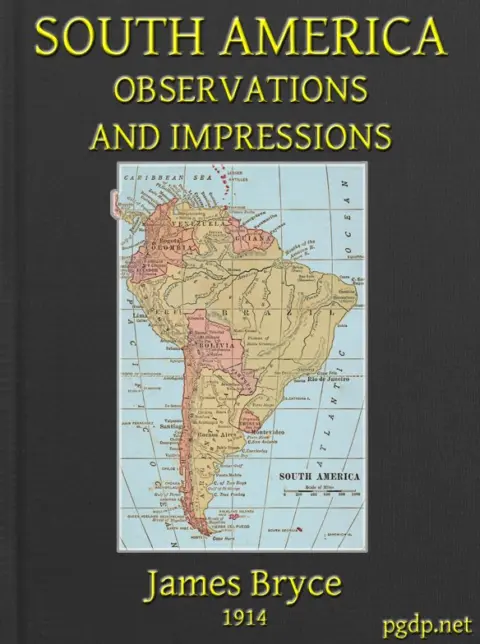
"South America: Observations and Impressions" by Viscount James Bryce is a travelogue written in the early 20th century. This work chronicles Bryce's journey through various countries in South America, including Panama, Peru, and Argentina, providing insights into the landscapes, people, and historical context of the regions explored. The focus of the book is on the author's personal observations and reflections, making it an engaging narrative for readers interested in travel literature and cultural studies. The opening of this travelogue sets the stage for Bryce's exploration of South America, beginning with his preface where he acknowledges the influences that sparked his interest in the continent. He articulates his desire to understand the social, economic, and historical realities of the seven republics he visited. Through vivid descriptions, he introduces the notion of geographical significance, specifically emphasizing the Ismuth of Panama and its pivotal historical role. This part of the text captures Bryce's intent to share firsthand experiences and impressions gained during his travels, highlighting both the unique aspects of South America and the complexities of its societies and natural landscapes.
Introduction adapted from the source catalogue; source summaries may be automatically generated.
Free to read · English · 174,009 words · No account needed
MAKE TIME FOR A GOOD BOOK
On by default. Untick to stop anonymous reading totals. Each page counts after 10 seconds in view. How this works.
Anonymous counting is on unless you have switched it off.
[74] The guanaco is the only large wild quadruped of these regions. He belongs to the same genus (Auchenia) as the llama, alpaca, and vicuña, but is bigger than any of them. Pigafetta describes him as having "the head of a mule, the body of a camel, the feet of a stag, and the tail of a horse."
[75] The steamers of the Pacific Steam Navigation Company began to run through the Straits about 1840.
[76] The enormous herds of fur seals which existed a century ago in the islands of South Georgia, the South Orkneys, and the South Shetlands have vanished. 300,000 are said to have been killed within five years in the South Shetlands alone.
[77] I reckon Oakland and Berkeley as, for this purpose, parts of San
Francisco.
[78] The population of the Republic is about 7,000,000, and that of
Buenos Aires 1,300,000.
[79] The English, adopting this term, talk of the rural parts of
Argentina as "the Camp," an expression which at first puzzles the
visitor.
[80] There were, in 1911, 30,000,000 cattle, 68,000,000 sheep, and
7,500,000 horses.
[81] The total amount of British capital invested in Argentine railroads, tramways, banks, and land was, in 1910, £295,000,000. In writing about a country which attracts the world chiefly by its material development it is impossible to avoid figures, but I wish to give the reader no more than are absolutely needed.
[82] There is, however, a small population of mixed Indian and colonial stock in the plateau of the Andean northwest adjoining Bolivia.
[83] 844,000 were from Italy, 424,000 from Spain.
[84] Some remarks upon this obscure question will be found in Chapter XCII of the author's American Commonwealth (edition of 1910). The problem is rather simpler here than in the United States because the recently injected elements are here less various.
[85] I was told that many of the street police are Indians from the
north of the country.
[86] They have a mass of readers near at hand and a revenue from advertisements comparable to those which are found in the United States and Australia, but are not found in Spanish America outside Buenos Aires.
Mr. F. Seebey states that, in 1903, 212 periodicals were published in Buenos Aires in various languages or dialects, including Basque, Catalan, and Genoese.
[87] The account of the origin of the red shirt given by Mr. G. M. Trevelyan in his interesting book, Garibaldi and the Defence of Rome, is not quite the same as that which I heard in Uruguay, but not incompatible therewith.
[88] Such legal or quasi-legal questions have arisen several times in
Central America.
[89] This question is involved with that relating to the voyages, real or alleged, of Americus Vespuccius in 1497, and is too intricate to be discussed here.
[90] See Chapter XVI, post.
[91] Opposite the Montanvert at Chamouni.
[92] See page 368.
Your reading position is saved on this browser. Take it to another device with a library code. Reading pages adapt to text, rather than matching a printed edition.
James Bryce, Viscount Bryce
James Bryce, Viscount Bryce
James Bryce, Viscount Bryce
BEHIND THE BOOK
This eBook is for the use of anyone anywhere in the United States and most other parts of the world at no cost and with almost no restrictions whatsoever. You may copy it, give it away or re-use it under the terms of the Project Gutenberg License included with this eBook or online at www.gutenberg.org. If you are not located in the United States, you will have to check the laws of the country where you are located before using this eBook. Read the source licence.
The original source file, including credits and licence, is retained by this library. Request an original-format copy at no charge. Please include the book title and Project Gutenberg identifier #45961.
KEEP YOUR CURIOSITY GOING
Wilfrid Scawen Blunt
Wilfrid Scawen Blunt

E. W. (Edgar Watson) Howe
Francis Greenleaf Allinson & Anne C. E. (Anne Crosby Emery) Allinson
Cyrenus Cole

John Martineau