THE CLASSIC COLLECTION✦Promoting good citizenshipCLASSIC FREE BOOKS
Promoting good citizenship
James Bryce, Viscount Bryce
THE CLASSIC COLLECTION · 1912
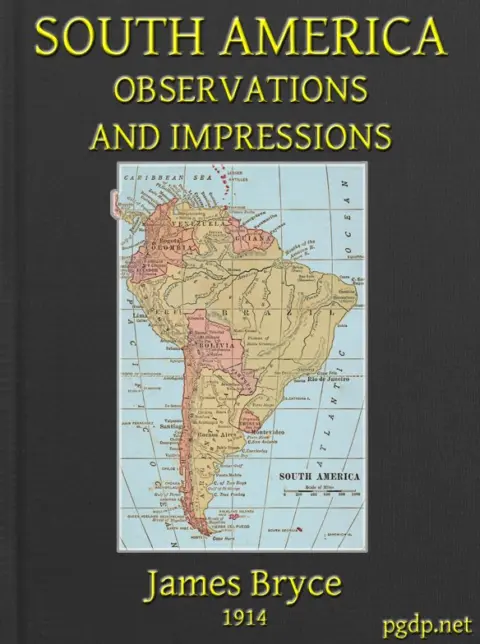
"South America: Observations and Impressions" by Viscount James Bryce is a travelogue written in the early 20th century. This work chronicles Bryce's journey through various countries in South America, including Panama, Peru, and Argentina, providing insights into the landscapes, people, and historical context of the regions explored. The focus of the book is on the author's personal observations and reflections, making it an engaging narrative for readers interested in travel literature and cultural studies. The opening of this travelogue sets the stage for Bryce's exploration of South America, beginning with his preface where he acknowledges the influences that sparked his interest in the continent. He articulates his desire to understand the social, economic, and historical realities of the seven republics he visited. Through vivid descriptions, he introduces the notion of geographical significance, specifically emphasizing the Ismuth of Panama and its pivotal historical role. This part of the text captures Bryce's intent to share firsthand experiences and impressions gained during his travels, highlighting both the unique aspects of South America and the complexities of its societies and natural landscapes.
Introduction adapted from the source catalogue; source summaries may be automatically generated.
Free to read · English · 174,009 words · No account needed
MAKE TIME FOR A GOOD BOOK
On by default. Untick to stop anonymous reading totals. Each page counts after 10 seconds in view. How this works.
Anonymous counting is on unless you have switched it off.
The interest which Argentina arouses is entirely unlike that which appeals to the traveller's eye and mind in Peru or Bolivia or Chile. In each of these three countries there is scenery grand in scale and different in type from what any other part of the world has to shew. In Peru and Bolivia there are also the remains of a primitive civilization, scanty, no doubt, but all the more attractive because they stimulate rather than satisfy our curiosity. They speak of antiquity, and indeed all three countries have a flavour of antiquity, though Chile has scarcely any relics coming down from it. But in the River Plate regions there is (except along the Andes and in the far north) little natural beauty, and nothing that recalls the past. All is modern and new; all belongs to the prosperous present and betokens a still more prosperous future. Argentina is like western North America. The swift and steady increase in its agricultural production, with an increase correspondingly large in means of internal transportation, is what gives its importance to the country and shews that it will have a great part to play in the world. It is the United States of the Southern Hemisphere.
Not even the approach by sea to Alexandria or to the mouth of the Hooghly below Calcutta, is duller than that to Buenos Aires. Before land is seen, the vessel enters a muddy, reddish brown sea, and presently the winding channel, marked for a long way by buoys, shews how shallow is the water on either side. This is the estuary, two hundred miles long and at this point about thirty miles broad, of the Rio de la Plata, formed by the union of the great river Uruguay with the still greater Paraná, streams which between them drain nearly one-fourth part of the South American continent. Approaching the Argentine shore, one sees a few masts and many funnels rising above the tall hulls of steamships, docked in lines alongside huge wharves. Beyond the open space of the wharf runs a row of offices and warehouses, but nothing else is seen, nor can one tell, except from the size of the docks and the crowd of vessels, that a great city lies behind. Nothing can be seen, because Buenos Aires stands only some thirty feet above high-water mark in a perfectly flat alluvial plain, with scarcely any rise in the ground for hundreds of miles, and not a rock anywhere. On entering the city one is surprised to find that with a boundless prairie all around, the streets should be so narrow that in most of them wheeled traffic is allowed to move only one way. One great thoroughfare, the Avenida de Mayo, traverses the centre of the city from the large plaza in which the government buildings stand to the still larger and very handsome plaza which is adorned by the palace of the legislature. Fortunately it is wide, and being well planted with trees is altogether a noble street, statelier than Piccadilly in London, or Unter den Linden in Berlin, or Pennsylvania Avenue in Washington. In the newer parts of the city more width is now being given to streets as they are from time to time laid out, but the congestion of the nucleus is a serious obstacle to rapid locomotion, which is otherwise well provided for by numerous electric car lines. No North American city has a better car service. Though skyscrapers have scarcely yet made their appearance, the houses are much higher than in the west coast cities, because earthquakes are not feared; and many mansions in the residential quarters, built in the modern French style, have architectural merit. So, too, the numerous small plazas, usually planted with trees or shrubs and furnished with seats, partly atone for the want of space in the streets. It must be added that the statues which adorn these plazas do not tempt the passer-by to linger in æsthetic enjoyment. One is too acutely reminded of the bronze equestrian warriors so numerous in Washington. The cities of the western world, having a short history, seem to run to the commemoration of heroes whose names, little known to other nations, will soon be forgotten in their own, whereas the old countries, except Italy, seem forgetful of those whom the western stranger would like to have seen held up to reverence.
Your reading position is saved on this browser. Take it to another device with a library code. Reading pages adapt to text, rather than matching a printed edition.
James Bryce, Viscount Bryce
James Bryce, Viscount Bryce
James Bryce, Viscount Bryce
BEHIND THE BOOK
This eBook is for the use of anyone anywhere in the United States and most other parts of the world at no cost and with almost no restrictions whatsoever. You may copy it, give it away or re-use it under the terms of the Project Gutenberg License included with this eBook or online at www.gutenberg.org. If you are not located in the United States, you will have to check the laws of the country where you are located before using this eBook. Read the source licence.
The original source file, including credits and licence, is retained by this library. Request an original-format copy at no charge. Please include the book title and Project Gutenberg identifier #45961.
KEEP YOUR CURIOSITY GOING
Wilfrid Scawen Blunt
Wilfrid Scawen Blunt

E. W. (Edgar Watson) Howe
Francis Greenleaf Allinson & Anne C. E. (Anne Crosby Emery) Allinson
Cyrenus Cole

John Martineau