THE CLASSIC COLLECTION✦Promoting good citizenshipCLASSIC FREE BOOKS
Promoting good citizenship
James Bryce, Viscount Bryce
THE CLASSIC COLLECTION · 1912
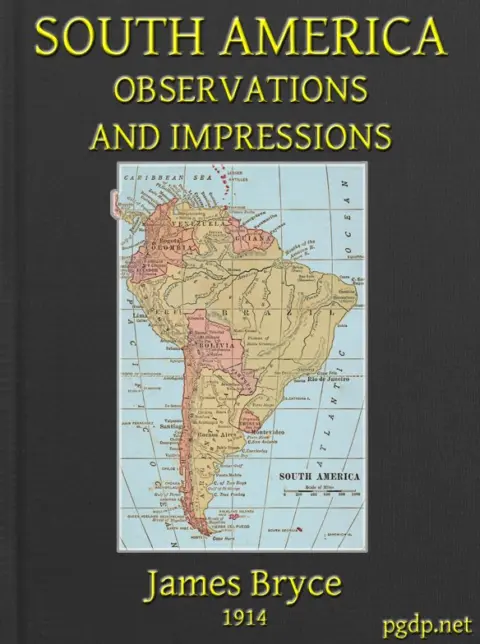
"South America: Observations and Impressions" by Viscount James Bryce is a travelogue written in the early 20th century. This work chronicles Bryce's journey through various countries in South America, including Panama, Peru, and Argentina, providing insights into the landscapes, people, and historical context of the regions explored. The focus of the book is on the author's personal observations and reflections, making it an engaging narrative for readers interested in travel literature and cultural studies. The opening of this travelogue sets the stage for Bryce's exploration of South America, beginning with his preface where he acknowledges the influences that sparked his interest in the continent. He articulates his desire to understand the social, economic, and historical realities of the seven republics he visited. Through vivid descriptions, he introduces the notion of geographical significance, specifically emphasizing the Ismuth of Panama and its pivotal historical role. This part of the text captures Bryce's intent to share firsthand experiences and impressions gained during his travels, highlighting both the unique aspects of South America and the complexities of its societies and natural landscapes.
Introduction adapted from the source catalogue; source summaries may be automatically generated.
Free to read · English · 174,009 words · No account needed
MAKE TIME FOR A GOOD BOOK
On by default. Untick to stop anonymous reading totals. Each page counts after 10 seconds in view. How this works.
Anonymous counting is on unless you have switched it off.
Andes mountains, 38, 39, 42, 47;
description of peaks of Western Cordillera, 55-58, 60, 61,
63, 81, 82;
gold in the, 192;
splendor of scenery of, 200-201, 203, 241-242;
tunnel through the, 251, 256;
trips across the, 252-261, 267-271;
passage of, by San Martin's army, 268, 280-281;
the Christ of the, summit of Uspallata Pass, 269-270;
descent of, on open trolley, 270-271;
comparisons of, with other great ranges, 271 ff.;
as a field for mountain climbers, 272;
advantages of distance for viewing, 272-275;
why an unfavourable field for landscape painters, 275-276;
comparison of, with Himalayas, 276-277;
comparison with Alps and North American ranges, 277-279;
expense and difficulty of travel in the, 588.
Andrez, nephew of Tupac Amaru, 92.
Animals, on Peruvian highlands, 77-78, 81-82;
of Bolivia, 177;
of forests of southern Chile, 245;
absence of, among Fuegians, 294-295;
on Pampas of Argentina, 325-326.
Antarctic current, the, 38, 39, 43, 45, 489.
Antimony mines, 87.
Antiquities. See Ruins.
Antiquity of Cuzco, 109 n.
Antofagasta, 169, 202, 210, 211, 215.
Antofagasta and Bolivia Railroad, 187, 189-190, 191-192.
Araucana, epic by Alonzo de Ercilla, 236.
Araucanian Indians, 159, 225;
home of, in Central Valley of Chile, 232-233;
primitive semi-civilization of, 233-234;
maintain their independence against the Spanish, 233-235;
Chile asserts authority over, 235-236;
remain the one unconquered native people of South America, 236;
estimates of former and present numbers, 236;
inroads of disease and drink among, and government protection
of, 236-237;
religion of, 237-238.
Araucaria, conifer of southern Chile, 244.
Arawak Indians, 457.
Areche, Spanish judge, 116.
Arequipa, Peru, 60;
history, 60;
altitude, 60;
climate, 60-61;
Harvard Observatory at, 61;
scenic wonders at, 62-64;
houses, streets, and people, 64-66;
Indian labourers in, 66;
an ecclesiastical stronghold, 66-67;
romance of the runaway nun at, 69-74;
terminal of Southern Railroad of Peru, 80.
Argentina, 52;
entrance to, across the Andes, 251-260;
contrasts between Chile and, 264-265;
railways of, 264, 329, 337, 588;
difference as to interest aroused between Peru, Bolivia, and Chile
and, 315, 346;
proportion of population of, dwelling in Buenos Aires, 322-323;
natural features of, 324-325;
the Pampas, 325-329;
farms and cattle ranches of, 329-331;
allotment of land into large estates held by great landowners,
331-333;
Italians in, 332-333, 339-340, 438, 516-517;
leading agricultural products of, 336;
cattle, sheep, and horses in, 336 n.;
possibilities of, as to growth in wealth and population, 337-338;
composition of population of the country, 338-340;
effect on future of nation of European commingling, 339-341,
346-348;
separation of church from politics in, 342-343;
anarchist propaganda in, 343;
relative positions held by politics, literature, and business
in, 344-346;
excessive patriotism of people, 346;
influence of geographical position on its differentiation as a
separate political entity, 429;
a true nation by the test of possessing a distinctive national
quality and a strong national sentiment, 441;
armament maintained by, 449;
slight influence of Italians on political and intellectual life
of, 516-517;
British capital invested in railways of, 517;
a bona fide republic, after a troubled and sanguinary political
history, 544-545;
pre-eminent fitness of, for immigration, 556-557;
universities and schools in, 575;
writers on theoretical jurisprudence and international law in, 578 n.
Your reading position is saved on this browser. Take it to another device with a library code. Reading pages adapt to text, rather than matching a printed edition.
James Bryce, Viscount Bryce
James Bryce, Viscount Bryce
James Bryce, Viscount Bryce
BEHIND THE BOOK
This eBook is for the use of anyone anywhere in the United States and most other parts of the world at no cost and with almost no restrictions whatsoever. You may copy it, give it away or re-use it under the terms of the Project Gutenberg License included with this eBook or online at www.gutenberg.org. If you are not located in the United States, you will have to check the laws of the country where you are located before using this eBook. Read the source licence.
The original source file, including credits and licence, is retained by this library. Request an original-format copy at no charge. Please include the book title and Project Gutenberg identifier #45961.
KEEP YOUR CURIOSITY GOING
Wilfrid Scawen Blunt
Wilfrid Scawen Blunt

E. W. (Edgar Watson) Howe
Francis Greenleaf Allinson & Anne C. E. (Anne Crosby Emery) Allinson
Cyrenus Cole

John Martineau