THE CLASSIC COLLECTION✦Promoting good citizenshipCLASSIC FREE BOOKS
Promoting good citizenship
James Bryce, Viscount Bryce
THE CLASSIC COLLECTION · 1912
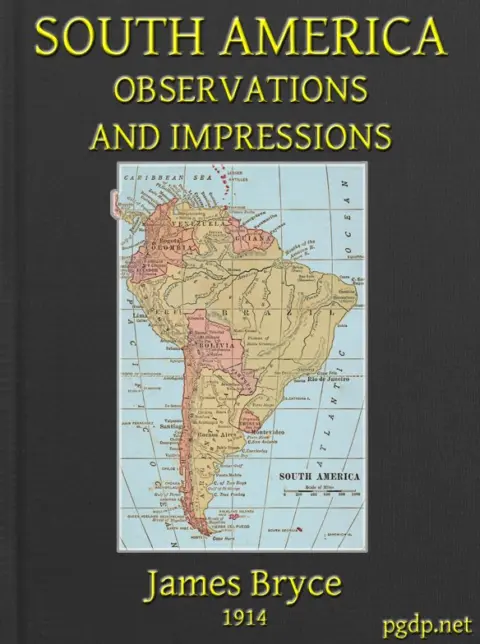
"South America: Observations and Impressions" by Viscount James Bryce is a travelogue written in the early 20th century. This work chronicles Bryce's journey through various countries in South America, including Panama, Peru, and Argentina, providing insights into the landscapes, people, and historical context of the regions explored. The focus of the book is on the author's personal observations and reflections, making it an engaging narrative for readers interested in travel literature and cultural studies. The opening of this travelogue sets the stage for Bryce's exploration of South America, beginning with his preface where he acknowledges the influences that sparked his interest in the continent. He articulates his desire to understand the social, economic, and historical realities of the seven republics he visited. Through vivid descriptions, he introduces the notion of geographical significance, specifically emphasizing the Ismuth of Panama and its pivotal historical role. This part of the text captures Bryce's intent to share firsthand experiences and impressions gained during his travels, highlighting both the unique aspects of South America and the complexities of its societies and natural landscapes.
Introduction adapted from the source catalogue; source summaries may be automatically generated.
Free to read · English · 174,009 words · No account needed
MAKE TIME FOR A GOOD BOOK
On by default. Untick to stop anonymous reading totals. Each page counts after 10 seconds in view. How this works.
Anonymous counting is on unless you have switched it off.
Agriculture, in Peru, 41-42, 78;
of Indians in interior of Peru, 87-88;
on central plateau of Peru, 120, 122-124;
importance of, to Bolivia, 193;
in southern Chile, 231, 240;
difficulties of practice of, on Falkland Isles, 310;
in Argentina, 329-331;
risks to, in Argentina, from drought and locusts, 333-334, 557;
rank of Argentina in agricultural products, 336;
in Uruguay, 354;
in Brazil, 403 ff.;
retardation of, by the unassimilated Indian population, 475-476;
suitability of Argentina, Uruguay, and southern Brazil for, 556-557.
Aguas Calientes, town of, 87.
Akers, History of South America by, 587.
Alakaluf tribe of Fuegians, 294.
Albatrosses, seen on voyage to Straits of Magellan, 287, 288.
Alcaldes of Indian villages, 91;
powers and duties of, 180-181.
Alcohol from sugar-cane, made by Peruvian Indians, 467.
Alexander VI, Pope, bull of, dividing New World between Spain and
Portugal, 366.
Alfalfa, 177, 202, 263, 334.
Almagro, Diego de, 204, 218.
Alpacas, 78, 81.
Alpaca wool, 122.
Alps, comparison of Andes and, 277.
Altars of churches, Cuzco, 99.
Altitude, mountain sickness resulting from high, 83; effects of, of La Paz, 171-174; of Ecuador, Peru, and Bolivia a deterrent to immigration, 555.
Amazonian plain (the Selvas), 369-370;
future of, 558-562.
Amazon River, 40, 369;
forests of the, 75-76, 393-394;
sources of the, 86.
American Commonwealth, cited, 340 n.
Americas, the two: the naming of, 484-487; names which might have been given, 487; physical similarities between, 488-489; points of similarity in settlement of, 489-490; points of divergence, 490 ff.; Latin America and Teutonic America, 490; differences in the aboriginal tribes, 491-492; differences in climate, in discoveries of mines, and in class of immigrants to, 492-494; differences in the sphere of government and administration, 494-495; resultant unlikeness of, in everything but position in Western Hemisphere, 495-496; effect on mutual relations of achievement of independence, 496-497; divergence of fortunes of, as to wealth and population, 497-499; difference in the formation of nations,--two in Teutonic America against nineteen states in Latin America, 499-500; points of resemblance to be found in republican forms of government, in social equality, and in detachment from European politics, 501-504; contrasts between people of, in ideas and temperament, 504-505; present attitude of, toward one another, 507 ff.; common relations between, shown to be wholly wanting, 507-520; the Monroe Doctrine, and South American view of, 508-510.
Ampato, Mt., 57, 81.
Anahuac, Peruvian Indians compared with those of, 159, 160; plateau of, compared with the Andes, 278.
Anarchist propaganda in Argentina, 343.
Ancohuma (Hanko Uma), peak of, 142.
Ancon, hill of, 9-12.
Ancon, village of, 27.
Ancud, channel of, 239.
Andenes, terraces in Lake Titicaca region, 122.
Your reading position is saved on this browser. Take it to another device with a library code. Reading pages adapt to text, rather than matching a printed edition.
James Bryce, Viscount Bryce
James Bryce, Viscount Bryce
James Bryce, Viscount Bryce
BEHIND THE BOOK
This eBook is for the use of anyone anywhere in the United States and most other parts of the world at no cost and with almost no restrictions whatsoever. You may copy it, give it away or re-use it under the terms of the Project Gutenberg License included with this eBook or online at www.gutenberg.org. If you are not located in the United States, you will have to check the laws of the country where you are located before using this eBook. Read the source licence.
The original source file, including credits and licence, is retained by this library. Request an original-format copy at no charge. Please include the book title and Project Gutenberg identifier #45961.
KEEP YOUR CURIOSITY GOING
Wilfrid Scawen Blunt
Wilfrid Scawen Blunt

E. W. (Edgar Watson) Howe
Francis Greenleaf Allinson & Anne C. E. (Anne Crosby Emery) Allinson
Cyrenus Cole

John Martineau