THE CLASSIC COLLECTION✦Address delivered before the British Association assembled at BelfastCLASSIC FREE BOOKS
Address delivered before the British Association assembled at Belfast
John Tyndall
THE CLASSIC COLLECTION · 1867
"Sound" by John Tyndall is a scientific publication written in the late 19th century. The book delves into the principles and phenomena of acoustics, exploring topics such as the propagation of sound, the physics of sound waves, and the interaction of sound with different media. It aims to improve public knowledge of science, particularly focusing on the nature of sound. The beginning of "Sound" introduces the reader to the basic concepts of acoustics, emphasizing the significance of nerve transmission in perceiving sound. Tyndall explains how sound is produced and propagated, using experiments to illustrate the behavior of sound waves in various conditions, including vacuums and different gases. He discusses the role of air in sound transmission and the influence of temperature and pressure on sound characteristics, setting the stage for deeper explorations into the science of sound throughout the book.
Introduction adapted from the source catalogue; source summaries may be automatically generated.
Free to read · English · 123,502 words · No account needed
MAKE TIME FOR A GOOD BOOK
On by default. Untick to stop anonymous reading totals. Each page counts after 10 seconds in view. How this works.
Anonymous counting is on unless you have switched it off.
Mayer, his formula of the equivalent of heat, 66
Melde, M., his experiments with vibrating strings, 141, 427 —— and with sonorous ripples, 194
Metals, velocity of sound transmitted through, 72
—— determination of velocity in, 73
Molecular structure, influence of, on the velocity of sound, 73, 212
Monochord or sonometer, the, 121
Motion, conveyed to the brain by the nerves, 31
—— sonorous motion. See SOUND.
Mouth, resonance of the, 241-242
Music, physical difference between noise and, 82, 117
—— a musical tone produced by periodic, noise by unperiodic,
impulses, 83, 117
—— production of musical sounds by taps, 84, 117
—— —— by puffs of air, 89, 117
—— pitch and intensity of musical sounds, 90, 92, 117
—— description of the siren, 97
—— definition of an octave, 105
—— description of the double siren, 110
—— transmission of musical sounds through liquids and solids, 113
—— musical chords, 432-433
—— the diatonic scale, 432-433
—— See also HARMONY.
Musical-box, formation of the, 169, 197
Nerves of the human body, motion conveyed by the, to the brain, 31 —— rapidity of impressions conveyed by, 31 note
Newton, Sir Isaac, his calculation of the velocity of sound, 58
Nodes, 131-132
—— the nodes not points of absolute rest, 135
—— nodes of a tuning-fork, 175, 177
—— rendered visible, 177, 180
—— a node the origin of vibration, 251
Noise, physical difference between music and, 82, 117
Octave, definition of an, 105
Organ-pipes, 219, 256
Organ-pipes, vibrations of stopped pipes, 221, 256
—— —— Pandean pipes, 224
—— —— open pipes, 224, 256, 260
—— state of the air in sounding-pipes, 227, 257
—— reeds and reed-pipes, 234
Otolites of the ear, 425
Overtones, definition of, 153
—— relation of the point plucked to the, 155
—— corresponding to the vibrations of a rod fixed at both ends, 165
—— of a tuning-fork, 177
—— rendered visible, 177, 179
—— of rods vibrating longitudinally, 207
—— of the siren, 415
—— influence of overtones on harmony, 429
Pandean pipes, the, 224
Piano-wires, clang of, 158
—— curves described by vibrating, 160
Pipes. See ORGAN-PIPES
Pitch of musical sounds, 90 —— illustration of the dependence of pitch on rapidity of vibration, 100 —— relation of velocity to pitch, 211-212 —— velocity deduced from pitch, 233
Plateau, his theory of the resolution of a liquid vein into drops, 295
Pythagoreans, notions of the, regarding musical consonance, 410
Rain, reputed power of obstructing sound, 341-342 —— artificial, passage of sound through, 345
Reeds and reed-pipes, 234
Reeds, the clarinet and flute, 237
Reflection of sound, 45
—— from gases, 332
—— aërial, proved experimentally, 258
Refraction of sound, 51
Resonance, 213
—— of the air, 213-214, 256
—— of coal-gas, 216
—— of the mouth, 242
Resonators, 213
Resultant tones, discovery of, 399
—— conditions of their production, 400
—— experimental illustrations, 401
—— theories of Young and Helmholtz, 404, 406
Reversibility, acoustic, 461-469
Robinson, Dr., his summary of existing knowledge of fog-signals, 307 —— Professor, his production of musical sounds by puffs of air, 89
Rod, vibrations of a, fixed at both ends; its subdivisions and corresponding overtones, 165, 197 —— vibrations of a rod fixed at one end, 166, 197 —— —— of rods free at both ends, 173, 197
Savart’s experiments on the influence of sounds on jets of water, 457
Schultze’s bristles in the mechanism of hearing, 425
Sea-water, velocity of sound in, 70
Sensitive flames, 274
Smoke-jets, action of musical sounds on, 290
Your reading position is saved on this browser. Take it to another device with a library code. Reading pages adapt to text, rather than matching a printed edition.
John Tyndall
John Tyndall
Thomas Henry Huxley & George F. (George Frederick) Barker & E. D. (Edward Drinker) Cope & James Hutchison Stirling & John Tyndall
John Tyndall
BEHIND THE BOOK
This eBook is for the use of anyone anywhere in the United States and most other parts of the world at no cost and with almost no restrictions whatsoever. You may copy it, give it away or re-use it under the terms of the Project Gutenberg License included with this eBook or online at www.gutenberg.org. If you are not located in the United States, you will have to check the laws of the country where you are located before using this eBook. Read the source licence.
The original source file, including credits and licence, is retained by this library. Request an original-format copy at no charge. Please include the book title and Project Gutenberg identifier #54969.
KEEP YOUR CURIOSITY GOING
John Muir
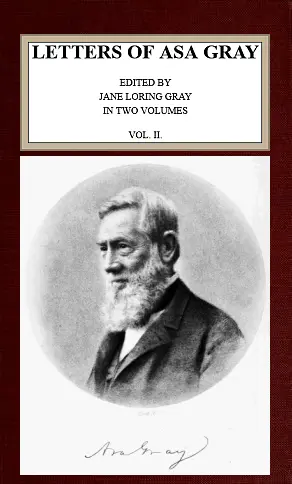
Asa Gray
Asa Gray
Florence Nightingale
Elizabeth Robins Pennell
Denison Olmsted