THE CLASSIC COLLECTION✦Address delivered before the British Association assembled at BelfastCLASSIC FREE BOOKS
Address delivered before the British Association assembled at Belfast
John Tyndall
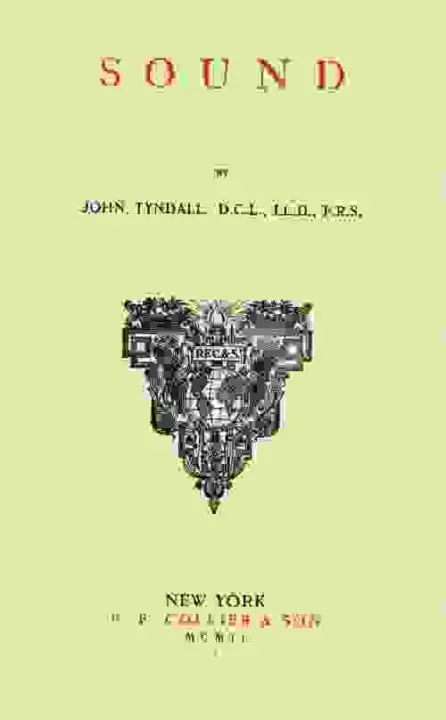
THE CLASSIC COLLECTION · 1867
"Sound" by John Tyndall is a scientific publication written in the late 19th century. The book delves into the principles and phenomena of acoustics, exploring topics such as the propagation of sound, the physics of sound waves, and the interaction of sound with different media. It aims to improve public knowledge of science, particularly focusing on the nature of sound. The beginning of "Sound" introduces the reader to the basic concepts of acoustics, emphasizing the significance of nerve transmission in perceiving sound. Tyndall explains how sound is produced and propagated, using experiments to illustrate the behavior of sound waves in various conditions, including vacuums and different gases. He discusses the role of air in sound transmission and the influence of temperature and pressure on sound characteristics, setting the stage for deeper explorations into the science of sound throughout the book.
Introduction adapted from the source catalogue; source summaries may be automatically generated.
Free to read · English · 123,502 words · No account needed
MAKE TIME FOR A GOOD BOOK
On by default. Untick to stop anonymous reading totals. Each page counts after 10 seconds in view. How this works.
Anonymous counting is on unless you have switched it off.
Derham, Dr., on fog-signals, 306
Diatonic scale, 263
Difference-tones, 404
Diffraction of sound, 76 note, 78
Disks, analysis of vibrations of, 187, 198
Dissonance, cause of, 428
—— graphic representation of, 430
Doppler, his theory of the colored stars, 113
Ear, limits of the range of hearing of the, 106, 118
—— causes of artificial deafness, 108, 119
—— mechanism of the ear, 424
—— consonant intervals in relation to, 426
Echoes, 48
—— instances of, 48-50
—— aërial, production of, 328-329
—— from flame, 339-340
—— reputed cloud echoes, 328
Eolian harp, formation of the, 159-160
Erith, effects of the explosion of 1864 on the village and church
of, 53
Eustachian tube, the, 198
—— mode of equalizing the air on each side of the tympanic membrane,
109, 119
Falsetto voice, causes of the, 239
Faraday, Mr., his experiment on sonorous ripples, 195
Fiddle, formation of the, 123
—— sound-board of the, 123
—— the iron fiddle, 169, 197
—— the straw-fiddle, 175, 197
Flames, sounding, 261, 302
—— rhythmic character of friction, 260, 301
—— influence of the tube surrounding the flame, 263, 302
—— singing-flames, 264, 302
—— effect of unisonant notes on singing-flames, 275
—— action of sound on naked flames, 275, 302-304
—— influence of pitch, 283
—— extraordinary delicacy of flames as acoustic reagents, 285
—— the vowel-flame, 286
—— discovery of a new sensitive flame by Philip Barry, 288
—— echo from, 339
—— action of beats on flame, 387
Flute, tones of the, 237
Fog, its want of power to obstruct sound, 348
—— observations in London, 348
—— fog-signals in, 355
—— artificial, experiments on, 357
Fog-signals, researches on the acoustic transparency of the atmosphere
in relation to the question of, 305
—— station at South Foreland, 309
—— instruments and observations, 309
—— variations of range, 315-316
—— contradictory results, 317
—— solution of contradictions, 317-323
—— extraordinary case of acoustic opacity, 318
—— in fogs, 355
—— minimum range of, 371
—— its position, 370
—— disadvantages of the gun, 368
Foreland, South, fog-signal station at, 309
—— fog at, 354
Gaines’s Farm, account of the battle of, 324
Gases, velocity of sound in, 69
Gun, range of, for fog-signals, 312-313
—— inferiority to the siren, 369
—— its disadvantages as a signal, 368
Hail, doubt as to its power to obstruct sound, 342
Harmonic tones of strings, 152-154
Harmony, 410
—— notions of the Pythagoreans, 411
—— Euler’s theory, 419
—— conditions of harmony, 411
—— influence of overtones on harmony, 429
—— graphic representations of consonance and dissonance, 431
Harmonica, the glass, 176
Hawksbee, his experiment on sounding bodies placed in vacuo, 36
Hearing, mechanism of, 424
Heat, thermal changes in the air produced by the sonorous wave, 60 —— ratio of specific heats at constant pressure and at constant volume deduced from velocities of sound, 64
—— mechanical equivalent of heatdeduced from this ratio, 66 —— inference that atmospheric air possesses no sensible power to radiate heat, 68 —— musical sounds produced by heated bars, 87
Helmholtz, his theory of resultant tones, 405, 406
—— —— consonance, 414, 420
Herschel, Sir John, his article on “Sound” quoted, 50 —— his account of Arago’s observation on velocity of sound, 328
Hooke, Dr. Robert, his anticipation of the stethoscope, 75 —— his production of musical sounds by the teeth of a rotating wheel, 85
Horn, as an instrument for fog-signalling, 310-311
Your reading position is saved on this browser. Take it to another device with a library code. Reading pages adapt to text, rather than matching a printed edition.
John Tyndall
John Tyndall
Thomas Henry Huxley & George F. (George Frederick) Barker & E. D. (Edward Drinker) Cope & James Hutchison Stirling & John Tyndall
John Tyndall
BEHIND THE BOOK
This eBook is for the use of anyone anywhere in the United States and most other parts of the world at no cost and with almost no restrictions whatsoever. You may copy it, give it away or re-use it under the terms of the Project Gutenberg License included with this eBook or online at www.gutenberg.org. If you are not located in the United States, you will have to check the laws of the country where you are located before using this eBook. Read the source licence.
The original source file, including credits and licence, is retained by this library. Request an original-format copy at no charge. Please include the book title and Project Gutenberg identifier #54969.
KEEP YOUR CURIOSITY GOING

John Muir

Asa Gray
Asa Gray

Florence Nightingale
Elizabeth Robins Pennell
Denison Olmsted