THE CLASSIC COLLECTION✦Address delivered before the British Association assembled at BelfastCLASSIC FREE BOOKS
Address delivered before the British Association assembled at Belfast
John Tyndall
THE CLASSIC COLLECTION · 1867
"Sound" by John Tyndall is a scientific publication written in the late 19th century. The book delves into the principles and phenomena of acoustics, exploring topics such as the propagation of sound, the physics of sound waves, and the interaction of sound with different media. It aims to improve public knowledge of science, particularly focusing on the nature of sound. The beginning of "Sound" introduces the reader to the basic concepts of acoustics, emphasizing the significance of nerve transmission in perceiving sound. Tyndall explains how sound is produced and propagated, using experiments to illustrate the behavior of sound waves in various conditions, including vacuums and different gases. He discusses the role of air in sound transmission and the influence of temperature and pressure on sound characteristics, setting the stage for deeper explorations into the science of sound throughout the book.
Introduction adapted from the source catalogue; source summaries may be automatically generated.
Free to read · English · 123,502 words · No account needed
MAKE TIME FOR A GOOD BOOK
On by default. Untick to stop anonymous reading totals. Each page counts after 10 seconds in view. How this works.
Anonymous counting is on unless you have switched it off.
Snow, its reputed power to obstruct sound, 344
Solids, velocity of sound transmitted through, 69, 72 —— musical sounds transmitted through, 115-116, 122 —— determination of velocity in, 211
Sonometer, or monochord, the, 121
Sorge, his discovery of resultant tones, 399
Sound, production and propagation of, 32, 77 —— experiments on sounding bodies placed in vacuo, 36, 77 —— deadened by hydrogen, 38 —— action of hydrogen upon the voice, 40 —— propagation of sound through air of varying density, 40 —— amplitude of the vibration of a sound-wave, 42, 77 —— the action of sound compared with that of light and radiant heat, 45 —— reflection of, 45, 77 —— echoes, 48-50, 78 —— sounds reflected from the clouds, 49-50 —— refraction of sound, 51, 77 —— diffraction of sound, 53, 78 —— influence of density and elasticity on velocity, 54, 78 —— influence of temperature on velocity of sound, 55, 78 —— determination of velocity, 57, 78 —— Newton’s calculation, 58, 80 —— Laplace’s correction of Newton’s formula, 59, 80 —— thermal changes produced by the sonorous wave, 60, 80 —— velocity of sound in different gases, 69, 81 —— —— in liquids and solids, 70-73, 81 —— influence of molecular structure on the velocity of sound, 73, 81 —— velocity of sound transmitted through wood, 74, 81 —— diffraction of, 76 note, 78 —— physical distinction between noise and music, 82 —— musical sounds periodic, noise unperiodic, impulses, 83 —— —— produced by taps, 84 —— —— by puffs of air, 89 —— pitch and intensity o£ musical sounds, 90 —— vibrations of a tuning-fork, 91 —— M. Lissajous’s method of giving optical expression to the vibrations of a tuning-fork, 93 —— definition of the wave-length, 96 —— description of the siren, 97 —— determination of the rapidity of vibration, 101 —— and of the length of the corresponding sonorous wave, 102 —— various definitions of vibration and of sound-wave, 103 —— limits of range of hearing of the ear: highest and deepest tones, 106 —— double siren, 110 —— transmission of musical sounds through liquids and solids, 113-117 —— vibrations of strings, 120 —— the sonometer, or monochord, 121 —— influence of sound-boards, 123 —— laws of vibrating strings, 125 —— direct and reflected pulses, 129 —— stationary and progressive waves, 130 —— nodes and ventral segments, 130, 133 —— application of the results to the vibration of musical strings, 138 —— M. Melde’s experiments, 141, 427 —— longitudinal and transverse impulses, 144 —— laws of vibration thus demonstrated, 148, 162 —— harmonic tones of strings, 152, 163-164 —— definitions of timbre, or quality, of overtones and clang, 153, 164 —— relation of the point of string plucked to overtones, 155-156 —— vibrations of a rod fixed at both ends; its subdivisions and corresponding overtones, 165 —— —— of a rod fixed at one end, 166 —— Chladni’s tonometer, 168 —— Wheatstone’s kaleidophone, 170, 196 —— vibrations of rods free at both ends, 173, 197 —— nodes and overtones of a tuning-fork, 175-178, 197 —— —— rendered visible, 177-179, 197-198 —— vibrations of square plates, 184, 198 —— —— of disks and bells, 187-190, 198-199 —— sonorous ripples in water, 193 —— Faraday’s and Melde’s experiments on sonorous ripples, 194-195 —— longitudinal vibrations of a wire, 200 —— relative velocities of sound in brass and iron, 203, 206 —— examination of vibrating bars by polarized light, 209 —— determination of velocity in solids, 211 —— relation of velocity to pitch, 212 —— resonance, 213, 253, 256 —— —— of the air, 213, 256 —— —— of coal-gas, 216, 256 —— description of vowel-sounds, 240 —— Kundt’s experiments on sound-figures within tubes, 244-251, 259 —— new methods of determining velocity of sound, 247-251, 259 —— causes that obstruct the propagation of, 306 —— action of fog upon sound, 307 —— contradictory results of fog-signalling, 317 —— solution of contradictions of fog-signalling, 317-318 —— extraordinary case of acoustic opacity, 318 —— great change of acoustic transparency, 323 —— noise of battle unheard, 324 —— echoes from invisible acoustic clouds, 325, 375 —— report of Arago on the velocity of, 328 —— aërial echoes of, 330 —— demonstration of reflection from gases, 332 —— reflection from vapors, 336 —— —— heated air, 337 —— echo from flame, 340 —— investigations of the transmission of sound through the atmosphere, 341 —— action of hail and rain, 341 —— action of snow, 344 —— passage through tissues, 345 —— —— artificial showers, 346 —— action of fog, 347 —— fluctuations of bells, 351-354 —— action of wind, 361 —— atmospheric selection, 365 —— law of vibratory motions in water and air, 377, 407 —— superposition of vibrations, 381 —— interference and coincidence of sonorous waves, 382-383, 407 —— extinction of sound by sound, 384, 407 —— theory of beats, 385, 408 —— action of beats on flame, 387 —— optical illustration of beats, 390, 408 —— various illustrations of beats, 397 —— resultant tones, 399, 409 —— —— conditions of their production, 400 —— —— experimental illustrations, 401 —— —— theories of Young and Helmholtz, 405-406 —— difference-tones and summation-tones, 405 —— combination of musical sounds, 410 —— sympathetic vibrations, 421 —— mode in which sonorous motion is communicated to the auditory nerve, 426
Your reading position is saved on this browser. Take it to another device with a library code. Reading pages adapt to text, rather than matching a printed edition.
John Tyndall
John Tyndall
Thomas Henry Huxley & George F. (George Frederick) Barker & E. D. (Edward Drinker) Cope & James Hutchison Stirling & John Tyndall
John Tyndall
BEHIND THE BOOK
This eBook is for the use of anyone anywhere in the United States and most other parts of the world at no cost and with almost no restrictions whatsoever. You may copy it, give it away or re-use it under the terms of the Project Gutenberg License included with this eBook or online at www.gutenberg.org. If you are not located in the United States, you will have to check the laws of the country where you are located before using this eBook. Read the source licence.
The original source file, including credits and licence, is retained by this library. Request an original-format copy at no charge. Please include the book title and Project Gutenberg identifier #54969.
KEEP YOUR CURIOSITY GOING
John Muir
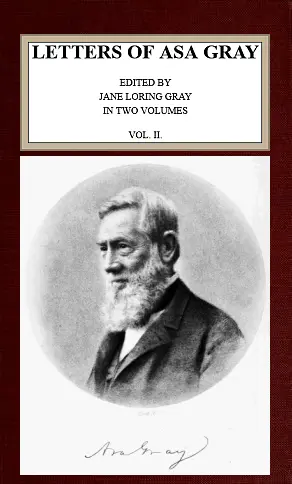
Asa Gray
Asa Gray
Florence Nightingale
Elizabeth Robins Pennell
Denison Olmsted