THE CLASSIC COLLECTION✦An outlaw’s diary: the CommuneCLASSIC FREE BOOKS
An outlaw’s diary: the Commune
Cécile Tormay
THE CLASSIC COLLECTION · 1918
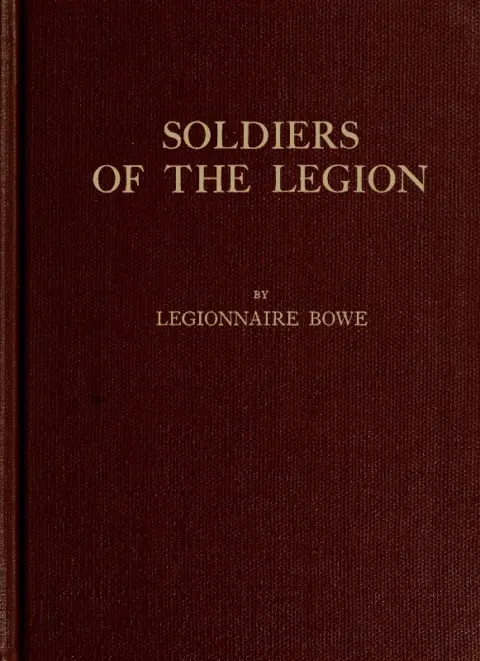
"Soldiers of the Legion, Trench-Etched" by John Bowe is a historical account written in the early 20th century. This narrative sheds light on the experiences of American volunteers who enlisted in the French Foreign Legion during World War I, aiming to capture the essence of camaraderie, sacrifice, and the diverse backgrounds of the legionnaires. The author, a veteran himself, aims to provide both a personal and broader view of these soldiers' motivations and encounters on the battlefield. At the start of the book, Bowe introduces his own journey as he prepares to join the Foreign Legion in France. He recounts his initial experiences at the Hotel des Invalides in Paris, where a mix of international soldiers undergoes intense training amid the backdrop of an advancing German army. The narrative emphasizes the harsh conditions, the diverse personalities present, and the immediate need for men at the front, ultimately highlighting the strong sense of unity and equality among the legionnaires, despite their varied origins. As Bowe transitions into his training, the opening sets the stage for a gripping exploration of war, identity, and the shared human experience amidst the chaos of conflict.
Introduction adapted from the source catalogue; source summaries may be automatically generated.
Free to read · English · 44,707 words · No account needed
MAKE TIME FOR A GOOD BOOK
On by default. Untick to stop anonymous reading totals. Each page counts after 10 seconds in view. How this works.
Anonymous counting is on unless you have switched it off.
On February 18th, at Noyon, when the Germans were compelled to retreat, in addition to burning, wrecking and looting, they carried away by force fifty young girls between fourteen and twenty-one years of age. They looted the American Relief store, dynamited the building, then turned the canal water into the basement.
From Roubaix, Turcoing and Lille 25,000 civilians were deported.
“These slave raids commenced, April 22, 1916, at 3 o’clock in the morning. Troops, with fixed bayonets, barred the streets, machine guns commanded the roads, against unarmed people. Soldiers made their way into the houses, officers pointed out the people who were to go. Half an hour later, everybody was driven, pell-mell, into an adjacent factory, from then to the station, whence they departed.” Taken from the Yellow Book, published by the Minister of War, dated June 30, 1916.
At Warsage, August 4, 1914, the day Belgium was violated, three civilians were shot, six hanged, nine murdered.
At Luneville, eighteen civilians were killed, including one boy of twelve, shot, and an old woman of ninety-eight, bayoneted.
At Liege, twenty-nine civilians were murdered, some shot and others bayoneted—yet others burned alive.
At Seilles, fifty civilians were killed.
At Audenne, August 20 and 21, 1914, 250 civilians were killed, according to French records, while General Von Bulow, over his own signature, in a written order to the people of Liege, dated August 22, says that he commanded the town to be reduced to ashes and ordered 110 persons shot.
The process of terrorism is invariably the same:—First, the crushing blow of invasion, followed by pillage, rape and murder; then, when the victims are paralyzed, crushed in spirit, shocked to the heart’s core, obnoxious regulations are published and enforced to prevent their recuperating.
At La Fontenelle, Ban de Sept, and many other villages along the front, manure had been thrown into the wells, the fruit trees were cut down, the copper was taken from coffins of the dead, the farm houses were demolished, and all property was taken away or destroyed. One would not pay $10 for the whole outfit of a peasant farmer’s home: table, a half dozen chairs, a bedstead in the corner, a crucifix hanging on the wall, a marriage certificate and a picture of the virgin, yet all was gone. The ammunition trains that came up from Germany went back loaded with such poor people’s belongings. Nothing left, an old woman’s bonnet on a dung-heap, a baby’s shoe in a corner, a broken picture frame or two—that’s all.
Your reading position is saved on this browser. Take it to another device with a library code. Reading pages adapt to text, rather than matching a printed edition.
BEHIND THE BOOK
This eBook is for the use of anyone anywhere in the United States and most other parts of the world at no cost and with almost no restrictions whatsoever. You may copy it, give it away or re-use it under the terms of the Project Gutenberg License included with this eBook or online at www.gutenberg.org. If you are not located in the United States, you will have to check the laws of the country where you are located before using this eBook. Read the source licence.
The original source file, including credits and licence, is retained by this library. Request an original-format copy at no charge. Please include the book title and Project Gutenberg identifier #54057.
KEEP YOUR CURIOSITY GOING
Cécile Tormay

Moritz Busch
John L. Ransom
Frances Wright
Cécile Tormay

Mabel Potter Daggett