THE CLASSIC COLLECTION✦An outlaw’s diary: the CommuneCLASSIC FREE BOOKS
An outlaw’s diary: the Commune
Cécile Tormay
THE CLASSIC COLLECTION · 1918
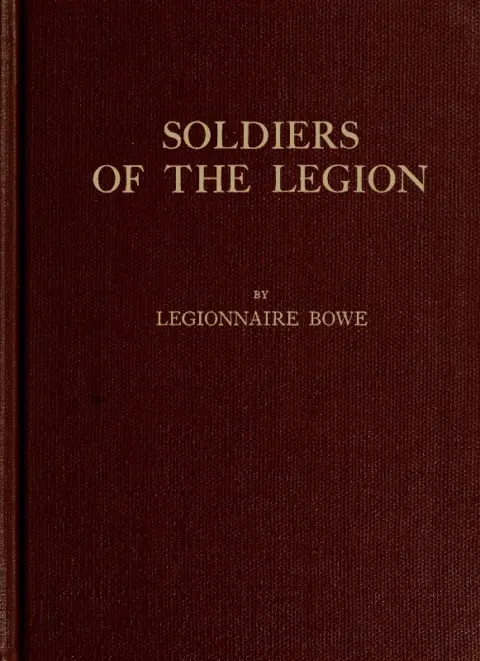
"Soldiers of the Legion, Trench-Etched" by John Bowe is a historical account written in the early 20th century. This narrative sheds light on the experiences of American volunteers who enlisted in the French Foreign Legion during World War I, aiming to capture the essence of camaraderie, sacrifice, and the diverse backgrounds of the legionnaires. The author, a veteran himself, aims to provide both a personal and broader view of these soldiers' motivations and encounters on the battlefield. At the start of the book, Bowe introduces his own journey as he prepares to join the Foreign Legion in France. He recounts his initial experiences at the Hotel des Invalides in Paris, where a mix of international soldiers undergoes intense training amid the backdrop of an advancing German army. The narrative emphasizes the harsh conditions, the diverse personalities present, and the immediate need for men at the front, ultimately highlighting the strong sense of unity and equality among the legionnaires, despite their varied origins. As Bowe transitions into his training, the opening sets the stage for a gripping exploration of war, identity, and the shared human experience amidst the chaos of conflict.
Introduction adapted from the source catalogue; source summaries may be automatically generated.
Free to read · English · 44,707 words · No account needed
MAKE TIME FOR A GOOD BOOK
On by default. Untick to stop anonymous reading totals. Each page counts after 10 seconds in view. How this works.
Anonymous counting is on unless you have switched it off.
In 1913 Lieut. Von Forstner of the 91st German Regiment used abusive language and insulted the French flag, while warning the Alsatian conscripts against listening to French agents, who the Germans claimed were inducing men to join the Foreign Legion.
On Nov. 29, 1913, at Severne near the Rhine-Marne Canal, the civilians assembled in protest. The soldiers charged the crowd, arrested the Mayor, two judges, and a dozen other prominent citizens; who in response to the universal demand of the population were later released,—while the officers responsible for the outrage were court-martialed and acquitted.
A short time afterward Lieut. Von Forstner had a dispute with a lame shoemaker and cut him down with his sword.
This brutal act resulted in the officer being again court-martialed for wounding an unarmed civilian. Sentenced to a year’s imprisonment, said sentence was annulled by a higher court, who claimed that he acted in “supposed self defense.”
The demand for justice caused by the injustice of the decision was so loud and threatening that the Reichstag was compelled to investigate the matter. For the first time in the German Empire a vote of censure was passed on the Government, 293 to 54.
This vote, which challenged the supremacy of the military dynasty, together with the refusal of the Social Democrats in the Reichstag to stand up and cheer the Kaiser, was one of the determining factors that helped bring on the war.
In the spring of 1915 the Foreign Legion in Europe consisted of four regiments. In November, the small nucleus gathered about the 1st Regiment was all that remained of those splendid men.
The 2nd Regiment, after passing the winter of 1914-15 at Croanelle in front of Croane, went into the Champagne attack, September 25, 1915, with 3,200. October 28th but 825 survived. These were merged into the 1st Regiment.
The 3rd Regiment, officered by Parisian firemen, had a very brief and sanguinary existence, and later were merged into the 1st Regiment.
The 4th Regiment, the Garibaldeans, 4,000 strong, after a famous bayonet attack in Argonne, captured three lines of trenches, losing half their effectives, including the two Garibaldi brothers, Bruno and Peppino. The survivors went to Italy to aid their own country, upon her entry into the war.
Many English, Russians, Italians, Belgians went home during that summer. When Legionnaires marched inside the long range of heavy German guns, with attacks and counter-attacking machine gun emplacements, with wire entanglements in front, which, owing to shortage of artillery, could not be blown up or destroyed, but must be hand-cut, or crawled through, is it any wonder they were scattered? Killed, missing, the hillsides were dotted with their graves; their wounded were in every hospital.
Your reading position is saved on this browser. Take it to another device with a library code. Reading pages adapt to text, rather than matching a printed edition.
BEHIND THE BOOK
This eBook is for the use of anyone anywhere in the United States and most other parts of the world at no cost and with almost no restrictions whatsoever. You may copy it, give it away or re-use it under the terms of the Project Gutenberg License included with this eBook or online at www.gutenberg.org. If you are not located in the United States, you will have to check the laws of the country where you are located before using this eBook. Read the source licence.
The original source file, including credits and licence, is retained by this library. Request an original-format copy at no charge. Please include the book title and Project Gutenberg identifier #54057.
KEEP YOUR CURIOSITY GOING
Cécile Tormay

Moritz Busch
John L. Ransom
Frances Wright
Cécile Tormay

Mabel Potter Daggett