THE CLASSIC COLLECTION✦An outlaw’s diary: the CommuneCLASSIC FREE BOOKS
An outlaw’s diary: the Commune
Cécile Tormay
THE CLASSIC COLLECTION · 1918
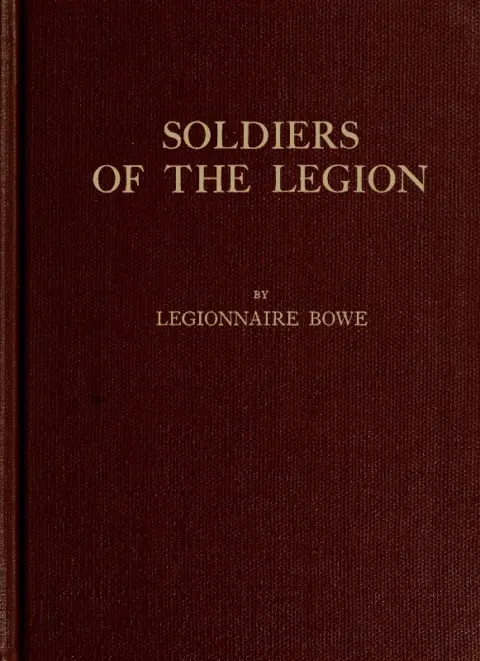
"Soldiers of the Legion, Trench-Etched" by John Bowe is a historical account written in the early 20th century. This narrative sheds light on the experiences of American volunteers who enlisted in the French Foreign Legion during World War I, aiming to capture the essence of camaraderie, sacrifice, and the diverse backgrounds of the legionnaires. The author, a veteran himself, aims to provide both a personal and broader view of these soldiers' motivations and encounters on the battlefield. At the start of the book, Bowe introduces his own journey as he prepares to join the Foreign Legion in France. He recounts his initial experiences at the Hotel des Invalides in Paris, where a mix of international soldiers undergoes intense training amid the backdrop of an advancing German army. The narrative emphasizes the harsh conditions, the diverse personalities present, and the immediate need for men at the front, ultimately highlighting the strong sense of unity and equality among the legionnaires, despite their varied origins. As Bowe transitions into his training, the opening sets the stage for a gripping exploration of war, identity, and the shared human experience amidst the chaos of conflict.
Introduction adapted from the source catalogue; source summaries may be automatically generated.
Free to read · English · 44,707 words · No account needed
MAKE TIME FOR A GOOD BOOK
On by default. Untick to stop anonymous reading totals. Each page counts after 10 seconds in view. How this works.
Anonymous counting is on unless you have switched it off.
=G. Casmese=, real friend, old soldier of the Legion, got mixed up and
disappeared in the quick-acting movements of these chain-lightning
times.
=Russell A. Kelly=, son of a New York stock broker, went through the hard and early fighting and was killed at Givenchy, June 17, 1915. His father, a true descendant of the Isle of Unrest, on hearing the news said,—“He did his duty—I do not complain.”
=John Huffert=, New York, would not drive a motor car in the rear, so he scrambled out on top. In an aeroplane, he became the hero of several desperate battles above.
=John Roxas=, Manila, Philippine Islands, son of the largest land owner in the Philippines, having absorbed American freedom, he is carrying it to Germany.
=William E. Dugan=, 27 years old, Rochester, New York, graduate of Massachusetts Institute of Technology, joined the Legion, Sept. 19, 1914, changed to aviation, October 15, 1915. Decorated with Croix de Guerre, wounded at Verdun.
=Kenneth Proctor Littaner=, Sergeant in military life, poet in civil life, decorated and cited, as follows:—
“A good pilot, brave, devoted to duty, an excellent soldier, invariably showing energy and coolness, especially on Feb. 8, 1917, in course of an engagement with a German machine, his aeroplane hit in several places, he compelled his adversary to retreat.”
=Narutz=, an American philosopher, a serious personage, went through the hard fighting of 1915 and was killed on the Somme in July, 1916.
=Norman Prince=, Boston, Mass., a Harvard man of splendid character, was descending in the early darkness at Corceuix, when his machine ran into a telegraph wire and tipped. Taken to Gerardmer, while lying unconscious, the Legion of Honor was pinned to his breast alongside of the Croix de Guerre and the Medaille Militaire. That day he had brought down a Boche machine, the third he had accounted for. Cited as follows:—
“=Prince=, Sergeant, Pilot in Squadron V. B. 108:—An American citizen, who enlisted for the duration of the war; excellent military pilot who always shows proof of the greatest audacity and presence of mind;—ever impatient to start, he has executed numerous expeditions of bombardment, particularly successful in a region which was difficult in consequence of the firing of the enemy’s artillery, by which his aeroplane was frequently hit.”
Killed October 15, 1916.
=Fred Prince=, brother of Norman, is now in the aviation, while the father, Mr. Prince, is one of the best friends of the Foreign Legion boys, and they, like France, do not forget.
=Dr. Van Vorst=, from the middle west, a Spanish War veteran in America, adjutant in the Foreign Legion. He introduced new sanitary ideas into the camps of repose and kept the stretcher bearers busy cleaning up.
Your reading position is saved on this browser. Take it to another device with a library code. Reading pages adapt to text, rather than matching a printed edition.
BEHIND THE BOOK
This eBook is for the use of anyone anywhere in the United States and most other parts of the world at no cost and with almost no restrictions whatsoever. You may copy it, give it away or re-use it under the terms of the Project Gutenberg License included with this eBook or online at www.gutenberg.org. If you are not located in the United States, you will have to check the laws of the country where you are located before using this eBook. Read the source licence.
The original source file, including credits and licence, is retained by this library. Request an original-format copy at no charge. Please include the book title and Project Gutenberg identifier #54057.
KEEP YOUR CURIOSITY GOING
Cécile Tormay

Moritz Busch
John L. Ransom
Frances Wright
Cécile Tormay

Mabel Potter Daggett