THE CLASSIC COLLECTION✦An outlaw’s diary: the CommuneCLASSIC FREE BOOKS
An outlaw’s diary: the Commune
Cécile Tormay
THE CLASSIC COLLECTION · 1918
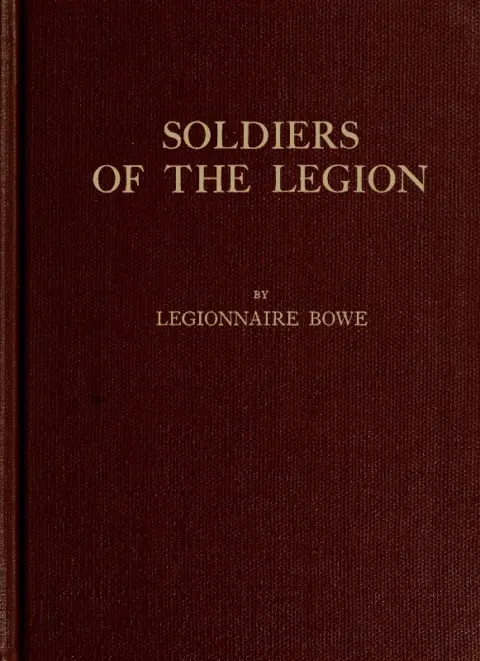
"Soldiers of the Legion, Trench-Etched" by John Bowe is a historical account written in the early 20th century. This narrative sheds light on the experiences of American volunteers who enlisted in the French Foreign Legion during World War I, aiming to capture the essence of camaraderie, sacrifice, and the diverse backgrounds of the legionnaires. The author, a veteran himself, aims to provide both a personal and broader view of these soldiers' motivations and encounters on the battlefield. At the start of the book, Bowe introduces his own journey as he prepares to join the Foreign Legion in France. He recounts his initial experiences at the Hotel des Invalides in Paris, where a mix of international soldiers undergoes intense training amid the backdrop of an advancing German army. The narrative emphasizes the harsh conditions, the diverse personalities present, and the immediate need for men at the front, ultimately highlighting the strong sense of unity and equality among the legionnaires, despite their varied origins. As Bowe transitions into his training, the opening sets the stage for a gripping exploration of war, identity, and the shared human experience amidst the chaos of conflict.
Introduction adapted from the source catalogue; source summaries may be automatically generated.
Free to read · English · 44,707 words · No account needed
MAKE TIME FOR A GOOD BOOK
On by default. Untick to stop anonymous reading totals. Each page counts after 10 seconds in view. How this works.
Anonymous counting is on unless you have switched it off.
Hoskier fell while he and his companion were fighting six Boche machines. He and two Boche fell among the advancing English troops and were all killed, April 24, 1917.
Cited in General Orders of the French Army: “Sergeant Ronald Wood Hoskier, an American, who volunteered for service in the French Army. He showed splendid conduct and self-sacrifice. He fell on April 23, 1917, after defending himself heroically against three enemy machines.”
=Paul Perigord=, college professor, formerly an instructor in St. Paul Seminary, later a parish priest at Olivia, Minn., went to France and into the trenches at the outbreak of hostilities. Cited four times in army orders, decorated with the Croix de Guerre, promoted to a Lieutenancy in the 14th Regiment of the Line. Later, he returned to America on a patriotic lecturing mission.
=Victor Chapman=, son of John Jay Chapman, was one of the splendid fellows that it was a pleasure to meet and never to forget. Changing from the Legion to the Aviation he was killed near Verdun, June 23, 1916, in a battle with French comrades against German machines. The “Petit Parisian” headline announcing the event, said: “The king of the air dies like a king.”
Harvard University students have raised a fund, known as the Victor Chapman Scholarship Fund, of $25,000, bearing interest of $1,000 a year, which is set aside for the education of a worthy French student. A young man from Lyons is at present at Harvard, perpetuating and cementing the ties for which Chapman gave his life.
=Eugene Galliard=, Minneapolis, Minn., served two years in the trenches, twice wounded, was mustered out as a lieutenant and returned to America.
=John Huffer=, an American of the Legion, was decorated with the Medaille Militaire, and the Croix de Guerre, with five citations, four being palms.
=Bennet Moulter=, an American, went from Mexico to France, changed his animosity from Caranza to the Kaiser; and was seriously wounded July, 1917.
=Christopher Charles=, of Brooklyn, New York, 21 years old, machine gun operator, has been in all attacks since September, 1914. He was decorated with the Croix de Guerre at Chalons, July 14, 1917. At Bordeaux, I met his marraine (godmother), who said,—“Yes, I know Christopher Charles. I met him when he was wounded in hospital here. That boy is an American. His place is in his own country now. I will get him out of the Legion if I have to go to Washington to do it.”
=Norman Barclay=, New York City, formerly of Long Island, aviator, was killed by aeroplane, nose diving. Had two years’ service on the front before being snuffed out. Killed June 22, 1917.
Your reading position is saved on this browser. Take it to another device with a library code. Reading pages adapt to text, rather than matching a printed edition.
BEHIND THE BOOK
This eBook is for the use of anyone anywhere in the United States and most other parts of the world at no cost and with almost no restrictions whatsoever. You may copy it, give it away or re-use it under the terms of the Project Gutenberg License included with this eBook or online at www.gutenberg.org. If you are not located in the United States, you will have to check the laws of the country where you are located before using this eBook. Read the source licence.
The original source file, including credits and licence, is retained by this library. Request an original-format copy at no charge. Please include the book title and Project Gutenberg identifier #54057.
KEEP YOUR CURIOSITY GOING
Cécile Tormay

Moritz Busch
John L. Ransom
Frances Wright
Cécile Tormay

Mabel Potter Daggett