THE CLASSIC COLLECTION✦An outlaw’s diary: the CommuneCLASSIC FREE BOOKS
An outlaw’s diary: the Commune
Cécile Tormay
THE CLASSIC COLLECTION · 1918
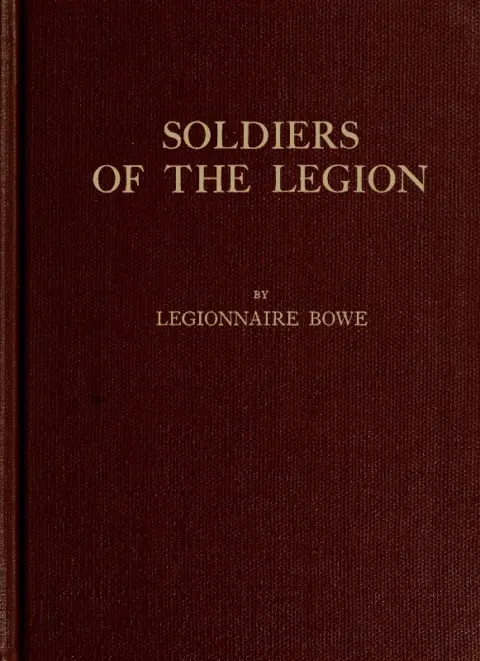
"Soldiers of the Legion, Trench-Etched" by John Bowe is a historical account written in the early 20th century. This narrative sheds light on the experiences of American volunteers who enlisted in the French Foreign Legion during World War I, aiming to capture the essence of camaraderie, sacrifice, and the diverse backgrounds of the legionnaires. The author, a veteran himself, aims to provide both a personal and broader view of these soldiers' motivations and encounters on the battlefield. At the start of the book, Bowe introduces his own journey as he prepares to join the Foreign Legion in France. He recounts his initial experiences at the Hotel des Invalides in Paris, where a mix of international soldiers undergoes intense training amid the backdrop of an advancing German army. The narrative emphasizes the harsh conditions, the diverse personalities present, and the immediate need for men at the front, ultimately highlighting the strong sense of unity and equality among the legionnaires, despite their varied origins. As Bowe transitions into his training, the opening sets the stage for a gripping exploration of war, identity, and the shared human experience amidst the chaos of conflict.
Introduction adapted from the source catalogue; source summaries may be automatically generated.
Free to read · English · 44,707 words · No account needed
MAKE TIME FOR A GOOD BOOK
On by default. Untick to stop anonymous reading totals. Each page counts after 10 seconds in view. How this works.
Anonymous counting is on unless you have switched it off.
=R. Hard=, Rosebank, Staten Island, New York, having only one eye, went into the gas manufacturing works, and commenced to fill gas shells with a bicycle pump. Gradually, the business developed till ten men could turn out 1,875 shells every ten hours. A thin, wiry man, the gas fumes affected his heart. Stout men get the poison in the lungs.
=Henry La Grange= went to France at the outbreak of war and was ordered to the Foreign Legion: “No,” he said, “I want to go to my grandfather’s regiment, the 8th. If I can’t join that I will not go at all.” His great-grandfather had fought in Egypt. The grandson, following the old man’s footsteps, rose to the rank of sergeant. He was decorated with the Croix de Guerre and, later, detailed to America to instruct the growing army in artillery observation.
=Mjojlo Milkovich=, of San Francisco, Cal., a professional boxer, left the Golden West with $6,000 in his pocket and an elaborate wardrobe. He was torpedoed in the “Brindisti” and, after five hours in the water, reached shore, naked as the day he was born. At Corfu, Greece, he joined the French Army, was wounded on the Bulgarian front and tended in the Scottish Woman’s Hospital at Salonica. After his recovery he went direct to the front, and, again severely wounded, was sent to France. At quarters one day he accosted me:
“What, you understand English?” “Yes.”
“Are you an American?”
“Yes.”
“So am I,—can’t speak a word of French.”
The three main cords of his leg were severed by shell splinters. He chafed at the slow hospital life, and, every second day, he pounded the doctors on the back.
“Why don’t you let me go back to America? You have got my leg, you know I can never march again. Why don’t you let me go home?” He was decorated with the Croix de Guerre, with the following citation: “A very good soldier, seriously wounded, advancing resolutely to attack a village very strongly fortified.”
I asked him what he saw down in the Balkans.
“I saw enough—so that I’ll never forget it.”
“Well what did you see?”
“I saw enough to make me sick.”
“Well, what did you see?”
“I saw boys seven and eight years old with throats cut.”
“How many did you see?”
“Seven or eight at least.”
“What else?”
“I saw young girls who tried to protect themselves with faces streaked with knife wounds—some had their noses cut off.”
“What else did you see?”
“I saw old women laying in corners dying of hunger—I saw others out in the fields eating grass.”
Your reading position is saved on this browser. Take it to another device with a library code. Reading pages adapt to text, rather than matching a printed edition.
BEHIND THE BOOK
This eBook is for the use of anyone anywhere in the United States and most other parts of the world at no cost and with almost no restrictions whatsoever. You may copy it, give it away or re-use it under the terms of the Project Gutenberg License included with this eBook or online at www.gutenberg.org. If you are not located in the United States, you will have to check the laws of the country where you are located before using this eBook. Read the source licence.
The original source file, including credits and licence, is retained by this library. Request an original-format copy at no charge. Please include the book title and Project Gutenberg identifier #54057.
KEEP YOUR CURIOSITY GOING
Cécile Tormay

Moritz Busch
John L. Ransom
Frances Wright
Cécile Tormay

Mabel Potter Daggett