
The Writing of News A Handbook with Chapters on Newspaper Correspondence and Copy Reading
Charles G. (Charles Griffith) Ross
THE CLASSIC COLLECTION · 1897
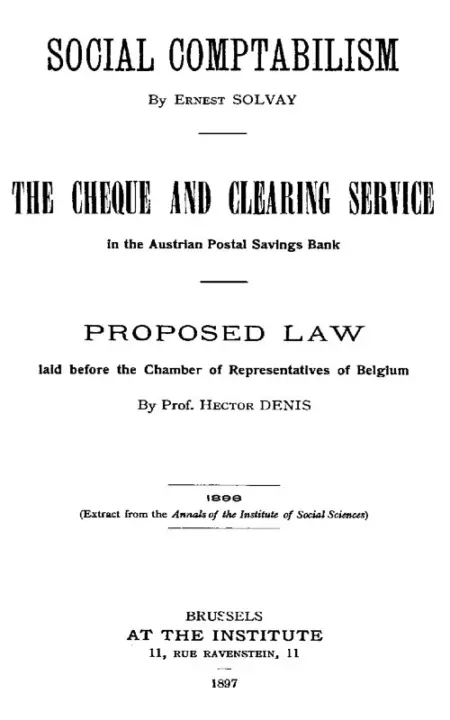
"Social Comptabilism" by Ernest Solvay is a scientific publication written in the late 19th century. The work explores the theoretical foundation of a new economic system that proposes replacing traditional money with a system of bookkeeping transactions, which it claims could offer significant advantages without the disadvantages of currency. The primary focus lies in analyzing how transactions could function without the necessity of money, emphasizing the idea of maintaining records of value and credit through a system referred to as “social comptabilism.” The opening of the work introduces the concept of replacing money with an account-keeping system that theoretically would allow for transactions to be conducted without physical currency. Solvay begins by discussing the role of money in society, arguing that it is mainly beneficial for commercial transactions and is not strictly necessary for all individuals. He posits that if transactions could be recorded legally and efficiently in a bookkeeping manner, money itself could become obsolete. The text outlines the theoretical implications of such a system, suggesting that it could simplify trade and improve economic relations without the complications brought about by the fluctuations of monetary value. The work aims to lay the groundwork for a practical application of these ideas, including examples from existing systems in Austria.
Introduction adapted from the source catalogue; source summaries may be automatically generated.
Free to read · English · 31,761 words · No account needed
MAKE TIME FOR A GOOD BOOK
On by default. Untick to stop anonymous reading totals. Each page counts after 10 seconds in view. How this works.
Anonymous counting is on unless you have switched it off.
[1] Post Office Savings Bank.
[2] Advice with reference to an order for repayment.
[3] Payable to....
[4] In the Post Office designated on the back.
[5] Paid.
[6] To be paid without Savings Book.
[7] Post Office Savings Bank.
[8] Order for repayment.
[9] Valid during two months.
[10] The Post Office.
[11] Pay on this order to....
[12] The sum of....
[13] Paid.
[14] In acknowledgement of the receipt of the above sum.
[15] Date.]
The importance of these payments is not considerable as is seen by the
following figures:
1884 99,942 florins.
1885 374,697 "
1886 445,338 "
1887 844,978 "
1888 887,037 "
1889 955,019 "
1890 1,274,607 "
1891 1,091,839 "
1892 1,149,872 "
1893 1,685,791 "
1894 1,697,270 "
1895 1,865,919 "
Fifthly.
The Postal Savings Bank pays in the same way on account of the adherents of the cheque and clearing service, bills, signed bonds, accounts admitted and approved. Bills of exchange are settled at the Postal Office at Vienna. In order to realize their payment, the holder of an account draws a cheque for the amount of the bill and writes on the back: for payment of the bill herein refered to. He indicates the date of its falling due and puts his signature below these remarks. This cheque is sent to the Postal Office at Vienna before the bill falls due. It can be addressed also to the possessor of the bill, who will present it at the date it is due to the Postal pay Office with at the same time his claim. If the possessor of the bill is himself affiliated to the cheque service he can have the bill put to the credit of his account.
The degree of importance of this branch is indicated by the following
figures:
1885 406,451 florins
1886 1,522,404 "
1887 1,877,602 "
1888 3,053,419 "
1889 2,823,845 "
1890 3,436,795 "
1891 4,564,179 "
1892 6,183,954 "
1893 7,343,438 "
1894 7,917,723 "
1895 8,818,997 "
From this it will be seen that during the last five years the movement has so accelerated that the amount has in the interval nearly doubled.
Sixthly.
Here the system presents to us its highest degree of interest: the possessors of account books, adherents of the clearing service, can discharge their debts one to the other by the transfer of accounts. It is sufficient to write at the back of the cheque: to be carried to the credit of account N^o ..., with the name of the holder of the account and his address. In this case the amount of the cheque is placed to the debit of the person who issued it and to the credit of the person in whose favour it is drawn.
The two holders of accounts at the Savings Bank are immediately
informed of this transfer by the sending of the extract of their
accounts.
Your reading position is saved on this browser. Take it to another device with a library code. Reading pages adapt to text, rather than matching a printed edition.
BEHIND THE BOOK
This eBook is for the use of anyone anywhere in the United States and most other parts of the world at no cost and with almost no restrictions whatsoever. You may copy it, give it away or re-use it under the terms of the Project Gutenberg License included with this eBook or online at www.gutenberg.org. If you are not located in the United States, you will have to check the laws of the country where you are located before using this eBook. Read the source licence.
The original source file, including credits and licence, is retained by this library. Request an original-format copy at no charge. Please include the book title and Project Gutenberg identifier #45824.
KEEP YOUR CURIOSITY GOING
Charles G. (Charles Griffith) Ross
Hannah Webster Foster

Emily Lawless
Edwin Hamlin Carr

Charles De Lano Hine
Andrew Ure