
The Writing of News A Handbook with Chapters on Newspaper Correspondence and Copy Reading
Charles G. (Charles Griffith) Ross
THE CLASSIC COLLECTION · 1897
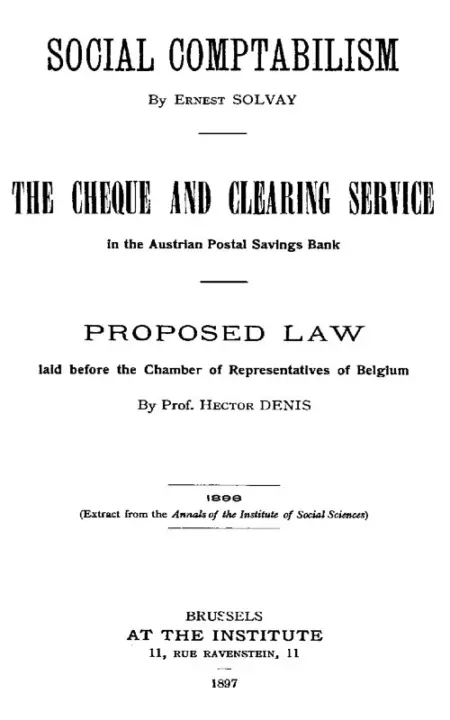
"Social Comptabilism" by Ernest Solvay is a scientific publication written in the late 19th century. The work explores the theoretical foundation of a new economic system that proposes replacing traditional money with a system of bookkeeping transactions, which it claims could offer significant advantages without the disadvantages of currency. The primary focus lies in analyzing how transactions could function without the necessity of money, emphasizing the idea of maintaining records of value and credit through a system referred to as “social comptabilism.” The opening of the work introduces the concept of replacing money with an account-keeping system that theoretically would allow for transactions to be conducted without physical currency. Solvay begins by discussing the role of money in society, arguing that it is mainly beneficial for commercial transactions and is not strictly necessary for all individuals. He posits that if transactions could be recorded legally and efficiently in a bookkeeping manner, money itself could become obsolete. The text outlines the theoretical implications of such a system, suggesting that it could simplify trade and improve economic relations without the complications brought about by the fluctuations of monetary value. The work aims to lay the groundwork for a practical application of these ideas, including examples from existing systems in Austria.
Introduction adapted from the source catalogue; source summaries may be automatically generated.
Free to read · English · 31,761 words · No account needed
MAKE TIME FOR A GOOD BOOK
On by default. Untick to stop anonymous reading totals. Each page counts after 10 seconds in view. How this works.
Anonymous counting is on unless you have switched it off.
Statistics distinguish these three categories of cheques and enable us
to follow their movement.
Payments effected
By cheques By cheques to particular persons By foreign payable to bearer paid at the Post Post Office (Cassa checks)[I] Offices[J] Orders[K]
1884 13,639,555 25,791,497 83,834 1885 78,375,622 132,053,520 777,914 1886 141,052,319 220,198,781 1,420,668 1887 178,365,871 278,559,689 1,583,098 1888 180,295,982 280,241,673 1,705,948 1889 223,060,247 303,720,753 2,008,593 1890 271,660,264 335,293,896 2,469,268 1891 318,239,728 361,727,429 2,611,044 1892 347,410,842 398,456,797 2,558,398 1893 386,027,972 437,492,243 2,590,614 1894 433,377,459 472,345,574 3,028,639 1895 463,540,198 524,212,798 3,781,586
It will be seen that in the last ten years the movement of the cheques payable to bearer has been more rapid than that of cheques paid at the post offices; the amount of the former has more than tripled.
Fourthly.
The possessors of cheque books can cause purchases to be made by the Post Office in the public funds up to the amount of their account. The order ought to be explained by the transmission of a cheque of a value corresponding to that of the stocks to be bought. The rights acquired by the Post Office will either be sent on to the purchaser of the stocks, or at his request kept by the Office and under its guarantee. The Office banks the dividend warrants on their payments and places them to the credit of its client unless he requires them to be sent to him or the money remitted.
[Illustration: FIGURE IV.
[1]K. k. Postsparcassen-Amt in Wien
[2]Aviso
über eine Zahlungsanweisung
N^o ddto
per
[3]zahlbar an
[4]bei dem aus der Aussenseite bezeichneten Postamte.
[5]Ausgezahlt:
[6]Ohne Büchel auszuzahlen.
D.S. Nr. 8 II (21.) ex 96
------------------------------------------
Coupon |
|
| für Rechnung
|
| von der Partei
| abzutrennen.
[7]K. k. Postsparcassen-Amt in Wien.
[8]Zahlungs-Anweisung.
N^o
[9](2 Monate giltig.)
[10]Das k. k. Postamt
[11]zahlt gegen diese Anweisung an:
[12]den Betrag von
====================================================================== | [13]Ausgezahlt: | [14]Den obigen Betrag empfangen | | zu haben bestätigt: | | | | | | [15]Datum. | | | | | |
Your reading position is saved on this browser. Take it to another device with a library code. Reading pages adapt to text, rather than matching a printed edition.
BEHIND THE BOOK
This eBook is for the use of anyone anywhere in the United States and most other parts of the world at no cost and with almost no restrictions whatsoever. You may copy it, give it away or re-use it under the terms of the Project Gutenberg License included with this eBook or online at www.gutenberg.org. If you are not located in the United States, you will have to check the laws of the country where you are located before using this eBook. Read the source licence.
The original source file, including credits and licence, is retained by this library. Request an original-format copy at no charge. Please include the book title and Project Gutenberg identifier #45824.
KEEP YOUR CURIOSITY GOING
Charles G. (Charles Griffith) Ross
Hannah Webster Foster

Emily Lawless
Edwin Hamlin Carr

Charles De Lano Hine
Andrew Ure