
The Writing of News A Handbook with Chapters on Newspaper Correspondence and Copy Reading
Charles G. (Charles Griffith) Ross
THE CLASSIC COLLECTION · 1897
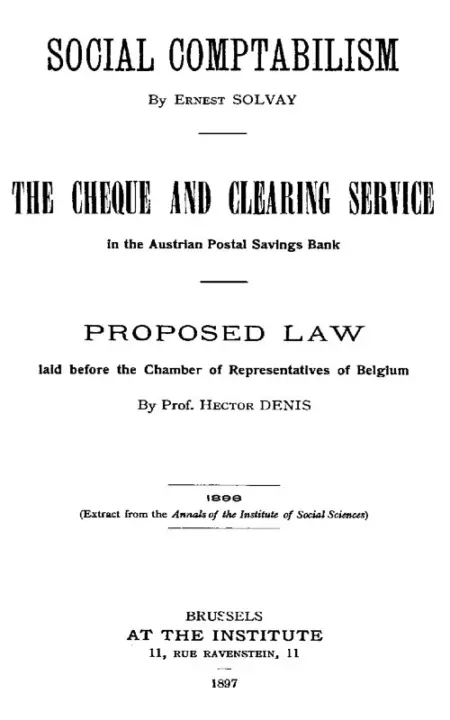
"Social Comptabilism" by Ernest Solvay is a scientific publication written in the late 19th century. The work explores the theoretical foundation of a new economic system that proposes replacing traditional money with a system of bookkeeping transactions, which it claims could offer significant advantages without the disadvantages of currency. The primary focus lies in analyzing how transactions could function without the necessity of money, emphasizing the idea of maintaining records of value and credit through a system referred to as “social comptabilism.” The opening of the work introduces the concept of replacing money with an account-keeping system that theoretically would allow for transactions to be conducted without physical currency. Solvay begins by discussing the role of money in society, arguing that it is mainly beneficial for commercial transactions and is not strictly necessary for all individuals. He posits that if transactions could be recorded legally and efficiently in a bookkeeping manner, money itself could become obsolete. The text outlines the theoretical implications of such a system, suggesting that it could simplify trade and improve economic relations without the complications brought about by the fluctuations of monetary value. The work aims to lay the groundwork for a practical application of these ideas, including examples from existing systems in Austria.
Introduction adapted from the source catalogue; source summaries may be automatically generated.
Free to read · English · 31,761 words · No account needed
MAKE TIME FOR A GOOD BOOK
On by default. Untick to stop anonymous reading totals. Each page counts after 10 seconds in view. How this works.
Anonymous counting is on unless you have switched it off.
The cheques which have this destination are properly speaking clearing cheques not intended to be paid in species; but it may happen that a cheque destined for a member, adherent to the clearing service has in an exceptional case to be paid in money; the person who has issued it will in that case have to make a note at the back of the document: Outside the clearing circulation.
The statistics show the growing importance of clearing cheques.
1884 1,620,102 florins
1885 40,271,880 "
1886 102,185,786 "
1887 150,479,085 "
1888 177,846,958 "
1889 216,683,156 "
1890 264,262,296 "
1891 310,141,924 "
1892 360,498,168 "
1893 414,342,892 "
1894 445,378,270 "
1895 482,031,950 "
It will be seen that in the last ten years, the amount has nearly quintupled. The pace of the movement is here more rapid than in cheques payable in cash.
The proportional relations of all the modes of disposing of the credit of the adherents of the cheques and clearing service show that in 1895 on a total of liquidations or payments of 1,484,251,488 florins, 32% were occasioned by transfers of accounts, 32% by cheques to bearer (cassa-checks), 35% by cheques to appointed persons, and the remainder by the other modes indicated.
The progress of the figures taken all round is as follows:
1883 213,239 florins
1884 41,234,429 "
1885 252,260,083 "
1886 466,807,297 "
1887 611,693,909 "
1888 643,718,457 "
1889 750,898,892 "
1890 877,975,829 "
1891 998,376,144 "
1892 1,116,258,031 "
1893 1,249,482,460 "
1894 1,363,744,935 "
1895 1,484,251,448 "
All this formidable account keeping is done strictly day by day. Three hundred employés are working at it constantly. Special employés who have acquired an extraordinary ability, verify the signatures on each occasion. The type signatures are classed alphabetically. Current-accounts are drawn up on loose sheets and not in books: this is considered a real progress for books are soon in tatters. On each occasion an extract of the account is sent to the party interested: every transfer entails the sending extracts to both parties interested. Envelopes with their names and addresses printed are classified in pigeon holes so as to be easily found. I join to this explanation some extracts from typical accounts. One shows a banking made by a post office, the other a transfer made between adherents to the clearing system. (Fig. V.)
The centralisation of all this vast account-keeping at the Central Office of the Savings Bank at Vienna is the basis of the system, the pledge of the regularity of the service and of the certainty of the control. Notwithstanding the inevitable complexity of operations and accounts, this complexity does not entail any really prejudicial delays[L]. The increasing figure of the operations is a proof of the growing favour of the public and is a testimony to the usefulness of the institution beyond all argument. The coefficient of error has been very slight and fraud has not been as yet able to succeed in causing trouble in the working of this admirable machinery of circulation.
Your reading position is saved on this browser. Take it to another device with a library code. Reading pages adapt to text, rather than matching a printed edition.
BEHIND THE BOOK
This eBook is for the use of anyone anywhere in the United States and most other parts of the world at no cost and with almost no restrictions whatsoever. You may copy it, give it away or re-use it under the terms of the Project Gutenberg License included with this eBook or online at www.gutenberg.org. If you are not located in the United States, you will have to check the laws of the country where you are located before using this eBook. Read the source licence.
The original source file, including credits and licence, is retained by this library. Request an original-format copy at no charge. Please include the book title and Project Gutenberg identifier #45824.
KEEP YOUR CURIOSITY GOING
Charles G. (Charles Griffith) Ross
Hannah Webster Foster

Emily Lawless
Edwin Hamlin Carr

Charles De Lano Hine
Andrew Ure