THE CLASSIC COLLECTION✦A dead man’s diaryCLASSIC FREE BOOKS
A dead man’s diary
Coulson Kernahan
THE CLASSIC COLLECTION · 1916
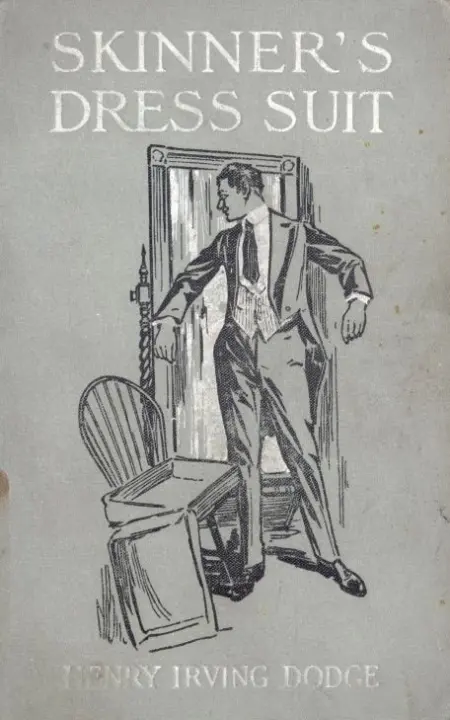
"Skinner's Dress Suit" by Henry Irving Dodge is a novel written in the early 20th century. The story revolves around the central character, Skinner, a cashier at McLaughlin & Perkins, who is trapped in his mundane job and longs for a raise to accommodate his wife's aspirations. The narrative explores themes of self-esteem, ambition, and the transformative power of outward appearances, particularly highlighted by Skinner's apprehensions and dreams associated with his desire for a dress suit. The opening of the book introduces Skinner, affectionately dubbed the "cage man" by messenger boys, who is gripped by anxiety over asking his boss for a raise. Skinner's fears stem not from physical intimidation, but from his internal struggle and fear of failure, as he has always strived to be a hero in the eyes of his supportive wife, Honey. The narrative captures his reluctance and reflections on their modest savings, the sacrifices Honey has made, and the pressure he feels to prove himself. Ultimately, the stage is set for Skinner's journey as he steps out of his comfort zone, seeking validation and transformation through the lens of social status and material success, embodied by the coveted dress suit.
Introduction adapted from the source catalogue; source summaries may be automatically generated.
Free to read · English · 26,756 words · No account needed
MAKE TIME FOR A GOOD BOOK
On by default. Untick to stop anonymous reading totals. Each page counts after 10 seconds in view. How this works.
Anonymous counting is on unless you have switched it off.
When Skinner entered the office of McLaughlin & Perkins, Inc., two days later, he found that the partners had arranged a reception committee of two to welcome him.
Both shook hands cordially and McLaughlin said, "Skinner, we're not only convinced that you're a thoroughly honest and methodical man"--he glanced knowingly at Perking--"but that you're a very able man as well. We--"
Skinner cut him short. "Mr. McLaughlin, do I get the ostrich feather?"
"You do, indeed,--and I'm only sorry that the great auk is dead!"
Skinner blushed. "You don't know how good you 've made me feel, really you don't--giving me this chance to show what I could do."
"You had your chance and you showed what you could do, all right," McLaughlin broke in. He paused, then, "Now, tell us, Skinner, how did you do it?"
Skinner hesitated. "I'd rather not."
"Why?" said McLaughlin. "Ain't you got it patented?"
"Secret process," said Skinner.
"It's more than that, it's an effective process. But what's
important to us, Skinner, is--could you work it on other folks besides
Jackson?"
"Yes--that is, most other men--middle-aged men."
"Why middle-aged men?"
"Because they're married--most middle-aged men are."
McLaughlin turned to Perkins. "I'm darned if he ain't gone and mashed the climber. That's what I think!"
Skinner thrust his hands into his pockets, walked over to the window, then turned and slowly came back to within a few feet of where McLaughlin was sitting.
"On my way back from St. Paul, Mr. McLaughlin," he said--and Perkins, recognizing the premonitory symptoms, crossed to the window and stood with his back to his partner and "the cage man"--"Mr. McLaughlin," Skinner repeated after a pause, "I've been thinking that the most valuable man to any concern is the one that gets the business for it."
"Right-o!" said McLaughlin.
"And the hardest man to get," Skinner went on, "is the customer you get back. You not only have to pry him loose from some other concern with better figures, but you have his personal pride to overcome. To come back is a surrender."
"All of which means that you expect a raise, eh, Skinner?"
"I was only going to suggest--"
"You don't have to suggest. We've already decided to raise you twenty-five dollars a week. How does that strike you? Just as a mark of appreciation."
Your reading position is saved on this browser. Take it to another device with a library code. Reading pages adapt to text, rather than matching a printed edition.
BEHIND THE BOOK
This eBook is for the use of anyone anywhere in the United States and most other parts of the world at no cost and with almost no restrictions whatsoever. You may copy it, give it away or re-use it under the terms of the Project Gutenberg License included with this eBook or online at www.gutenberg.org. If you are not located in the United States, you will have to check the laws of the country where you are located before using this eBook. Read the source licence.
The original source file, including credits and licence, is retained by this library. Request an original-format copy at no charge. Please include the book title and Project Gutenberg identifier #26080.
KEEP YOUR CURIOSITY GOING
Coulson Kernahan

Maurice Baring
Frances Wright
Cécile Tormay

Frederic Jesup Stimson

W. H. P. (William Henry Pope) Jarvis