THE CLASSIC COLLECTION✦A dead man’s diaryCLASSIC FREE BOOKS
A dead man’s diary
Coulson Kernahan
THE CLASSIC COLLECTION · 1916
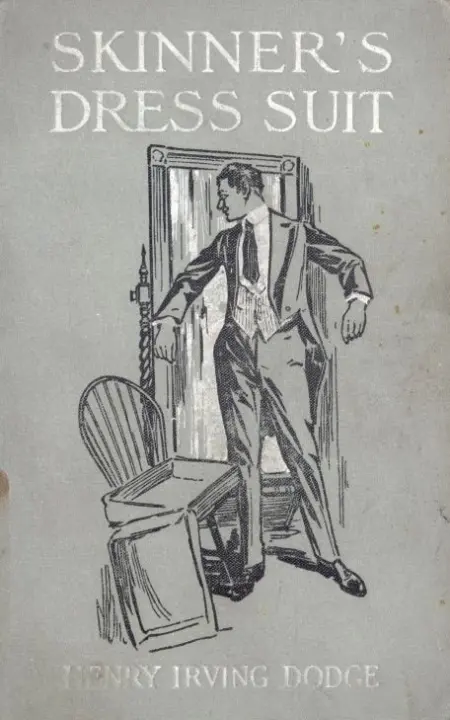
"Skinner's Dress Suit" by Henry Irving Dodge is a novel written in the early 20th century. The story revolves around the central character, Skinner, a cashier at McLaughlin & Perkins, who is trapped in his mundane job and longs for a raise to accommodate his wife's aspirations. The narrative explores themes of self-esteem, ambition, and the transformative power of outward appearances, particularly highlighted by Skinner's apprehensions and dreams associated with his desire for a dress suit. The opening of the book introduces Skinner, affectionately dubbed the "cage man" by messenger boys, who is gripped by anxiety over asking his boss for a raise. Skinner's fears stem not from physical intimidation, but from his internal struggle and fear of failure, as he has always strived to be a hero in the eyes of his supportive wife, Honey. The narrative captures his reluctance and reflections on their modest savings, the sacrifices Honey has made, and the pressure he feels to prove himself. Ultimately, the stage is set for Skinner's journey as he steps out of his comfort zone, seeking validation and transformation through the lens of social status and material success, embodied by the coveted dress suit.
Introduction adapted from the source catalogue; source summaries may be automatically generated.
Free to read · English · 26,756 words · No account needed
MAKE TIME FOR A GOOD BOOK
On by default. Untick to stop anonymous reading totals. Each page counts after 10 seconds in view. How this works.
Anonymous counting is on unless you have switched it off.
Honey went to the city with Skinner the next day, and during the lunch-hour a high-class tailor in the financial district measured Skinner for his dress suit. Honey had sensed from Dearie's protest the night of the "raise" that it would be hard to pry him loose from any more cash than the first ninety dollars, so she did n't try to--with words. She would let him convince himself. So, when the wonderful outfit arrived a few days later, and Skinner put it on, she pretended to admire the whole effect unqualifiedly.
"Beautiful!" she cried; "perfectly beautiful!"
But she chuckled to herself as she noted the look of perplexity that gradually came into Skinner's eyes as he regarded himself in the mirror.
"These clothes are very handsome," he said presently, "and they're a perfect fit--but the general effect does n't seem right."
Honey remained discreetly silent.
Presently Skinner turned to her with a suggestion of trouble in his eyes. "Say, Honey, what do dress shirts cost?"
"I don't know exactly. Four dollars, perhaps."
"Four dollars!" There was a suggestion of a snarl in Skinner's tone, the first she'd ever heard. "Four dollars!--the one I've got on only cost ninety cents."
"But that is n't a dress shirt, Dearie."
"No, you bet it is n't! But it's good enough for me!" Then with a touch of sarcasm in his tone, "I suppose a certain kind of collar and tie are necessary for a dress shirt?"
"A dollar would cover that."
"How many collars?" he almost shouted.
"One."
Another pause; then, "I've got to have studs?"
Honey nodded.
Another pause. "And, holy smoke, cuff-buttons? Say, where do we get
off?"
"They 're not expensive, Dearie."
"But have you any idea how much?" he insisted.
"Four dollars ought to cover that."
"By gosh! Well, I guess that's all," he said quietly. Just then he glanced down at his shoes. "It is n't necessary to have patent leathers, too?" he appealed.
"It's customary, Dearie, but not absolutely necessary."
"People don't see your feet in a reception like that," he urged.
Honey smiled. "They might without difficulty, Dearie, if you chanced to walk across the floor in some vacant space. Remember, you're not in the subway where everybody stands on them and hides them."
"Don't be funny," said Skinner. "Mine are only in proportion. How much? That's the question, while we're at it--how much?"
"You know the price of men's shoes better than I do, Dearie."
"I saw some patent leathers on Cortlandt Street at three dollars and a
half."
Your reading position is saved on this browser. Take it to another device with a library code. Reading pages adapt to text, rather than matching a printed edition.
BEHIND THE BOOK
This eBook is for the use of anyone anywhere in the United States and most other parts of the world at no cost and with almost no restrictions whatsoever. You may copy it, give it away or re-use it under the terms of the Project Gutenberg License included with this eBook or online at www.gutenberg.org. If you are not located in the United States, you will have to check the laws of the country where you are located before using this eBook. Read the source licence.
The original source file, including credits and licence, is retained by this library. Request an original-format copy at no charge. Please include the book title and Project Gutenberg identifier #26080.
KEEP YOUR CURIOSITY GOING
Coulson Kernahan

Maurice Baring
Frances Wright
Cécile Tormay

Frederic Jesup Stimson

W. H. P. (William Henry Pope) Jarvis