THE CLASSIC COLLECTION✦A dead man’s diaryCLASSIC FREE BOOKS
A dead man’s diary
Coulson Kernahan
THE CLASSIC COLLECTION · 1916
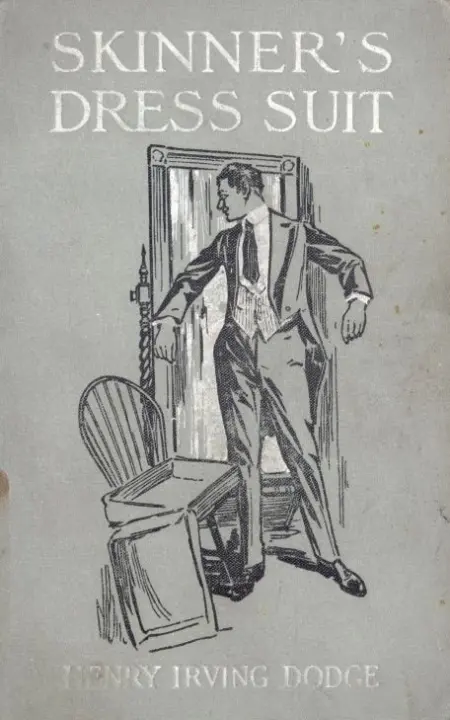
"Skinner's Dress Suit" by Henry Irving Dodge is a novel written in the early 20th century. The story revolves around the central character, Skinner, a cashier at McLaughlin & Perkins, who is trapped in his mundane job and longs for a raise to accommodate his wife's aspirations. The narrative explores themes of self-esteem, ambition, and the transformative power of outward appearances, particularly highlighted by Skinner's apprehensions and dreams associated with his desire for a dress suit. The opening of the book introduces Skinner, affectionately dubbed the "cage man" by messenger boys, who is gripped by anxiety over asking his boss for a raise. Skinner's fears stem not from physical intimidation, but from his internal struggle and fear of failure, as he has always strived to be a hero in the eyes of his supportive wife, Honey. The narrative captures his reluctance and reflections on their modest savings, the sacrifices Honey has made, and the pressure he feels to prove himself. Ultimately, the stage is set for Skinner's journey as he steps out of his comfort zone, seeking validation and transformation through the lens of social status and material success, embodied by the coveted dress suit.
Introduction adapted from the source catalogue; source summaries may be automatically generated.
Free to read · English · 26,756 words · No account needed
MAKE TIME FOR A GOOD BOOK
On by default. Untick to stop anonymous reading totals. Each page counts after 10 seconds in view. How this works.
Anonymous counting is on unless you have switched it off.
Jackson waited an hour before Skinner appeared. Skinner had reckoned that about that time the curmudgeon would be lounging around downstairs, waiting to meet him quite accidentally, so he permitted himself a cigar and a stroll in the office, which stroll was made to appear casual.
The curmudgeon had disposed himself in a huge armchair, which commanded a view of the elevator, and no sooner did he see Skinner emerge than he busied himself assiduously staring at, but not perceiving, the pages of the Sunday magazine section. With equal assiduity, Skinner, who as soon as he had left the elevator had observed Jackson, avoided seeing him, although he clearly perceived him.
Thus they played at cross-purposes for a while, these two overgrown
boys.
"Hello," said Jackson, looking up from his paper as Skinner strolled past for the fourth time. "You here yet?"
"I hate to tear myself away," said Skinner. "Have a cigar?"
Jackson took the weed and indicated a chair next his own.
"By Jove," said Skinner, seating himself and crossing his legs comfortably, "I like this town. Wonderful climate, fine people--and"--he turned to Jackson--"devilish good grub."
"Have you had a trout dinner yet?" said Jackson.
"Yes. Out at the Lake the other day."
"I mean a real one--cooked by a real cook--all the trimmings."
"No, I can't say that I have."
Jackson paused, drummed on the arm of his chair, and swallowed hard. "I've got the best cook in the Middle West," he observed.
"That's going some."
"You think you've eaten, don't you? Well, you haven't. You ought to
try my cook."
"That would be fine," said Skinner.
Skinner knew exactly what Jackson would say next. It was wonderful, he thought, almost uncanny, how the curmudgeon was doing just what he had schemed out that he would do--willed him to do. He felt like a magician operating the wires for some manikin to dance at the other end or a hypnotist directing a subject.
Things were going swimmingly for Jackson, too. He felt that he had executed his little scheme very well, without any danger of being found out or even suspected, yet he had never known things to fall in line as they were doing now. Still, he flattered himself it was good management. For Jackson was not a believer in luck.
"How long are you going to stay here?" he asked abruptly.
"Tuesday morning."
"You and the Missus had better come out and try that cook of mine
before you go."
Your reading position is saved on this browser. Take it to another device with a library code. Reading pages adapt to text, rather than matching a printed edition.
BEHIND THE BOOK
This eBook is for the use of anyone anywhere in the United States and most other parts of the world at no cost and with almost no restrictions whatsoever. You may copy it, give it away or re-use it under the terms of the Project Gutenberg License included with this eBook or online at www.gutenberg.org. If you are not located in the United States, you will have to check the laws of the country where you are located before using this eBook. Read the source licence.
The original source file, including credits and licence, is retained by this library. Request an original-format copy at no charge. Please include the book title and Project Gutenberg identifier #26080.
KEEP YOUR CURIOSITY GOING
Coulson Kernahan

Maurice Baring
Frances Wright
Cécile Tormay

Frederic Jesup Stimson

W. H. P. (William Henry Pope) Jarvis