THE CLASSIC COLLECTION✦A dead man’s diaryCLASSIC FREE BOOKS
A dead man’s diary
Coulson Kernahan
THE CLASSIC COLLECTION · 1916
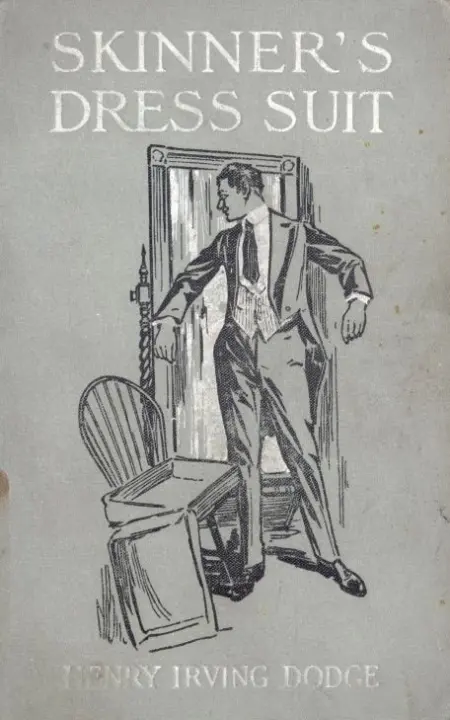
"Skinner's Dress Suit" by Henry Irving Dodge is a novel written in the early 20th century. The story revolves around the central character, Skinner, a cashier at McLaughlin & Perkins, who is trapped in his mundane job and longs for a raise to accommodate his wife's aspirations. The narrative explores themes of self-esteem, ambition, and the transformative power of outward appearances, particularly highlighted by Skinner's apprehensions and dreams associated with his desire for a dress suit. The opening of the book introduces Skinner, affectionately dubbed the "cage man" by messenger boys, who is gripped by anxiety over asking his boss for a raise. Skinner's fears stem not from physical intimidation, but from his internal struggle and fear of failure, as he has always strived to be a hero in the eyes of his supportive wife, Honey. The narrative captures his reluctance and reflections on their modest savings, the sacrifices Honey has made, and the pressure he feels to prove himself. Ultimately, the stage is set for Skinner's journey as he steps out of his comfort zone, seeking validation and transformation through the lens of social status and material success, embodied by the coveted dress suit.
Introduction adapted from the source catalogue; source summaries may be automatically generated.
Free to read · English · 26,756 words · No account needed
MAKE TIME FOR A GOOD BOOK
On by default. Untick to stop anonymous reading totals. Each page counts after 10 seconds in view. How this works.
Anonymous counting is on unless you have switched it off.
"Dearie," said Honey, rising, her eyes brimming, "you mean to say that I'm going to St. Paul with you?"
"Don't have to say it. Is n't that letter enough?"
"Dearie, you're the most wonderful man I ever saw. Think of it!--a letter from Mrs. Colby! I'll bet those Wilkinsons are swells!"
"They breathe the Colby stratum of the atmosphere. It's a special stratum, designed and created for that select class."
"It's quite intoxicating."
"Special brands usually are."
"I thought those Western cities did n't have classes."
"My dear, blood is n't a matter of geography. There's not a village in the United States that does n't have its classes. The more loudly they brag of their democracy, the greater the distance from the top to the bottom."
As Skinner said this, he jotted down in his little book:--
Dress-Suit Account
Debit Credit
One "open sesame" to the
smartest set west of the
Alleghanies!
and Honey clapped her hands.
And as he put Mrs. Colby's letter in his inside pocket, Skinner muttered to himself, "A climber, but does n't climb. She'll climb for this all right!"
The Skinners reached St. Paul Tuesday night and registered at The Hotel. When he had deposited Honey in the suite which had been reserved by wire for them, Skinner proceeded to execute the next step in his scheme for the reclamation of Willard Jackson. He returned to the desk.
"I wish," he said to the chief clerk, "that you 'd see to it that a paragraph regarding my arrival is put in the morning papers, just a little more than mere mention among hotel arrivals"--he took pen and paper and wrote--"something like this: 'William Manning Skinner, of McLaughlin & Perkins, Inc., New York, reached town last evening and is stopping at The Hotel.' There's a lot of people here I want to see, but I might overlook 'em in the rush of business. If they know I'm here, they'll come to see me."
"Very good, Mr. Skinner," said the clerk. "I'll see to it."
Skinner paused a moment. "By Jove, I've almost forgotten the principal thing." He added a few words to the copy. "Put that in, too, please. Can you read it? See: 'Mrs. Skinner, daughter of the late Archibald Rutherford, of Hastings-on-the-Hudson, accompanies her husband.' That's just to please her."
"'Rutherford'--'Hastings-on-the-Hudson'--swagger name," commented the
clerk.
Skinner smiled at the clerk's comment. If it impressed this dapper, matter-of-fact, know-everybody man-of-affairs that way, how much more would it appeal to Mrs. Curmudgeon W. Jackson's social nose. Veritably, it augured well for his scheme.
But he only said, "It reads a devilish sight better than plain Skinner,
does n't it?"
Your reading position is saved on this browser. Take it to another device with a library code. Reading pages adapt to text, rather than matching a printed edition.
BEHIND THE BOOK
This eBook is for the use of anyone anywhere in the United States and most other parts of the world at no cost and with almost no restrictions whatsoever. You may copy it, give it away or re-use it under the terms of the Project Gutenberg License included with this eBook or online at www.gutenberg.org. If you are not located in the United States, you will have to check the laws of the country where you are located before using this eBook. Read the source licence.
The original source file, including credits and licence, is retained by this library. Request an original-format copy at no charge. Please include the book title and Project Gutenberg identifier #26080.
KEEP YOUR CURIOSITY GOING
Coulson Kernahan

Maurice Baring
Frances Wright
Cécile Tormay

Frederic Jesup Stimson

W. H. P. (William Henry Pope) Jarvis