THE CLASSIC COLLECTION✦A dead man’s diaryCLASSIC FREE BOOKS
A dead man’s diary
Coulson Kernahan
THE CLASSIC COLLECTION · 1916
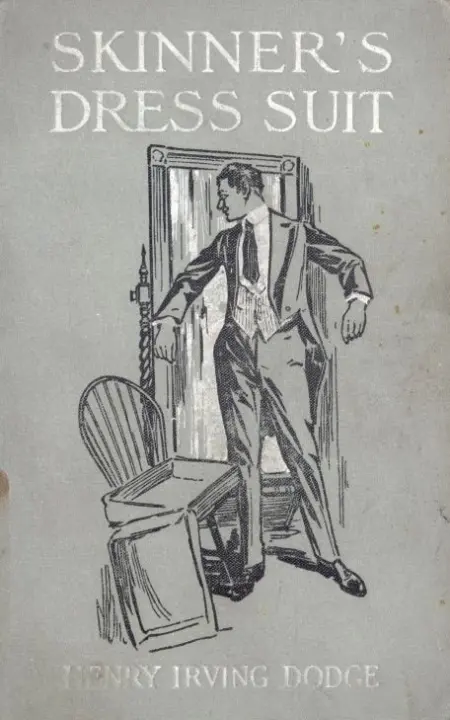
"Skinner's Dress Suit" by Henry Irving Dodge is a novel written in the early 20th century. The story revolves around the central character, Skinner, a cashier at McLaughlin & Perkins, who is trapped in his mundane job and longs for a raise to accommodate his wife's aspirations. The narrative explores themes of self-esteem, ambition, and the transformative power of outward appearances, particularly highlighted by Skinner's apprehensions and dreams associated with his desire for a dress suit. The opening of the book introduces Skinner, affectionately dubbed the "cage man" by messenger boys, who is gripped by anxiety over asking his boss for a raise. Skinner's fears stem not from physical intimidation, but from his internal struggle and fear of failure, as he has always strived to be a hero in the eyes of his supportive wife, Honey. The narrative captures his reluctance and reflections on their modest savings, the sacrifices Honey has made, and the pressure he feels to prove himself. Ultimately, the stage is set for Skinner's journey as he steps out of his comfort zone, seeking validation and transformation through the lens of social status and material success, embodied by the coveted dress suit.
Introduction adapted from the source catalogue; source summaries may be automatically generated.
Free to read · English · 26,756 words · No account needed
MAKE TIME FOR A GOOD BOOK
On by default. Untick to stop anonymous reading totals. Each page counts after 10 seconds in view. How this works.
Anonymous counting is on unless you have switched it off.
As Skinner entered the office of McLaughlin & Perkins, Inc., conscious of his new clothes and suffering somewhat from stage fright, he sensed something in the air of the great room that was devoted to the fluttering femininity of the concern, something humorous. But as he was a man of authority there, there was no outward manifestation of the same. The messenger boys from outside, however, were not subject to the rules of McLaughlin & Perkins, Inc.
"Gee," Skinner heard Mickey, the "littlest," whisper to Jimmy of the Postal, "pipe de new glad rags on de cage man!"
And Postal, duly impressed, admonished, "You better not burn any wood in here now 'cause he'll git after you." Then, in a whisper, "He never did before 'cause he never had any breeches on an' he did n't dare to run out."
"How do you know dat?"
"You never seen him below de middle of his vest, did you?"
"From down here, lookin' up, wid dat winder in de way, I never seen him much below his collar," whispered Mickey, the "littlest."
"Well, den, you never knew whether he had breeches on or not," pursued
the young logician.
Skinner's lips trembled as he overheard, but he took no official notice. Instead, he frowned hard at his cash-book. But when the boys had gone, he turned his face away from the fluttering femininity in the big room and his form shook with emotion.
After a bit, he took out his little book and wrote:--
Dress-Suit Account
Debit Credit
The best laugh I ever
had--in this or any of my
previous existences.
Later in the day, Skinner crossed to the office of Ransome & Company, on a matter of business for the firm. There was no one there when he entered but the office boy. But the youngster, from force of habit, when he saw Skinner, the acquiescent one, said, "Mr. Ransome's very busy this morning."
"So am I very busy," Skinner jerked out. "Just tell him I'm here."
The boy looked at Skinner in surprise, then without a word shambled into the inside office. Presently, a tall, pompous man entered and looked about for somebody to take his name to Ransome. As the boy emerged from the private office, he caught sight of this gentleman and darted back. In a few moments he returned and spoke to Skinner.
"Mr. Ransome'll see you just as soon as he's finished with this gentleman," indicating the pompous one.
But the new business clothes had knocked all the acquiescence out of Skinner. In their spic-and-spanness they fairly shrieked for respect.
Your reading position is saved on this browser. Take it to another device with a library code. Reading pages adapt to text, rather than matching a printed edition.
BEHIND THE BOOK
This eBook is for the use of anyone anywhere in the United States and most other parts of the world at no cost and with almost no restrictions whatsoever. You may copy it, give it away or re-use it under the terms of the Project Gutenberg License included with this eBook or online at www.gutenberg.org. If you are not located in the United States, you will have to check the laws of the country where you are located before using this eBook. Read the source licence.
The original source file, including credits and licence, is retained by this library. Request an original-format copy at no charge. Please include the book title and Project Gutenberg identifier #26080.
KEEP YOUR CURIOSITY GOING
Coulson Kernahan

Maurice Baring
Frances Wright
Cécile Tormay

Frederic Jesup Stimson

W. H. P. (William Henry Pope) Jarvis