THE CLASSIC COLLECTION✦A dead man’s diaryCLASSIC FREE BOOKS
A dead man’s diary
Coulson Kernahan
THE CLASSIC COLLECTION · 1916
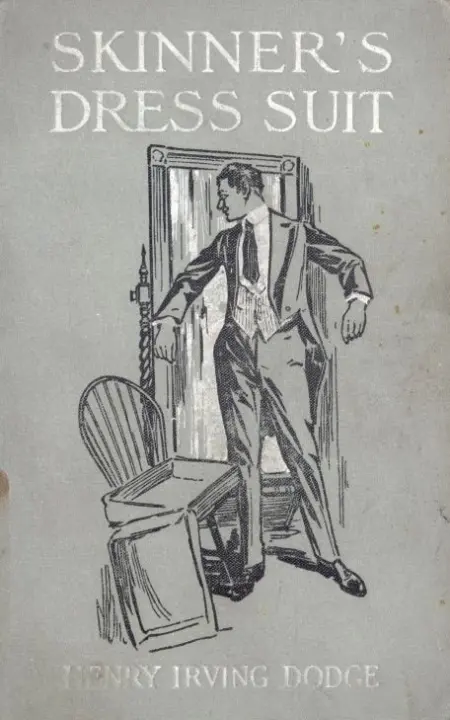
"Skinner's Dress Suit" by Henry Irving Dodge is a novel written in the early 20th century. The story revolves around the central character, Skinner, a cashier at McLaughlin & Perkins, who is trapped in his mundane job and longs for a raise to accommodate his wife's aspirations. The narrative explores themes of self-esteem, ambition, and the transformative power of outward appearances, particularly highlighted by Skinner's apprehensions and dreams associated with his desire for a dress suit. The opening of the book introduces Skinner, affectionately dubbed the "cage man" by messenger boys, who is gripped by anxiety over asking his boss for a raise. Skinner's fears stem not from physical intimidation, but from his internal struggle and fear of failure, as he has always strived to be a hero in the eyes of his supportive wife, Honey. The narrative captures his reluctance and reflections on their modest savings, the sacrifices Honey has made, and the pressure he feels to prove himself. Ultimately, the stage is set for Skinner's journey as he steps out of his comfort zone, seeking validation and transformation through the lens of social status and material success, embodied by the coveted dress suit.
Introduction adapted from the source catalogue; source summaries may be automatically generated.
Free to read · English · 26,756 words · No account needed
MAKE TIME FOR A GOOD BOOK
On by default. Untick to stop anonymous reading totals. Each page counts after 10 seconds in view. How this works.
Anonymous counting is on unless you have switched it off.
"Mercy, Dearie, if you learn to dance on Sixth Avenue, you'll have the Sixth-Avenue stamp to you. The men who dance on Sixth Avenue hire their dress suits on Third Avenue--it all goes together. Heavens," she sighed, breaking off abruptly, "have we built up a Frankenstein monster? Is that dress suit of yours going to prove as voracious as the fabled boa constrictor?"
"This dress suit is going to get all it wants to eat," said Skinner
with finality.
Honey was frightened at Dearie's newly developed stamina. Skinner, the acquiescent one, putting his foot down like that!
"But, Dearie," she urged, "it isn't absolutely necessary for us to
learn to dance. And, remember, you promised not to spend any more
money."
"I told you my dress suit was our engine of conquest--plant! You buy your machinery--your plant. That's the initial cost. Then you have to learn how to run it."
He took out his little book and put down:--
Dress-Suit Account
Debit Credit
Operating expenses.
"But you promised," Honey persisted.
"That was before we got this invitation. Things have changed. Promised not to spend any more money? What about my being a sit-in-the-corner, watch-the-other-fellow-dance, male-wallflower proposition, eh?"--and Honey was convicted by her own words.
"But, Dearie, what will this dress suit get us into?"
"Debt!--if we don't look out!"
Honey crossed to Dearie, put her head on his shoulder, and began to cry
softly.
"There, there," said Skinner, stroking her glossy hair, "don't you cry, Honey. There's nothing to worry about."
She lifted her face and smiled. "There is n't anything to worry about, is there? We have n't anywhere near spent that five hundred and twenty dollars, have we?"
"No," said Skinner grimly, "not yet!"
He disengaged himself from Honey's reluctant arms and slowly mounted the stairs. Once inside his room, he turned and locked the door, still smiling grimly. He strode to the closet, flung the door open, lifted his dress suit from its peg, and held it at arm's length where it swayed like a scarecrow.
"My God, you're a Nemesis!" he growled. "There's one for you--there's
another!"
He punched the thing hard and fast.
"That's you, Skinner--that's you--for being an ass--a blooming, silly
ass!"
When he rejoined Honey in the dining-room he was smiling, not grimly
now, but placidly.
"What is it, Dearie?" she asked.
"Just got something off my chest, that's all."
The words suggested something to Skinner; whenever his exasperation at his folly was too great for him to bear, he'd go upstairs and take it out on the dress suit. And the idea comforted him not a little!
Your reading position is saved on this browser. Take it to another device with a library code. Reading pages adapt to text, rather than matching a printed edition.
BEHIND THE BOOK
This eBook is for the use of anyone anywhere in the United States and most other parts of the world at no cost and with almost no restrictions whatsoever. You may copy it, give it away or re-use it under the terms of the Project Gutenberg License included with this eBook or online at www.gutenberg.org. If you are not located in the United States, you will have to check the laws of the country where you are located before using this eBook. Read the source licence.
The original source file, including credits and licence, is retained by this library. Request an original-format copy at no charge. Please include the book title and Project Gutenberg identifier #26080.
KEEP YOUR CURIOSITY GOING
Coulson Kernahan

Maurice Baring
Frances Wright
Cécile Tormay

Frederic Jesup Stimson

W. H. P. (William Henry Pope) Jarvis