THE CLASSIC COLLECTION✦A dead man’s diaryCLASSIC FREE BOOKS
A dead man’s diary
Coulson Kernahan
THE CLASSIC COLLECTION · 1916
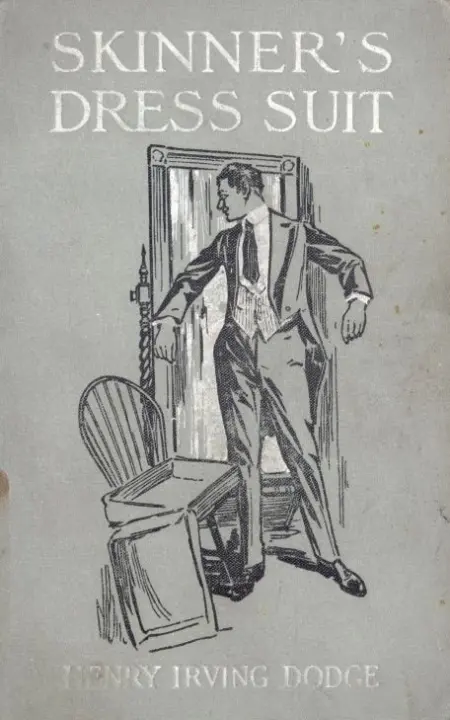
"Skinner's Dress Suit" by Henry Irving Dodge is a novel written in the early 20th century. The story revolves around the central character, Skinner, a cashier at McLaughlin & Perkins, who is trapped in his mundane job and longs for a raise to accommodate his wife's aspirations. The narrative explores themes of self-esteem, ambition, and the transformative power of outward appearances, particularly highlighted by Skinner's apprehensions and dreams associated with his desire for a dress suit. The opening of the book introduces Skinner, affectionately dubbed the "cage man" by messenger boys, who is gripped by anxiety over asking his boss for a raise. Skinner's fears stem not from physical intimidation, but from his internal struggle and fear of failure, as he has always strived to be a hero in the eyes of his supportive wife, Honey. The narrative captures his reluctance and reflections on their modest savings, the sacrifices Honey has made, and the pressure he feels to prove himself. Ultimately, the stage is set for Skinner's journey as he steps out of his comfort zone, seeking validation and transformation through the lens of social status and material success, embodied by the coveted dress suit.
Introduction adapted from the source catalogue; source summaries may be automatically generated.
Free to read · English · 26,756 words · No account needed
MAKE TIME FOR A GOOD BOOK
On by default. Untick to stop anonymous reading totals. Each page counts after 10 seconds in view. How this works.
Anonymous counting is on unless you have switched it off.
"He has n't begun to turn yet."
"How do you know? Hang it! A worm is always turning. There's no telling when he begins. He crawls in curves."
"Oh, rats!" was Perkins's only comment.
"Rats, eh? Skinner asked for a raise, did n't he? He did n't get it, did he? Right on top of it he comes out in gay attire--both of 'em! You ought to have seen 'em, Perk. No hand-me-down! The real thing!" McLaughlin paused longer than usual. He looked troubled. "Say, Perk," he said presently, "somehow, I'm afraid this particular worm of ours is pluming for flight."
"That's a dainty metaphor, Mac, but it's a little mixed."
McLaughlin glared at Perkins. He hated these petty corrections.
"Ain't a caterpillar a worm, my Harvard prodigy?"
"I grant you that."
"Don't he turn into a butterfly? Don't he plume for flight?"
McLaughlin nailed each successive argument with a bang of his fist on
the desk.
"Ain't Skinner getting to be a social butterfly? Get the connection? My metaphor may be mixed, as you say,--which I don't understand,--but my logic is O.K. Say, ain't it?"
"Your metaphor, Mac, suggests a picture. Imagine Skinner with wings on--those long legs drooping down or trailing behind him--like a great Jersey mosquito!"
At which they both laughed.
"Well," said McLaughlin, resignedly turning to the papers on his desk, "it beats me, that's all!"
Skinner had accurately reckoned that McLaughlin's wife would repeat Honey's cryptic remarks to the boss, and so, next day, he felt a natural constraint when in the presence of the senior partner. Constraint in the one reacted upon and caused constraint in the other, until it looked as if McLaughlin and Skinner, who had once been quite sociable as boss and clerk, would be little more than speaking acquaintances, after a time.
At any rate, that night Skinner jotted down:--
Dress-Suit Account
Debit Credit
A certain constraint on the
part of McLaughlin.
"Have you noticed anything in Skinner's conduct, Perk?" said
McLaughlin, two days later.
"You're getting morbid about Skinner, Mac."
"No, I ain't, either. But he acts--somehow, I can't get it out of my head that his wife meant--you know what!"
"You think Skinner told her we raised him?"
"That's it!"
"Suppose he did," said Perkins; "what of it?"
"How could he square it with her?" said McLaughlin slowly.
The partners looked at each other with a certain understanding, not too definite--just a suggestion.
"You think I'm morbid, Perk. You think I see things that ain't so. Just you keep your eye on him. See how he acts to you."
Your reading position is saved on this browser. Take it to another device with a library code. Reading pages adapt to text, rather than matching a printed edition.
BEHIND THE BOOK
This eBook is for the use of anyone anywhere in the United States and most other parts of the world at no cost and with almost no restrictions whatsoever. You may copy it, give it away or re-use it under the terms of the Project Gutenberg License included with this eBook or online at www.gutenberg.org. If you are not located in the United States, you will have to check the laws of the country where you are located before using this eBook. Read the source licence.
The original source file, including credits and licence, is retained by this library. Request an original-format copy at no charge. Please include the book title and Project Gutenberg identifier #26080.
KEEP YOUR CURIOSITY GOING
Coulson Kernahan

Maurice Baring
Frances Wright
Cécile Tormay

Frederic Jesup Stimson

W. H. P. (William Henry Pope) Jarvis