THE CLASSIC COLLECTION✦Fifteen Chapters of AutobiographyCLASSIC FREE BOOKS
Fifteen Chapters of Autobiography
George William Erskine Russell
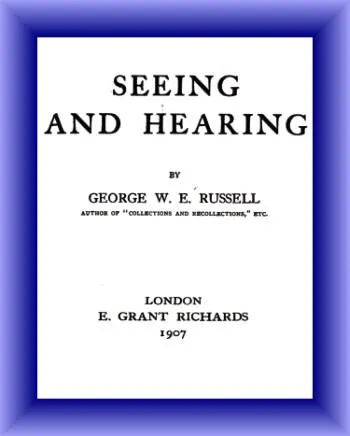
THE CLASSIC COLLECTION · 1907
"Seeing and Hearing" by George William Erskine Russell is a collection of essays or social commentaries written in the early 20th century. The essays explore various aspects of British society, including events like coronations and cultural observations, drawing on personal reflections and societal critiques. The introductory chapter notably focuses on the coronation of King Edward VII, blending themes of national identity, religion, and public sentiment. The opening of the work begins with an evocative description of the upcoming coronation, emphasizing its significance as a blend of religious and national identity. Russell reflects on the historical continuity represented by such ceremonies and their role in the hearts of the people. He juxtaposes this solemn occasion with a lighter scene set at a dining room in Belgravia, where guests are animatedly discussing their plans to witness the coronation, showcasing the different attitudes and social dynamics surrounding this pivotal moment in British history. The transitions between reverent introspection and casual social chatter illustrate the duality of life in London during this time, capturing both the grandeur of cultural traditions and the often frivolous nature of upper-class society.
Introduction adapted from the source catalogue; source summaries may be automatically generated.
Free to read · English · 86,316 words · No account needed
MAKE TIME FOR A GOOD BOOK
On by default. Untick to stop anonymous reading totals. Each page counts after 10 seconds in view. How this works.
Anonymous counting is on unless you have switched it off.
"Troops of social cavalry" were, when Lord Beaconsfield wrote "Lothair," the characteristic glories of Rotten Row; but horses and horsemanship alike have waned. Men take their constitutional canter in costumes anciently confined to rat-catching, and the general aspect of Rotten Row suggests the idea of Mounted Infantry rather than of "Cavalry." Alongside the ride forty years ago ladies drove their pony-phaetons--a pretty practice and a pretty carriage; but both have utterly disappeared, and the only bells that "gingle in the laughing air" are the warning signals of the Petrol Fiend, as, bent on destruction, he swoops down from Marble Arch to Piccadilly. Does a captious critic gaze enquiringly on the unfamiliar verb to "gingle"? It was thus that Lord Beaconsfield wrote it in "Lothair"; even as in the same high romance he described a lady with a rich bunch of "Stephanopolis" in her hand. It is not for the ephemeral scribbler to correct the orthography of the immortal dead. As to "stoppages in Bond Street," they were isolated and noteworthy incidents in 1870; in 1906, thanks to the admission of omnibuses into the narrow thoroughfare, they are occurrences as regular as the postman's knock or the policeman's mailed tread.
We have seen the aspects in which the London Season presented itself to two great men of yore. Let me now descend to a more personal level. We will imagine ourselves transported back to the year 1880, and to the month of May. A young gentleman--some five-and-twenty summers, as Mr. G. P. R. James would have said, have passed over his fair head--is standing near the steps of St. George's Hospital between the hours of eleven and midnight. He is smartly dressed in evening clothes, with a white waistcoat, a gardenia in his button-hole, and a silver-crutched stick in his hand. He is smoking a cigarette and pondering the question where he shall spend his evening, or, more strictly, the early hours of next day. He is in a state of serene contentment with himself and the world, for he has just eaten an excellent dinner, where plovers' eggs and asparagus have reminded him that the Season has really begun. To the pleasure-seeking Londoner these symptoms of returning summer mean more, far more, than the dogrose in the hedgerow or the first note of the nightingale in the copse. Since dinner he has just looked in at an evening party, which bored him badly, and has "cut" two others where he was not so likely to be missed. And now arises the vital question of the Balls. I use the plural number, for there will certainly be two, and probably three, to choose from. Here, at St. George's Hospital, our youth is at the centre of the world's social concourse. A swift and unbroken stream of carriages is pouring down from Grosvenor Square and Mayfair to Belgrave Square and Eaton Square and Chesham Place, and it meets as it goes the ascending procession which begins in Belgravia and ends in Portman Square. To-night there is a Royal Ball at Grosvenor House, certainly the most stately event of the season; a little dance, exquisitely gay and bright, in Piccadilly; and a gorgeous entertainment in Prince's Gate, where the aspiring Distiller is struggling, with enormous outlay, into social fame. All these have solicited the honour of our young friend's presence, and now is the moment of decision. It does not take long to repudiate Prince's Gate; there will be the best band in London, and ortolans for supper, but there will be no one there that one ever saw before, and it is too sickening to be called "My boy" by that bow-windowed bounder, the master of the house. There remain Grosvenor House and Piccadilly, and happily these can be combined in a harmonious perfection. Grosvenor House shall come first, for the arrival of the Prince and Princess is a pageant worth seeing--the most gracious host and the most beautiful hostess in London ushering the Royal guests, with courtly pomp, into the great gallery, walled with the canvases of Rubens, which serves as the dancing-room. Then the fun begins, and the bright hours fly swiftly, till one o'clock suggests the tender thought of supper, which is served on gold plate and Sèvres china in a garden-tent of Gobelins tapestry. And now it is time for a move; and our youth, extricating himself from the undesired attentions of the linkmen, pops into a hansom and speeds to Piccadilly, where he finds delights of a different kind--no Royalty, no pomp, no ceremony; but a warm welcome, and all his intimate friends, and the nicest girls in London eager for a valse.
Your reading position is saved on this browser. Take it to another device with a library code. Reading pages adapt to text, rather than matching a printed edition.
George William Erskine Russell
George William Erskine Russell
George William Erskine Russell
George William Erskine Russell
BEHIND THE BOOK
This eBook is for the use of anyone anywhere in the United States and most other parts of the world at no cost and with almost no restrictions whatsoever. You may copy it, give it away or re-use it under the terms of the Project Gutenberg License included with this eBook or online at www.gutenberg.org. If you are not located in the United States, you will have to check the laws of the country where you are located before using this eBook. Read the source licence.
The original source file, including credits and licence, is retained by this library. Request an original-format copy at no charge. Please include the book title and Project Gutenberg identifier #46821.
KEEP YOUR CURIOSITY GOING

David Patterson (Spirit) Hatch

David Patterson (Spirit) Hatch

David Patterson (Spirit) Hatch
Cécile Tormay

Moritz Busch
John L. Ransom