THE CLASSIC COLLECTION✦Fifteen Chapters of AutobiographyCLASSIC FREE BOOKS
Fifteen Chapters of Autobiography
George William Erskine Russell
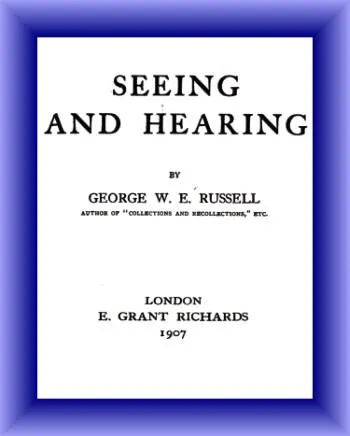
THE CLASSIC COLLECTION · 1907
"Seeing and Hearing" by George William Erskine Russell is a collection of essays or social commentaries written in the early 20th century. The essays explore various aspects of British society, including events like coronations and cultural observations, drawing on personal reflections and societal critiques. The introductory chapter notably focuses on the coronation of King Edward VII, blending themes of national identity, religion, and public sentiment. The opening of the work begins with an evocative description of the upcoming coronation, emphasizing its significance as a blend of religious and national identity. Russell reflects on the historical continuity represented by such ceremonies and their role in the hearts of the people. He juxtaposes this solemn occasion with a lighter scene set at a dining room in Belgravia, where guests are animatedly discussing their plans to witness the coronation, showcasing the different attitudes and social dynamics surrounding this pivotal moment in British history. The transitions between reverent introspection and casual social chatter illustrate the duality of life in London during this time, capturing both the grandeur of cultural traditions and the often frivolous nature of upper-class society.
Introduction adapted from the source catalogue; source summaries may be automatically generated.
Free to read · English · 86,316 words · No account needed
MAKE TIME FOR A GOOD BOOK
On by default. Untick to stop anonymous reading totals. Each page counts after 10 seconds in view. How this works.
Anonymous counting is on unless you have switched it off.
The subject is suggested to me by the notice-board outside the Court Theatre. There I learn that "The Campden Wonder" has run its course. A "horror" of the highest excellence has been on view for four weeks; and I, who might have revelled in it, have made, per viltate, the Great Refusal. I leave the italicized quality untranslated, because I am not quite sure of the English equivalent which would exactly suit my case. "Vileness" is a little crude. "Cowardice" is ignominious. "Poorness of Spirit "is an Evangelical virtue. "Deficiency of Enterprise" and "an impaired nervous system" would, at the best, be paraphrases rather than translations. On the whole, I think the nearest approximation to the facts of my case is to say that my refusal to profit by Mr. Masefield's Horror was due to Decadence. Fuimus. There has been a period when such a tale as the "Campden Wonder" would have attracted me with an irresistible fascination and gripped me with a grasp of iron. But I am not the man I was; and I am beginning to share the apprehensions of the aged lady who told her doctor that she feared she was breaking up, for she could no longer relish her Murders.
Youth, and early youth, is indeed the Golden Age of Horrors. To a well-constituted child battle and murder and sudden death appeal far more powerfully than any smooth tale of love. We snatch a fearful joy from the lurid conversation of servants and neighbours. We gaze, with a kind of panic-stricken rapture, at the stain on the floor which marks the place where old Mr. Yellowboy was murdered for his money; and run very fast, though with a backward gaze, past the tree on which young Rantipole hanged himself on being cut off with a shilling by his uncle Mr. Wormwood Scrubbs. In some privileged families the children are not left to depend on circumjacent gossip, but are dogmatically instructed in hereditary horrors. This happy lot was mine. My father's uncle had been murdered by his valet; and from a very tender age I could have pointed out the house where the murder took place--it went cheap for a good many years afterwards,--and could have described the murderer stripping himself naked before he performed the horrid act, and the bath of blood in which the victim was found, and the devices employed to create an impression of suicide instead of murder. I could have repeated the magnificent peroration in which the murderer's advocate exhorted the jury to spare his client's life (and which, forty years later, was boldly plagiarized by Mr. Montagu Williams in defending Dr. Lamson). The murderer, Benjamin Francis Courvoisier by name, long occupied a conspicuous place in Madame Tussaud's admirable collection. I can distinctly recall a kind of social eminence among my schoolfellows which was conferred by the fact that I had this relationship with the Chamber of Horrors; and I was conscious of a painful descent when Courvoisier lapsed out of date and was boiled down into Mr. Cobden or Cardinal Wiseman or some other more recent celebrity. Then, again, all literature was full of Horrors; and, though we should have been deprived of jam at tea if we had been caught reading a Murder Trial in the Daily Telegraph, we were encouraged to drink our fill of Shakespeare and Scott and Dickens and other great masters of the Horrible. From De Quincey we learned that Murder may be regarded as a Fine Art, and from an anonymous poet we acquired the immortal verse which narrates the latter end of Mr. William Weare. Shakespeare, as his French critics often remind us, reeks of blood and slaughter; the word "Murder" and its derivatives occupy two columns of Mrs. Cowden Clarke's closely-printed pages. Scott's absolute mastery over his art is nowhere more strikingly exemplified than in his use of murderous mechanisms. "The Heart of Midlothian" begins, continues, and ends with murder. "Rob Roy" contains a murder-scene of lurid beauty. The murderous attack on the bridegroom in "The Bride of Lammermoor" is a haunting horror. Not all the Dryasdusts in England and Germany combined will ever displace the tradition of Amy Robsart and the concealed trap-door. Front-de-Boeuf's dying agony is to this hour a glimpse of hell. Greatest of the great in humour, Dickens fell not far behind the greatest when he turned his hand to Horrors. One sheds few tears for Mr. Tulkinghorn, and we consign Jonas Chuzzlewit to the gallows without a pang. But is there in fiction a more thrilling scene than the arrest of the murderer on the moonlit tower-stair in "Barnaby Rudge," or the grim escape of Sikes from the vengeance of the mob in "Oliver Twist"? For deliberate, minute, and elaborated horror commend me to the scene at the limekiln on the marshes where Pip awaits his horrible fate at the hands of the crazy savage Dolge Orlick.
Your reading position is saved on this browser. Take it to another device with a library code. Reading pages adapt to text, rather than matching a printed edition.
George William Erskine Russell
George William Erskine Russell
George William Erskine Russell
George William Erskine Russell
BEHIND THE BOOK
This eBook is for the use of anyone anywhere in the United States and most other parts of the world at no cost and with almost no restrictions whatsoever. You may copy it, give it away or re-use it under the terms of the Project Gutenberg License included with this eBook or online at www.gutenberg.org. If you are not located in the United States, you will have to check the laws of the country where you are located before using this eBook. Read the source licence.
The original source file, including credits and licence, is retained by this library. Request an original-format copy at no charge. Please include the book title and Project Gutenberg identifier #46821.
KEEP YOUR CURIOSITY GOING

David Patterson (Spirit) Hatch

David Patterson (Spirit) Hatch

David Patterson (Spirit) Hatch
Cécile Tormay

Moritz Busch
John L. Ransom