THE CLASSIC COLLECTION✦Fifteen Chapters of AutobiographyCLASSIC FREE BOOKS
Fifteen Chapters of Autobiography
George William Erskine Russell
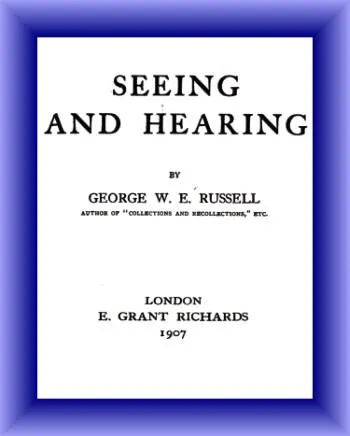
THE CLASSIC COLLECTION · 1907
"Seeing and Hearing" by George William Erskine Russell is a collection of essays or social commentaries written in the early 20th century. The essays explore various aspects of British society, including events like coronations and cultural observations, drawing on personal reflections and societal critiques. The introductory chapter notably focuses on the coronation of King Edward VII, blending themes of national identity, religion, and public sentiment. The opening of the work begins with an evocative description of the upcoming coronation, emphasizing its significance as a blend of religious and national identity. Russell reflects on the historical continuity represented by such ceremonies and their role in the hearts of the people. He juxtaposes this solemn occasion with a lighter scene set at a dining room in Belgravia, where guests are animatedly discussing their plans to witness the coronation, showcasing the different attitudes and social dynamics surrounding this pivotal moment in British history. The transitions between reverent introspection and casual social chatter illustrate the duality of life in London during this time, capturing both the grandeur of cultural traditions and the often frivolous nature of upper-class society.
Introduction adapted from the source catalogue; source summaries may be automatically generated.
Free to read · English · 86,316 words · No account needed
MAKE TIME FOR A GOOD BOOK
On by default. Untick to stop anonymous reading totals. Each page counts after 10 seconds in view. How this works.
Anonymous counting is on unless you have switched it off.
"Christmas, now," as Mr. Brooke in "Middlemarch" might have said--"I went a good deal into that kind of thing at one time; but I found it would carry me too far--over the hedge, in fact." That, I imagine, pretty well represents the attitude of the adult world towards the feast which closes the year. We all loved it when we were young. Now, it is all very well for once in a way; it might pall if frequently repeated; even recurring only annually, it must be observed temperately and enjoyed moderately. Anything resembling excess would carry one too far--"over the hedge, in fact." But, within these recognized and salutary limits, Christmas is an institution which I would not willingly let die. In the days of my youth a Jewish lady caused me not a little consternation by remarking that it seemed very odd for Christians to celebrate the Feast of Redemption with gluttony and drunkenness. She lived, I am bound to say, in a very unregenerate village in a remarkably savage part of the country, and as, of course, she did not go to church, I dare say that Gluttony and Drunkenness were the forms of Christmas observance which most obtruded themselves on her notice. Even Cardinal Newman seems to have remarked the same phenomenon in his youth, though he satirized it more delicately. "Beneficed clergymen used to go to rest as usual on Christmas-eve, and leave to ringers, or sometimes to carollers, the observance which was paid, not without creature comforts, to the sacred night." Now all that is changed. Churches of all confessions vie with one another in the frequency and heartiness and picturesque equipment of their religious services. Even the Daily Telegraph preaches Christmas sermons; and I very much question whether the populace gets more drunk at Christmas than at Easter. But, though we may have learnt to celebrate the festival with rites more devout and less bibulous, we have not yet escaped my Jewish friend's reproach of gluttony. The Christmas Dinner of the British Home is still a thing imagination boggles at. The dreadful pleasantries of the aged--their sorry gibes about the doctor and the draught; hoary chestnuts about little boys who stood up to eat more--remain among the most terrible memories of the Christmas dinner. And they were quite in keeping with the dinner itself. I say nothing against the Turkey, which (as my medical friends well know) was found, by practical experiment in the case of Alexis St. Martin, to be the most easily digested of all animal foods, except venison; but surely, as a nation, we eat quite beef enough in the course of the year without making Christmas an annual orgy of carnivorous excess. I protest that the very sight of the butchers' shops at this season of the year is enough to upset a delicately balanced organization. Rightly said the Shah, in that immortal Diary which he kept during his visit to England in 1873--"Meat is good, but it should not be hung up in windows." Macaulay used to say that Thackeray, in his famous description of the Clapham sect in "The Newcomes," made one blunder--he represented them as Dissenters, whereas, in fact, they were rather dogged Church-people. The only exception to the rule was a Baptist lady, who, living on Clapham Common, testified against the superstitions of the Established Church by eating roast veal and apple-pie on Christmas-day instead of more orthodox dainties. Churchman though I am, I protest that I think the Baptist lady was right: and I believe that the Puritans were wiser than they knew when they denounced Plum-Pudding and Mince Pies as inventions of the Evil One. Yet the love of these vindictive viands is one of the root-instincts of our English nature. Forty-eight years ago the British Army was keeping its Christmas in the Crimea, amid all the horrors and hardships of a peculiarly grim campaign. An English Sister of Mercy, who was nursing under Miss Nightingale in the Hospital at Scutari, thus described the melancholy festivity: "The 'Roast Beef of Old England' was out of the question, but with the aid of a good deal of imagination, it seemed possible at least to secure the Plum Pudding. I think I might with safety affirm that as the doctor left the ward every man drew from under his pillow a small portion of flour and fat, with an egg and some plums, and began to concoct a Christmas pudding. I assisted many to make the pudding, whom nothing short of a miracle would enable to eat it; still they must have the thing. For some days previously I had been asked for pieces of linen, which, without dreaming of the use to which they were to be applied, I supplied. Thus were the pudding cloths provided."
Your reading position is saved on this browser. Take it to another device with a library code. Reading pages adapt to text, rather than matching a printed edition.
George William Erskine Russell
George William Erskine Russell
George William Erskine Russell
George William Erskine Russell
BEHIND THE BOOK
This eBook is for the use of anyone anywhere in the United States and most other parts of the world at no cost and with almost no restrictions whatsoever. You may copy it, give it away or re-use it under the terms of the Project Gutenberg License included with this eBook or online at www.gutenberg.org. If you are not located in the United States, you will have to check the laws of the country where you are located before using this eBook. Read the source licence.
The original source file, including credits and licence, is retained by this library. Request an original-format copy at no charge. Please include the book title and Project Gutenberg identifier #46821.
KEEP YOUR CURIOSITY GOING

David Patterson (Spirit) Hatch

David Patterson (Spirit) Hatch

David Patterson (Spirit) Hatch
Cécile Tormay

Moritz Busch
John L. Ransom