THE CLASSIC COLLECTION✦Fifteen Chapters of AutobiographyCLASSIC FREE BOOKS
Fifteen Chapters of Autobiography
George William Erskine Russell
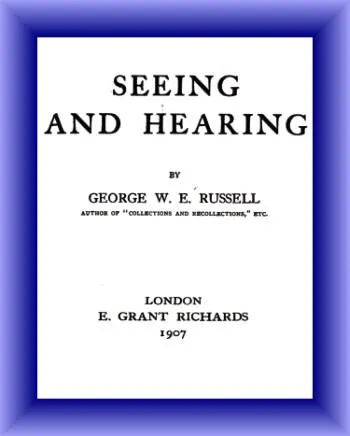
THE CLASSIC COLLECTION · 1907
"Seeing and Hearing" by George William Erskine Russell is a collection of essays or social commentaries written in the early 20th century. The essays explore various aspects of British society, including events like coronations and cultural observations, drawing on personal reflections and societal critiques. The introductory chapter notably focuses on the coronation of King Edward VII, blending themes of national identity, religion, and public sentiment. The opening of the work begins with an evocative description of the upcoming coronation, emphasizing its significance as a blend of religious and national identity. Russell reflects on the historical continuity represented by such ceremonies and their role in the hearts of the people. He juxtaposes this solemn occasion with a lighter scene set at a dining room in Belgravia, where guests are animatedly discussing their plans to witness the coronation, showcasing the different attitudes and social dynamics surrounding this pivotal moment in British history. The transitions between reverent introspection and casual social chatter illustrate the duality of life in London during this time, capturing both the grandeur of cultural traditions and the often frivolous nature of upper-class society.
Introduction adapted from the source catalogue; source summaries may be automatically generated.
Free to read · English · 86,316 words · No account needed
MAKE TIME FOR A GOOD BOOK
On by default. Untick to stop anonymous reading totals. Each page counts after 10 seconds in view. How this works.
Anonymous counting is on unless you have switched it off.
Dean versus Bishop--it is an antinomy as old as the history of Cathedral institutions. The Dean, with a good house and a thousand a year, has always murmured against the Bishop, with a better house and five times that income; and, as he is generally master of his Cathedral, he has before now contrived to make his murmurs sensible as well as audible. Of late years these spiritual strifes (which beautifully link the post-Reformation to the pre-Reformation Church) have been voted disedifying, and, if they continue to exist, they operate surreptitiously and out of public view. But, though Deans have ceased from clamouring, they retain their right to criticize, and the Dean of Norwich has just been exercising that right with a good deal of vivacity. I cull the following extract from a secular newspaper:--
"Dean Lefroy at a meeting of the General Diocesan Committee to make arrangements for the Church Congress at Great Yarmouth in October ... commented on the inordinate expense of founding bishoprics, and said that episcopacy in Canterbury Province cost £142,000 per annum, and in York £44,000. He believed that £2000 a year and a residence would be welcome to most bishops. The upkeep of large palaces swallowed up the bishops' incomes. Preserve the palaces, but give bishops the opportunity of living more simply. The surplus might go to poor and starving clergy."
One can picture the tempered gratitude with which the Bishops, and the ladies of the Episcopal household, and the Domestic Chaplains--those "amiable young gentlemen who make themselves agreeable in the drawing-rooms of the Mitre"--must regard this obliging invitation to "live more simply." There is a good deal of human nature even in apostolic bosoms, and a man who has enjoyed an official income of £5000 a year does not as a rule regard with enthusiasm a reduction to £2000. The Bishop in "Little Dorrit," when the guests at Mr. Merdle's banquet were extolling their host's opulence, "tried to look as if he was rather poor himself"; and his successors at the present day take great pains to assure the public that they are not overpaid. The locus classicus on the subject of episcopal incomes is to be found in the Rev. Hubert Handley's book called "The Fatal Opulence of Bishops," and was originally supplied by the artless candour of the present Bishop of London, who in the year 1893 published in the Oxford House Chronicle a statistical statement by an unnamed Bishop. This prelate had only a beggarly income of £4200, and must therefore be the occupant of one of those comparatively cheap and humble Sees which the exigencies of the Church have lately called into being. Out of this pittance he had to pay £1950 for a removal, furniture, and repairs to the episcopal residence. This, to the lay mind, seems a good deal. Hospitality he sets down as costing £2000 a year; but somehow one feels as if one could give luncheon to the country clergy, and satisfy even the craving appetites of ordinands, at a less cost. "Stables," says the good Bishop, "are almost a necessity, and in some respects a saving;" but here the haughty disregard of details makes criticism difficult. "Robes, £100." This item is plain enough and absurd enough. The perverted ingenuity of fallen man has never devised a costume more hideous or less expressive than the episcopal "magpie"; and I am confident that Mrs. Bishop's maid could have stitched together the necessary amounts of lawn and black satin at a less cost than £100. But this exactly illustrates the plan on which these episcopal incomes are always defended by their apologists. We are told precisely what the Bishop expends on each item of charge. But we are not told, and are quite unable to divine, why each of those items should cost so much, or why some of them should ever be incurred. The Bishop of London (then Mr. Winnington-Ingram) thus summed up the statement of his episcopal friend in the background: "It amounts to this--a bishop's income is a trust-fund for the diocese which head ministers. It would make no difference to him personally if three-quarters of it were taken away, so long as three-quarters of his liabilities were taken away too; and it is quite arguable that this would be a better arrangement."
Your reading position is saved on this browser. Take it to another device with a library code. Reading pages adapt to text, rather than matching a printed edition.
George William Erskine Russell
George William Erskine Russell
George William Erskine Russell
George William Erskine Russell
BEHIND THE BOOK
This eBook is for the use of anyone anywhere in the United States and most other parts of the world at no cost and with almost no restrictions whatsoever. You may copy it, give it away or re-use it under the terms of the Project Gutenberg License included with this eBook or online at www.gutenberg.org. If you are not located in the United States, you will have to check the laws of the country where you are located before using this eBook. Read the source licence.
The original source file, including credits and licence, is retained by this library. Request an original-format copy at no charge. Please include the book title and Project Gutenberg identifier #46821.
KEEP YOUR CURIOSITY GOING

David Patterson (Spirit) Hatch

David Patterson (Spirit) Hatch

David Patterson (Spirit) Hatch
Cécile Tormay

Moritz Busch
John L. Ransom