THE CLASSIC COLLECTION✦Fifteen Chapters of AutobiographyCLASSIC FREE BOOKS
Fifteen Chapters of Autobiography
George William Erskine Russell
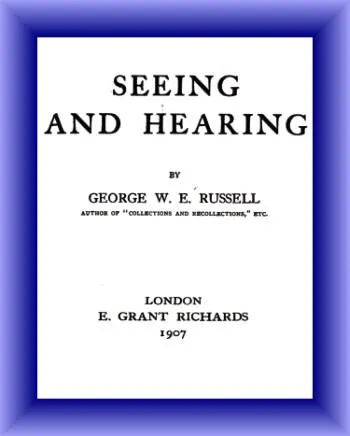
THE CLASSIC COLLECTION · 1907
"Seeing and Hearing" by George William Erskine Russell is a collection of essays or social commentaries written in the early 20th century. The essays explore various aspects of British society, including events like coronations and cultural observations, drawing on personal reflections and societal critiques. The introductory chapter notably focuses on the coronation of King Edward VII, blending themes of national identity, religion, and public sentiment. The opening of the work begins with an evocative description of the upcoming coronation, emphasizing its significance as a blend of religious and national identity. Russell reflects on the historical continuity represented by such ceremonies and their role in the hearts of the people. He juxtaposes this solemn occasion with a lighter scene set at a dining room in Belgravia, where guests are animatedly discussing their plans to witness the coronation, showcasing the different attitudes and social dynamics surrounding this pivotal moment in British history. The transitions between reverent introspection and casual social chatter illustrate the duality of life in London during this time, capturing both the grandeur of cultural traditions and the often frivolous nature of upper-class society.
Introduction adapted from the source catalogue; source summaries may be automatically generated.
Free to read · English · 86,316 words · No account needed
MAKE TIME FOR A GOOD BOOK
On by default. Untick to stop anonymous reading totals. Each page counts after 10 seconds in view. How this works.
Anonymous counting is on unless you have switched it off.
When I am asked why I do not describe the Painter, my reply is partly the same. We have got Gaston Phoebus, and Clive Newcome, and Claude Mellot, and the goodly company of Trilby, and we shall not easily improve upon those portraits, whether highly finished or merely sketched. But in this case I have another reason for reticence. I know a good many painters, who about this time of year bid me to their studios. I have experienced before now the delicate irritability of the artistic genius, and I know that a reverential reticence is my safest course. Conversely, my reason for not describing the Actor is that I really do not know him well enough. An actor off the stage is about as exhilarating an object as a theatre by daylight. The brilliancy and the glamour have departed; the savour of sawdust and orange-peel remains. Let us render all honour to the histrion when his foot is on his native boards; but if we are wise we shall eschew in private life the society of Mr. and Mrs. Vincent Crummles, nor open our door too widely to the tribe of Costigan and Fotheringay.
The mention of that great actress's name (for did not Emily Costigan, afterwards Lady Mirabel, figure as "Miss Fotheringay" on the provincial stage?) reminds me that, according to some of my critics, women played too rare and too secluded a part in my series of "Typical Developments." It is only too true, and no one knows as well as the author the amount of brilliancy and interest which has been forfeited thereby. But really it is a sacred awe that has made me mute. Even to-day, as I write, I am smarting under a rebuke recently administered to me, at a public gathering, by an outraged matron. This lady belongs to the political section of her tribe; holds man, poor man! in proper contempt; and clamours on Sir Henry Campbell-Bannerman's doorstep for that suffrage which is to make her truly free. At present she esteems herself little better than a Squaw, and has been heard to declare, in moments of expansive eloquence, that she was not created to be the Toy of Man--a declaration in which her hearers most heartily concurred. Well, this stern guardian of her sex's rights recently took me to task in a public place for the levity with which I had criticized a gathering of political ladies, and my nerve has scarcely rallied from the sudden onslaught. Had I been more myself I might even yet have tried my unskilled hand at female portraiture. Perhaps, in the spirit of that Cambridge professor who calls William II. "quite the nicest Emperor I know," I might have begun in the most illustrious circles, and have sketched the stone-laying and bazaar-opening activities of Royal Princesses. Or, yielding precedence to the Church, I might have discoursed of Episcopal ladies and have traced the influence of a tradition received from the beatified Mrs. Proudie. "We had a very nice Ordination this Trinity," says one lady of this class. "The Bishop and I were much disappointed by the poor response of the laity to our appeal," wrote another. When in May 1899 the Archbishops were playing at a Court for the trial of Ritualism, Episcopal ladies sat knitting by the judgment-seat, and stared at the incriminated clergymen, as the tricoteuses of the French Revolution may have stared at the victims of the guillotine, or as Miss Squeers peered through the keyhole at the flagellation of Smike. Or again, on a lowlier rung of the Ecclesiastical ladder, I might have drawn the Parochial Worker--the woman of waterproof and gingham, the distributor of tracts, the disciplinarian of the Sunday School, the presiding spirit of Mothers' Meetings. At a General Election this type of lady varies her activities--canvasses for the Conservative candidate, and tells the gaping washerwomen that Mr. Lloyd-George wishes to convert the Welsh cathedrals into music-halls for the Eisteddfod. Of all Parochial Workers the highest type is the Deaconess; and not long ago, in a parish with which I am conversant, the Deaconess and the Curate used to do their parochial rounds on a double bicycle, to the infinite amusement of the gutter-children and the serious perturbation of the severely orthodox. There was a picture worthy of the pen and pencil of Thackeray, but it faded all too soon into the blurred commonplace of matrimony.
Your reading position is saved on this browser. Take it to another device with a library code. Reading pages adapt to text, rather than matching a printed edition.
George William Erskine Russell
George William Erskine Russell
George William Erskine Russell
George William Erskine Russell
BEHIND THE BOOK
This eBook is for the use of anyone anywhere in the United States and most other parts of the world at no cost and with almost no restrictions whatsoever. You may copy it, give it away or re-use it under the terms of the Project Gutenberg License included with this eBook or online at www.gutenberg.org. If you are not located in the United States, you will have to check the laws of the country where you are located before using this eBook. Read the source licence.
The original source file, including credits and licence, is retained by this library. Request an original-format copy at no charge. Please include the book title and Project Gutenberg identifier #46821.
KEEP YOUR CURIOSITY GOING

David Patterson (Spirit) Hatch

David Patterson (Spirit) Hatch

David Patterson (Spirit) Hatch
Cécile Tormay

Moritz Busch
John L. Ransom