THE CLASSIC COLLECTION✦Fifteen Chapters of AutobiographyCLASSIC FREE BOOKS
Fifteen Chapters of Autobiography
George William Erskine Russell
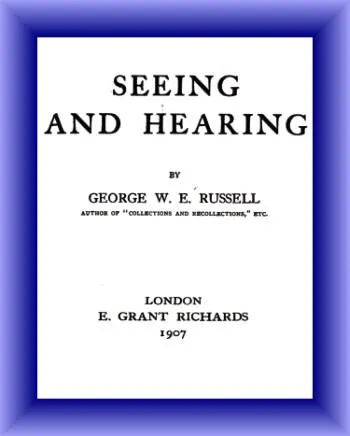
THE CLASSIC COLLECTION · 1907
"Seeing and Hearing" by George William Erskine Russell is a collection of essays or social commentaries written in the early 20th century. The essays explore various aspects of British society, including events like coronations and cultural observations, drawing on personal reflections and societal critiques. The introductory chapter notably focuses on the coronation of King Edward VII, blending themes of national identity, religion, and public sentiment. The opening of the work begins with an evocative description of the upcoming coronation, emphasizing its significance as a blend of religious and national identity. Russell reflects on the historical continuity represented by such ceremonies and their role in the hearts of the people. He juxtaposes this solemn occasion with a lighter scene set at a dining room in Belgravia, where guests are animatedly discussing their plans to witness the coronation, showcasing the different attitudes and social dynamics surrounding this pivotal moment in British history. The transitions between reverent introspection and casual social chatter illustrate the duality of life in London during this time, capturing both the grandeur of cultural traditions and the often frivolous nature of upper-class society.
Introduction adapted from the source catalogue; source summaries may be automatically generated.
Free to read · English · 86,316 words · No account needed
MAKE TIME FOR A GOOD BOOK
On by default. Untick to stop anonymous reading totals. Each page counts after 10 seconds in view. How this works.
Anonymous counting is on unless you have switched it off.
But it is in the sphere of rank just below that of the "Garter Families" that the Blue silk of Swift's imagination exercises its most potent influence. Men who are placed by the circumstances of their birth far beyond the temptations of mere cupidity, men who are justly satisfied with their social position and have no special wish to be transmogrified into marquises or dukes, are found to desire the Garter with an almost passionate fondness. Many a curious vote in a stand-or-fall division, many an unexpected declaration at a political crisis, many a transfer of local influence at an important election has been dictated by calculations about a possible Garter. It was this view of the decoration which inspired Lord Melbourne when, to the suggestion that he should take a vacant Garter for himself, he replied, "But why should I? I don't want to bribe myself." This same light-hearted statesman disputes with Lord Palmerston the credit of having said, "The great beauty of the Garter is that there's no d---- d nonsense of merit about it;" but it was undoubtedly Palmerston who declined to pay the customary fees to the Dean and Chapter of Windsor, and on being gravely told that, unless he paid, his banner could not be erected in St. George's Chapel, replied that, as he never went to church at Windsor or anywhere else, the omission would not much affect him.
What made the recent Chapter of the Garter peculiarly exciting to such as have æsthetic as well as historic minds was the fact that, for once, the Knights might be seen in the full splendour of their magnificent costume. No other Order has so elaborate a paraphernalia, and every detail smacks deliciously of the antique world. The long, sweeping mantle of Garter-blue is worn over a surcoat and hood of crimson velvet. The hat is trimmed with ostrich feathers and heron's plumes. The enamelled collar swings majestically from shoulder to shoulder; from it depends the image of St. George trampling down the dragon; and round the left knee runs the Garter itself, setting forth the motto of the Order in letters of gold. It is a truly regal costume; and those who saw Lord Spencer so arrayed at the Coronation of King Edward might have fancied that they were gazing on an animated Vandyke. These full splendours of the Order are seldom seen, but some modifications of them appear on stated occasions. The King was married in the mantle of the Garter, worn over a Field-Marshal's uniform; and a similar practice is observed at ceremonies in St. George's Chapel. The Statutes of the Order bind every Knight, on his chivalric obedience, to wear the badge--the "George," as it is technically called--at all times and places. In obedience to this rule the Marquis of Abercorn, who died in 1818, always went out shooting in the Blue Ribbon from which, in ordinary dress, the badge depends. But those were the days when people played cricket in tall hats and attended the House of Commons in knee-breeches and silk stockings. Prince Albert, whose conscience in ceremonial matters was even painfully acute, always wore his Blue Ribbon over his shirt and below his waistcoat; and in his ancient photographs it can be dimly traced crossing his chest in the neighbourhood of his shirt studs. But to-day one chiefly sees it at dinners. A tradition of the Order requires a Knight dining with a brother-Knight to wear it, and after dinner one may meet it at an evening party. The disuse of knee-breeches, except in Royal company, makes it practically impossible to display the actual Garter; unless one chooses to follow the example of the seventh Duke of Bedford, who, being of a skinny habit and feeling the cold intensely, yet desiring to display his Garter, used to wear it buckled round the trouser of his left leg. Lord Beaconsfield, in his later years, used to appear in the evening with a most magnificent Star of the Garter which had belonged to the wicked Lord Hertford, Thackeray's Steyne and his own Monmouth. It was a constellation of picked diamonds, surrounding St. George's Cross in rubies. After Lord Beaconsfield's death it was exposed for sale in a jeweller's window, and eventually was broken up and sold piecemeal. There was an opportunity missed. Lord Rosebery ought to have bought it, and kept it by him until he was entitled to wear it.
Your reading position is saved on this browser. Take it to another device with a library code. Reading pages adapt to text, rather than matching a printed edition.
George William Erskine Russell
George William Erskine Russell
George William Erskine Russell
George William Erskine Russell
BEHIND THE BOOK
This eBook is for the use of anyone anywhere in the United States and most other parts of the world at no cost and with almost no restrictions whatsoever. You may copy it, give it away or re-use it under the terms of the Project Gutenberg License included with this eBook or online at www.gutenberg.org. If you are not located in the United States, you will have to check the laws of the country where you are located before using this eBook. Read the source licence.
The original source file, including credits and licence, is retained by this library. Request an original-format copy at no charge. Please include the book title and Project Gutenberg identifier #46821.
KEEP YOUR CURIOSITY GOING

David Patterson (Spirit) Hatch

David Patterson (Spirit) Hatch

David Patterson (Spirit) Hatch
Cécile Tormay

Moritz Busch
John L. Ransom