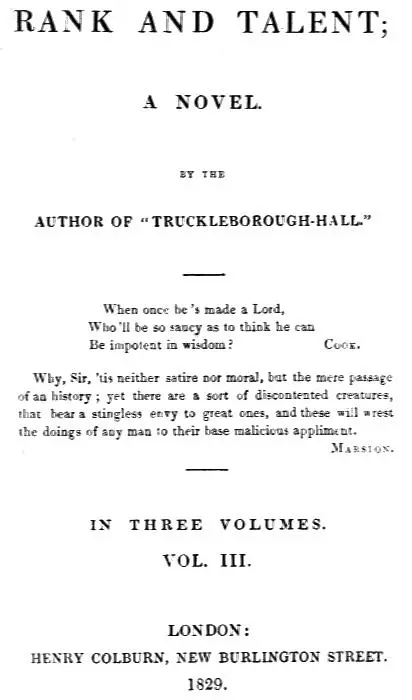
Rank and Talent; A Novel, Vol. 3 (of 3)
William Pitt Scargill
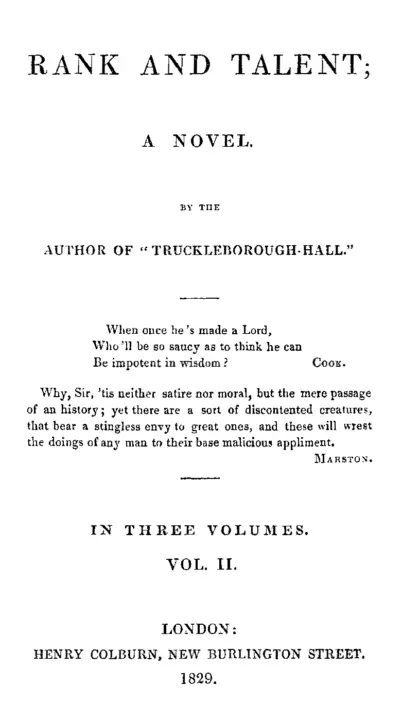
THE CLASSIC COLLECTION · 1829
"Rank and Talent; A Novel, Vol. 2" by William Pitt Scargill is a fictional narrative written in the early 19th century. The novel delves into the societal intricacies of London, exploring themes of class, ambition, and social standing through the character Philip Martindale and his interactions with various figures in high society. The narrative also introduces familial dynamics and romantic elements, particularly regarding the relationships of Martindale and the implications of his ambitious aspirations. The opening of the novel describes the bustling return of society to London after the country season, setting the stage for social rivalries and aspirations. We are introduced to Mr. Martindale, who is preparing to take his daughter Clara to a party hosted by Sir Gilbert Sampson. The dynamic reveals Martindale's cynical perspective on high society and his reluctance to engage with those he considers beneath him, while his cousin Philip faces pressures related to his rank and financial dependencies. Philip's qualms about his status and romantic entanglements foreshadow his struggles to navigate the expectations of aristocracy while exploring the social landscape influenced by wealth and privilege. The exploration of these intertwined relationships creates a rich backdrop for the continuing journey of ambition and class distinction.
Introduction adapted from the source catalogue; source summaries may be automatically generated.
Free to read · English · 56,943 words · No account needed
MAKE TIME FOR A GOOD BOOK
On by default. Untick to stop anonymous reading totals. Each page counts after 10 seconds in view. How this works.
Anonymous counting is on unless you have switched it off.
"Makes his approach in modesty's disguise,
To win applause; and takes it by surprise."
As we finished the last chapter by an allusion to plans, we may wisely commence this by suggesting one of our own. It would be very convenient in narrative to print the narrations of contemporaneous events in parallel columns on the same page; but that contrivance not being sanctioned by high authority, we dare not adopt it. Now how pleasant and agreeable it would have been to the reader while perusing the last chapter, and reading how Mr. Markham to his very great annoyance received an epistle from Miss Henderson, how pleasant would it have been to turn his eye across the page, and see at the same time what was passing in Miss Henderson's heart, or in Mr. Henderson's house! And again, how agreeable to know how our good and noble friends, the Earl and Countess of Trimmerstone, are going on at this time! This plan may some day or other be adopted. It would be a good speculation perhaps to publish Tom Jones, or Hume and Smollet, on this plan, and call it the Laputan System. In like manner the stage at our theatres might be divided into divers compartments, and events that occur at the same moment might at the same moment be exhibited to the audience or spectators. There would in this arrangement be a great advantage, inasmuch as, if one scene were stupid and sleepy, the good people might give their attention to another. Among the ingenious men who are daily exhibiting proofs of their Laputan education, some will no doubt be soon found who will adopt and perfect this plan. For the present we must go on according to the old system.
We must return, therefore, to Miss Henderson, who, as soon as she had despatched her note to Markham, began to think that she had acted rather forwardly, and feared that unpleasant consequences might result from thus almost saying yes, before she was asked. It was a pity that she did not think of that before. But there was no help for it. She thought it might be only regarded as an ebullition of friendship; and she thought that such a superior man as Markham would be above regarding the common-place etiquette of every-day society. Oh, how delightful it is to have a mind superior to the common herd of mortals! Miss Henderson was very sure that her mind was superior, and she trusted and hoped that Markham's also was superior. Of this, however, she began to entertain some doubts, when he did not make his appearance at Mr. Henderson's quite so soon as the young lady expected him. She thought that he was not a very ardent lover; but then again business might prevent him; and then again, what business ought to detain a lover from the idol of his soul? Day after day, Miss Henderson staid at home. Nothing could induce her to leave the house, for it was possible that in the hour of her absence, the beloved one might make his appearance. For with all her conviction of Markham's attachment, there was a lurking distrust and a feeling in her mind that he would not anxiously seek or long wait for her; and this feeling, though unacknowledged and unrecognised, had its influence on her mind. Doubts rose thicker and darker, amounting to serious apprehensions; and her mind was nearly in the same state as it had been when she made the last transfer of her affections. Anxious to miss no opportunity of seeing Markham, she was punctually in her pew at the chapel; and sorry are we to say it, she was more occupied with the thought of the young gentleman's absence than with the edifying and elegant discourse of her father. But Markham was not there. The young lady was absolutely angry, and began to think herself very ill used. Some of our readers may fear, that a very cold reception or severe lecture awaited the young gentleman. In that they are wrong, for had he made his appearance, his transgression would have been forgotten, and his reception most cordial. For at that time Miss Henderson could not spare him, having no one to supply his place. It is desirable always to keep up a proper supply and succession of lovers. Miss Henderson acted on this principle, inasmuch as an interregnum would be a sad loss of time. If indeed Mr. Markham knew as much as we did, his mind would have been much easier. But he was fearful that the young lady might break her heart, and he was fearful that the world would cast bitter reproaches upon him. That was a consideration which weighed mightily with him. Happy, however, was it for him, and a great relief it must be to our readers to be informed, that a new transfer of the heart of Miss Henderson was about to take place. Yet there may perhaps be some who are so hard-hearted as to delight in such torments, and to wish that our young friend might not be so soon and so easily dismissed from his state of trouble and uneasiness. A strange propensity it is in some minds, that they delight in the sufferings and pains of their fellow-creatures! Treatises have been written to account for this propensity, and many ingenious theories formed on the subject: but one theory is quite as good as another; and we are not willing to disturb the minds of those who have formed their own or adopted another's. To pass on from this philosophising, which is more pleasant to the writer than the reader, we will proceed with our narrative.
Your reading position is saved on this browser. Take it to another device with a library code. Reading pages adapt to text, rather than matching a printed edition.
William Pitt Scargill
William Pitt Scargill
BEHIND THE BOOK
This eBook is for the use of anyone anywhere in the United States and most other parts of the world at no cost and with almost no restrictions whatsoever. You may copy it, give it away or re-use it under the terms of the Project Gutenberg License included with this eBook or online at www.gutenberg.org. If you are not located in the United States, you will have to check the laws of the country where you are located before using this eBook. Read the source licence.
The original source file, including credits and licence, is retained by this library. Request an original-format copy at no charge. Please include the book title and Project Gutenberg identifier #44996.
KEEP YOUR CURIOSITY GOING
Coulson Kernahan

Maurice Baring
Frances Wright
Cécile Tormay

Frederic Jesup Stimson

W. H. P. (William Henry Pope) Jarvis