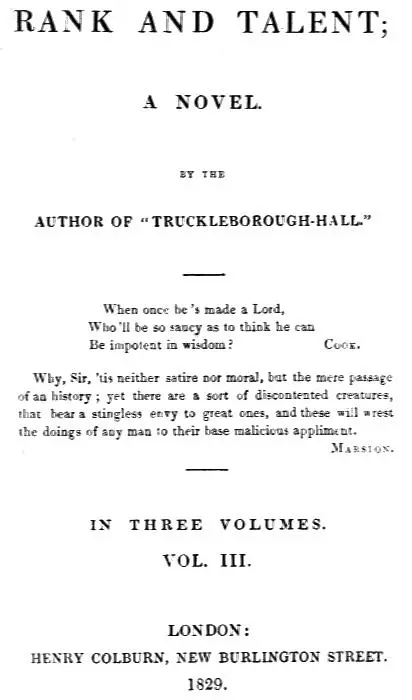
Rank and Talent; A Novel, Vol. 3 (of 3)
William Pitt Scargill
THE CLASSIC COLLECTION · 1829
"Rank and Talent; A Novel, Vol. 2" by William Pitt Scargill is a fictional narrative written in the early 19th century. The novel delves into the societal intricacies of London, exploring themes of class, ambition, and social standing through the character Philip Martindale and his interactions with various figures in high society. The narrative also introduces familial dynamics and romantic elements, particularly regarding the relationships of Martindale and the implications of his ambitious aspirations. The opening of the novel describes the bustling return of society to London after the country season, setting the stage for social rivalries and aspirations. We are introduced to Mr. Martindale, who is preparing to take his daughter Clara to a party hosted by Sir Gilbert Sampson. The dynamic reveals Martindale's cynical perspective on high society and his reluctance to engage with those he considers beneath him, while his cousin Philip faces pressures related to his rank and financial dependencies. Philip's qualms about his status and romantic entanglements foreshadow his struggles to navigate the expectations of aristocracy while exploring the social landscape influenced by wealth and privilege. The exploration of these intertwined relationships creates a rich backdrop for the continuing journey of ambition and class distinction.
Introduction adapted from the source catalogue; source summaries may be automatically generated.
Free to read · English · 56,943 words · No account needed
MAKE TIME FOR A GOOD BOOK
On by default. Untick to stop anonymous reading totals. Each page counts after 10 seconds in view. How this works.
Anonymous counting is on unless you have switched it off.
As Markham had neglected much beyond the usual period to pay a visit to Mr. or Miss Henderson, the latter began to think him little better than a gay deceiver; and when mention was made in her hearing concerning the probability of her union with the young gentleman, she no longer gave such confident assent to the report, but spoke doubtingly and hesitatingly. In this she acted wisely and discreetly. For if there was a probability that Markham should disappoint her, it would be highly important that she should hold herself disengaged, that there might be no time lost in providing herself with a successor. Now here we are in need of that arrangement of double columns, of which we made mention at the beginning of this chapter. For on that very day on which Mr. Markham, after a long absence and a great deal of doubting, did call on Mr. Henderson, on that very day Miss Henderson was out. She had not the slightest idea that Markham would call in the evening, but men of business cannot always call in the morning. Markham was very much occupied in the early part of the day. If we had the double-column plan, we might on one side paint the young gentleman's disappointment at not seeing the lady, and on the other depict the young lady at an evening party at the Right Hon. the Earl of Trimmerstone's town mansion; but as it is, we must leave the gentleman to bear his disappointment in solitude, and accompany our friend Miss Henderson to the mansion of nobility.
The Right Honorable the Earl of Trimmerstone had not, as we have before hinted, a very select circle of acquaintance. Access to his mansion and to the Countess's evening parties was no great difficulty. Easy, however, as it was, it was felt as an honor by some who visited there. Among these Miss Henderson was one. There was also another present at that party who was exceedingly proud of permission to visit a Right Honorable Earl. The person to whom we allude was a young physician of rising reputation in his practice at the west end. His name was Theodore Crack. In nervous cases the doctor had very much distinguished himself. We would indeed recommend all doctors to distinguish themselves in nervous cases. In some instances the patient wants the doctor, but in the nervous the doctor wants the patient. Dr. Crack had succeeded most wonderfully in some cases of this nature. The doctor we have said was young and successful, and the doctor was also very vain. Our readers would scarcely believe us if we were to state the full extent of the young man's conceit. One very special piece of coxcombry consisted in his change of name. He called himself Crack, though his real name was Crick; but as he came of very humble parentage, he altered his name that he might not seem to be related to persons in such humble condition. The west end of the town was quite a new world to him; and when first he settled there, he used to strut about and regard himself with astonishment. His native place he quite forgot; for seeing that the town in which he had been born was very small compared to London, Westminster, Southwark, and the suburbs, he thought it beneath his dignity to acknowledge or to recollect that so small a town was large enough for him to be born in. Sometimes there would come gaping up to London some rustic who had been school-fellow with this magnificent doctor, and sometimes such a one would, if meeting the doctor in the street, be rude enough to recognise and address him, whereupon he would cut them splendidly, and say that his own name was not Crick but Crack. Rustics are not likely to be nervous; and why should doctors care about them? Dr. Crack was constitutionally pompous; in very early life the propensity manifested itself. Being of short stature, he strutted and held up his head as high as he possibly could; and he made daily and hourly use of the most magnificent expressions and the finest words that he could find. There was also mingled with the pompous, something of the finical. In his dress he was superb and extravagant; and while he was engaged in the studies preparatory to practice, he cost his father two-thirds of his income. But Theodore was thought such a wonderful boy, that no expense was spared and no extravagance was grudged him. Theodore ought to have been more considerate; he had too many useless and idle expenses. It was very foolish, for instance, to spend a serious sum of money in finding family armorial bearings; but he was going to become a physician, and hoped to keep a carriage; he thought that it would be a pity not to have arms painted on the pannels; and then he wanted them for his seal; and seeing in a shop-window notice that arms were found there, the temptation was too great for him to resist, and he went into the shop accordingly; but was sadly disappointed after much research to discover that Crick had no arms, but Crack had; therefore from his own internal feelings being assured that he must be of the blood of the highest family of the two, he forthwith became Crack, and bore the arms of that family; and all the little insignificant low-born cousin Cricks were forgotten and cut; and our young gentleman swelled with conscious pride when he felt the blood of the Cracks flowing in his veins. These matters may appear trifling, but there is something in them interesting to those whose eyes can bear to look closely and minutely on such insect minds as Dr. Crack's. The pride of blood, birth, and connexion, extends very widely and very deeply; and there are multitudes who would have too much pride to be proud of these matters, did they but know how far the feeling extends. Another trait in the character of Dr. Crack ought not to be passed by unmentioned: he thought that every body else had as high an opinion of him as he had of himself. Therefore he could never believe or imagine that any one ever laughed at him; and the arrogance of his manners thus became truly amusing and ludicrous. We have had occasion to remark in a former part of this narrative, that nature gives instinct to those on whom she has not bestowed the gift of reason; and that in the rational being called man, where the reasoning power is not very strong, nature has made amends by the addition of a respectable and serviceable portion of instinct, thus reasoning for those who cannot reason for themselves. But sometimes it occurs that the pride of a man thus furnished scantily with reasoning power and abundantly with instinct, is such, that he fancies he has sufficient strength of reason, and then sets up for a rational being; at which nature, as if offended at such arrogance, leaves the poor thing to the sole guidance of its own fancied intellect. It is then like a child which is too proud to use leading-strings, and too weak to go without. Our young friend Dr. Crack was thus situated.
Your reading position is saved on this browser. Take it to another device with a library code. Reading pages adapt to text, rather than matching a printed edition.
William Pitt Scargill
William Pitt Scargill
BEHIND THE BOOK
This eBook is for the use of anyone anywhere in the United States and most other parts of the world at no cost and with almost no restrictions whatsoever. You may copy it, give it away or re-use it under the terms of the Project Gutenberg License included with this eBook or online at www.gutenberg.org. If you are not located in the United States, you will have to check the laws of the country where you are located before using this eBook. Read the source licence.
The original source file, including credits and licence, is retained by this library. Request an original-format copy at no charge. Please include the book title and Project Gutenberg identifier #44996.
KEEP YOUR CURIOSITY GOING
Coulson Kernahan

Maurice Baring
Frances Wright
Cécile Tormay

Frederic Jesup Stimson

W. H. P. (William Henry Pope) Jarvis