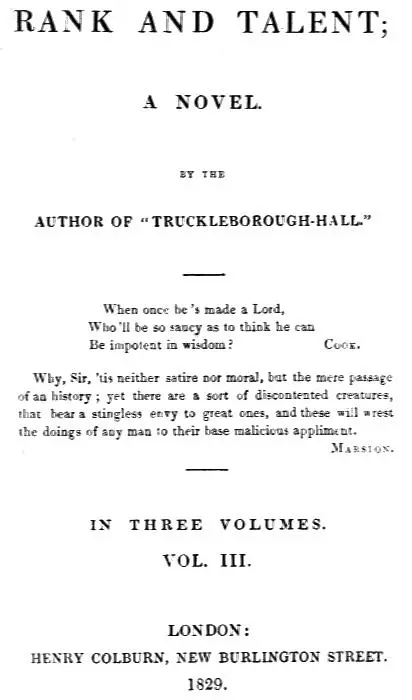
Rank and Talent; A Novel, Vol. 3 (of 3)
William Pitt Scargill
THE CLASSIC COLLECTION · 1829
"Rank and Talent; A Novel, Vol. 2" by William Pitt Scargill is a fictional narrative written in the early 19th century. The novel delves into the societal intricacies of London, exploring themes of class, ambition, and social standing through the character Philip Martindale and his interactions with various figures in high society. The narrative also introduces familial dynamics and romantic elements, particularly regarding the relationships of Martindale and the implications of his ambitious aspirations. The opening of the novel describes the bustling return of society to London after the country season, setting the stage for social rivalries and aspirations. We are introduced to Mr. Martindale, who is preparing to take his daughter Clara to a party hosted by Sir Gilbert Sampson. The dynamic reveals Martindale's cynical perspective on high society and his reluctance to engage with those he considers beneath him, while his cousin Philip faces pressures related to his rank and financial dependencies. Philip's qualms about his status and romantic entanglements foreshadow his struggles to navigate the expectations of aristocracy while exploring the social landscape influenced by wealth and privilege. The exploration of these intertwined relationships creates a rich backdrop for the continuing journey of ambition and class distinction.
Introduction adapted from the source catalogue; source summaries may be automatically generated.
Free to read · English · 56,943 words · No account needed
MAKE TIME FOR A GOOD BOOK
On by default. Untick to stop anonymous reading totals. Each page counts after 10 seconds in view. How this works.
Anonymous counting is on unless you have switched it off.
"Fair, gentle, sweet,
Your wit makes wise things foolish."
The intimacy between Clara Rivolta and Miss Henderson continued for a time uninterrupted. The friends of the former were not aware of the character of Miss Henderson; and had they been, they would not have supposed that Clara so much admired and esteemed her as she really did. Old Mr. Martindale had paid very kind and friendly attention to the settlement of the affairs of the late Lord Martindale, and having spent as much time in town as he thought desirable, removed his establishment to the coast, that his family might enjoy the pleasures of a watering-place. So it came to pass that the female friends were parted: but though separated, they were not forgetful of each other. Miss Henderson wrote a most beautiful hand, so small, so clear, with letters so peculiarly well-turned, that whenever she put a letter into the post-office, she thought that the letter-sorter and the postman must pause to admire the beauty of the writing. Not one of her numerous acquaintance could condense so many words into the compass of one common-sized sheet of letter-paper. With such qualifications, no wonder that she seized every opportunity of writing letters. People always do with pleasure that which they think they do well. It would gratify us if we could present the public with a fac-simile of one of Miss Henderson's letters, but our publisher will not allow of it. Our readers must therefore be contented with the printed copy of one. It is as follows:
"How feeble, my ever dear Clara, is the power of language to express the emotions of the heart! My heart is the seat of ten thousand times ten thousand agitating and conflicting thoughts, painful recollections, gloomy forebodings, tender regrets, joyous hopes. Oh, what is life without friendship! And how few, alas! who are worthy of the confidence of friendship. When I look upon the multitudes of people that pass and repass every day and every hour--when I see the common-place, every-day people of the world, and observe how careless and how contented they seem in the midst of their gross ignorance and stupidity, I cannot sometimes repress the almost impious wish that I were as stupid as they are. Is it not too true that increase of knowledge is increase of sorrow? The town is now empty, and yet pa's chapel is somehow well attended. Many people come from the city to hear him, and some young lawyers also from the inns of courts. You would be amused to see their vacant looks of admiration, almost amounting to astonishment, when pa gives one of his fine apostrophes, or his well-turned metaphors. Tippetson is still in town. I wonder what he can find to amuse him at this dull time of year. Pa would go to Brighton if he could find any tolerable substitute to fill his place in his absence, but the generality of preachers you know, my dear, are so dull, stupid, and common-place, that it is absolutely impossible for a person of any sense to sit and hear them; I am really astonished that the churches are so full as they are, there is scarcely one clergyman in twenty worth hearing. Tippetson says he is determined never to hear any body but pa. He was at the chapel yesterday, and sat directly opposite to us. I wish, my dear Clara, you could have seen him. He was so attentive, that he looked as if he was desirous of catching every syllable; and when any peculiarly fine and brilliant expression occurred, (you know pa's emphatic manner,) it was quite interesting to see how his countenance was lighted up with admiration. Pa makes it a point to preach quite as well when the fashionable people are out of town as when they are all here. Fashionable people! Ah, Clara, you do not know them so well as I do, and you need not wish to know them; so false, so vain, so hollow, so haughty! Mr. Martindale is the only person I ever saw who seems to understand them aright. What an advantage you have in the society of such an intelligent man! All his thoughts are wisdom, and all his sentences are oracles. Tippetson admires him prodigiously, and says that twenty such men in high life would produce a complete revolution in the fashionable world. I heard Tippetson say, but he did not know that I heard him, that he intended to procure a little velvet paper book, bound in pink satin and with silver clasps, and that he should on one side of the leaves record the wise sayings of Mr. Martindale, and on the other the beautiful similes that occurred in pa's sermons. I am sure, my dear, you will laugh when I tell you what a blunder pa was likely to make last week. He wanted to go out of town for a few weeks, and endeavoured to find a gen gentleman to officiate for him at the chapel, and a friend of ours recommended a person of whom he had some slight knowledge, and pa saw him, and was just on the point of engaging him, when by some odd expression pa found out that he was an evangelical. It would have been the ruin of the chapel if the mistake had not been discovered in time to prevent any engagement. Poor pa made the best excuse he could; and here we all remain for want of a proper substitute to supply the chapel in our absence. When Tippetson heard of the blunder, he laughed outright, and said it was a pity that the gentleman had not been engaged, in order that he might convert some of the good folks at this end of the town. I assure you, my dear, that Tippetson is far from being a dull man; the fact is, he has a considerable degree of wit, but he is not like some people who are always endeavouring to shine in conversation, and to say brilliant things. Now do you know there is nothing so excessively disagreeable to me as a perpetual endeavour to shine in conversation. Tippetson really does say some good things sometimes; I am told that some of those clever articles in the newspapers which are ascribed to Sir William Curtis, are actually the production of Tippetson. Well, my dear, dear Clara, you see what a rambling style I am writing in; but I don't know how it is, when I have the pen in my hand it seems to communicate the perpetual motion to my fingers. Talking of perpetual motion, what an absurdity it is to think that it can ever be discovered! and yet I have heard people who think themselves very clever at mechanics talk as if it might be discovered; I once heard a very superior man say that the perpetual motion was one of nature's arcana. Oh, how pleasant it is to have a correspondent to whom one can write freely and fully on any subject! How few are there like you, my dear friend, who have any interest in the pursuits of science and the discoveries of philosophy; and of those few who pretend to any relish for such things, there are not many who like you understand the subjects on which they converse: they are mere smatterers. You told me, I remember, that you found less literature and science in the world than you expected; and let me assure you, that is much rarer than even you imagine. The number of pretenders is very great; but real science is rare. I am afraid I shall tire you, my dear friend, but the truth is, I know not of any one to whom I can address myself so freely as to my dear Clara: but if I have trespassed too much on your valuable time by my poor unworthy scrawl, I can only cast myself on your mercy, or beg that you will punish me by an answer as long as my letter: punish did I say, I retract the unworthy expression, it would be no punishment to receive a copious epistle from a dear, intelligent, superior-minded friend. Your letters, my dear, are all instruction and wisdom. I could learn more from one of your letters than from a volume. I am almost ashamed of what I am going to say, I hesitate whether I shall acknowledge my sin; yet confession is one-half of repentance. I must acknowledge--will you ever forgive me? The fact is, I was so very naughty as to let Tippetson have a sight of your letter; and I am sure you will forgive me, if you can but imagine the admiration and delight with which he read it. I know you have too much strength of mind to be accessible to flattery, else I would not mention the affair to you; but the truth is, that he was so charmed with it that he begged me on his knees to let him have a copy of it, of course omitting names, and he was pleased to say that no pen was so worthy of the honor of transcribing it as mine: for the young man is pleased to compliment my hand-writing rather more than it deserves. There, now you are near the end of your labor of reading, and I am near the end of my pleasure in writing: for a pleasure it is to write to such a dear, kind, intelligent soul as my Clara Rivolta. Farewell; let me soon have another invaluable treasure in a letter from your intellectual pen to delight and instruct your faithful and sincere Rebecca Henderson."
Your reading position is saved on this browser. Take it to another device with a library code. Reading pages adapt to text, rather than matching a printed edition.
William Pitt Scargill
William Pitt Scargill
BEHIND THE BOOK
This eBook is for the use of anyone anywhere in the United States and most other parts of the world at no cost and with almost no restrictions whatsoever. You may copy it, give it away or re-use it under the terms of the Project Gutenberg License included with this eBook or online at www.gutenberg.org. If you are not located in the United States, you will have to check the laws of the country where you are located before using this eBook. Read the source licence.
The original source file, including credits and licence, is retained by this library. Request an original-format copy at no charge. Please include the book title and Project Gutenberg identifier #44996.
KEEP YOUR CURIOSITY GOING
Coulson Kernahan

Maurice Baring
Frances Wright
Cécile Tormay

Frederic Jesup Stimson

W. H. P. (William Henry Pope) Jarvis