THE CLASSIC COLLECTION✦An outlaw’s diary: the CommuneCLASSIC FREE BOOKS
An outlaw’s diary: the Commune
Cécile Tormay
THE CLASSIC COLLECTION · 1920
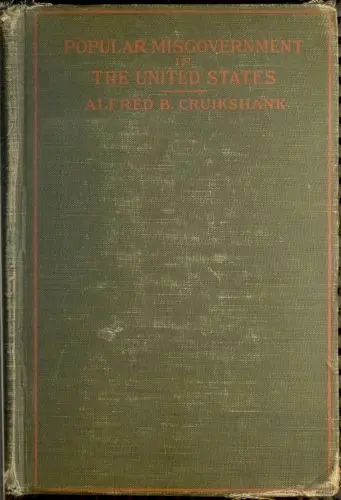
"Popular Misgovernment in the United States" by Alfred Byron Cruikshank is a political critique written in the early 20th century. The work discusses the perceived failures of popular governance in the United States, particularly focusing on the concept of universal suffrage and its implications for political corruption and inefficiency. Cruikshank argues that the unrestricted right to vote has led to the dominance of less qualified individuals in political office, leading to a governance that he views as ineffective and often corrupt. The opening of the book establishes a sense of urgency regarding the state of the American political system, highlighting the perceived threats of radical ideologies like Bolshevism, which he sees as a consequence of the failures of an unqualified electorate. Cruikshank emphasizes that the founding principles of governance should prioritize property ownership and societal contribution as qualifications for voters. He asserts that past political decisions, particularly the adoption of unqualified suffrage, have deteriorated American democracy, leading to governance characterized by inefficiency, corruption, and a disconnect from the virtues of the American foundations.
Introduction adapted from the source catalogue; source summaries may be automatically generated.
Free to read · English · 155,007 words · No account needed
MAKE TIME FOR A GOOD BOOK
On by default. Untick to stop anonymous reading totals. Each page counts after 10 seconds in view. How this works.
Anonymous counting is on unless you have switched it off.
It is often said that the main object of our government should be to preserve our political institutions. This is too short-sighted a view. These institutions are not an ultimate object; they are only the means of promoting and protecting civilization, the which ought to be the principal and ultimate object of the State. This object is to be accomplished by encouraging the citizens in the voluntary production of life’s primal material necessities: food, clothing, and shelter; in the conservation of the accumulated treasures of the past, and by favoring the addition thereto of new contributions by this generation, so that the total may be passed on intact to posterity. Any government is a failure which neglects that duty; which if accomplished, and a proper attention given to education, virtue and morality will take care of themselves. In the play of “Major Barbara,” one of Bernard Shaw’s best and most instructive comedies, the distinguished author shows the difficulty, the almost impossibility of the reclamation by mere admonition of a man degraded by pauperism; but that good wages regularly paid will do the job. Now, our present voting system not only fails to encourage thrift, saving or accumulation of wealth, or to promote civilization, but has a contrary tendency, because it grants equality and power in government to the non-producer, to the shiftless, lazy and vicious consumers and wasters of property.
In order to fairly realize the gross injustice of granting governmental powers to the thriftless classes, we must clearly visualize and properly estimate the results of the lives and labors of the thrifty and industrious. We must not fail to fully understand that frugality is the creator and preserver of the State. We have recently heard frequent appeals to save and help win the German war; because to save is to contribute to a fund out of which can be paid the expenses of the government. But the common fund of the nation’s wealth in peace as well as in war exists and is drawn upon by every member of the community, and it is just as true in peace as in war that the citizen who saves money is thus contributing to that common fund and thereby to the strength and well-being of the commonwealth, and this, whether he deposit his savings in a bank where it is loaned out to aid industry and create employment, or whether he invests it in commerce or manufactures, directly or indirectly, by the purchase of stocks or securities in industrial or commercial concerns. The mere fact of saving, that is to say of producing more than he consumes makes him at once a contributor to this general fund; and therefore any man who leaves behind him upon his death money or property which he accumulated in his lifetime has been a benefactor to the community, in the same sense as if he had contributed a great book or a valuable invention to the world, or had spent his life in benevolent work. To save or to make money and then to usefully spend it in one’s lifetime, reaping the tribute of the world’s appreciation is well enough; but to frugally save for a long lifetime in order to do good or give pleasure to others after one’s eyes are closed in death is surely nobler still. All the useful productions of man in the United States, the dwellings, stores, shops, ships, roads, railroads, telegraphs and telephones; the schools, colleges, hospitals and church edifices; all the accumulated fuel and stores of manufactured and other goods, are the fruits of individual saving. The greatness and power of the United States depend upon the collected savings of generations gone by, and evidence their industry, prudence and self-denial. The class of Americans who have wasted their surplus or who have produced no more than they earned; those devil-may-care fellows so admired by sentimentalists, have been of no permanent material value to the country; they are of the parasite class; they have no part in the creation of its civilization which is represented by its acquisitions and depends upon them for its continuance. Many of these people give themselves airs of virtue and generosity because they are not “mean” as they say; they even brag that they spend as they go, and for that attitude toward life expect and sometimes receive applause from others as great fools as themselves. Their ignorance prevents their perceiving their own selfishness; and their vanity hides from them a suspicion of their worthlessness. The late Andrew Carnegie is credited with many sayings wise and foolish; of the latter one of the oftenest quoted is that it is a disgrace to die rich. No proverb more mistaken and mischievous was ever uttered. For since no man, however much he made but might have squandered it all, therefore to die rich implies some prudence and self denial, and usually means that the departed left the world better off than he found it. The only anti-social rich are the land grabbers. All who have become capitalists by trade, production or invention, or by efforts in aid thereof, are public benefactors.
Your reading position is saved on this browser. Take it to another device with a library code. Reading pages adapt to text, rather than matching a printed edition.
BEHIND THE BOOK
This eBook is for the use of anyone anywhere in the United States and most other parts of the world at no cost and with almost no restrictions whatsoever. You may copy it, give it away or re-use it under the terms of the Project Gutenberg License included with this eBook or online at www.gutenberg.org. If you are not located in the United States, you will have to check the laws of the country where you are located before using this eBook. Read the source licence.
The original source file, including credits and licence, is retained by this library. Request an original-format copy at no charge. Please include the book title and Project Gutenberg identifier #57862.
KEEP YOUR CURIOSITY GOING
Cécile Tormay

Moritz Busch
John L. Ransom
Frances Wright
Cécile Tormay

Mabel Potter Daggett