THE CLASSIC COLLECTION✦An outlaw’s diary: the CommuneCLASSIC FREE BOOKS
An outlaw’s diary: the Commune
Cécile Tormay
THE CLASSIC COLLECTION · 1920
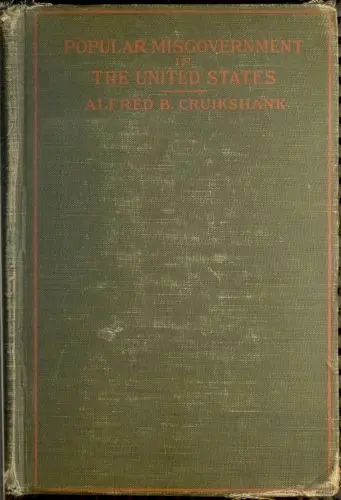
"Popular Misgovernment in the United States" by Alfred Byron Cruikshank is a political critique written in the early 20th century. The work discusses the perceived failures of popular governance in the United States, particularly focusing on the concept of universal suffrage and its implications for political corruption and inefficiency. Cruikshank argues that the unrestricted right to vote has led to the dominance of less qualified individuals in political office, leading to a governance that he views as ineffective and often corrupt. The opening of the book establishes a sense of urgency regarding the state of the American political system, highlighting the perceived threats of radical ideologies like Bolshevism, which he sees as a consequence of the failures of an unqualified electorate. Cruikshank emphasizes that the founding principles of governance should prioritize property ownership and societal contribution as qualifications for voters. He asserts that past political decisions, particularly the adoption of unqualified suffrage, have deteriorated American democracy, leading to governance characterized by inefficiency, corruption, and a disconnect from the virtues of the American foundations.
Introduction adapted from the source catalogue; source summaries may be automatically generated.
Free to read · English · 155,007 words · No account needed
MAKE TIME FOR A GOOD BOOK
On by default. Untick to stop anonymous reading totals. Each page counts after 10 seconds in view. How this works.
Anonymous counting is on unless you have switched it off.
Here then we find in the inherent powers of Society, in powers which are God-given or Nature-given if you prefer, an answer to the scruples of those who seek a source of authority in the State to protect its life by preserving its own machinery. It is this supreme potentate acting by and through the State that we invoke to settle the structure of the State on the foundations of capacity and intelligence.
Consider now the interest of Society in the proper regulation of the suffrage as the source and foundation of the State. Not alone is she vitally interested in the maintenance of the present civilizing forces which are sending us forward day by day on the march to higher planes of life; but also in preserving the material and intellectual inheritance of all the ages. This inheritance includes all the accumulated acquisitions of the civilized human race; its property, treasures, achievements and traditions; all the products of its mental and physical endeavor, the fruits of its art, literature, science and industry. These constitute the body of civilization in which its soul and mind are preserved, nourished and kept alive; they form a social trust for ourselves and for posterity. “Civilization,” said Burke, is “a triple contract between the noble dead, the “living and the unborn.” And by that contract we are forbidden to live or to legislate so as to cheat those who come after.
Society’s process for the preservation of our intellectual inheritance is called education; her method for the preservation of our material inheritance is the institution of private property rights. Humanity, property and education combined, constitute the material endowment of society, wherewith she works for the advancement of the human race, or as otherwise expressed for the promotion of civilization. Obviously she is justified in adopting all possible precautions to guard and preserve this precious deposit committed to her charge, nor can it be doubted that she should carefully select its custodians and overseers. Equally plain is it that since the civilization of the nation is and has been produced entirely by the thrifty members of the Social Commonwealth and remains in their guardianship, they and they alone, as constituting the class who have produced and cared for the same should be continued in its care as the representatives of Society and in her behalf; and should be authorized to formulate the laws and measures which make for its protection and advancement. To this end and purpose Society is constantly endeavoring. A volume could be written illustrating the exercise of her steady and mighty influence in placing the scepter in the hands of her chosen ones. Rome was the ancient conservator of civilization, and to her was given sway for centuries; England of all modern nations has been most devoted to preserving the best of the product of the generations as they pass on, and she and her race were made foremost among nations and peoples. Look at the community where you live and you will easily note how Society bestows influence, authority, distinction and esteem upon her own workers, the builders and creators of civilization and upon their children, and passes contemptuously by the unsocial and anti-social. You cannot fail to observe her disdain of the mere talkers and wasters and how she brings to naught the works and cheap distinctions of a manhood suffrage constituency. To the silly French Jacobin scheme of ascertaining the best by counting noses, Society opposes her own never failing system of continuous study, training and selection. She does not favor, on the contrary, she discourages the absurd and impossible purpose of modern liberalism of giving expression to ignorant individual wills with all their clashing selfishness and brutality. She does not favor the politician’s purpose of perpetuating moral feebleness and incapacity, nor of forwarding the foolish aims and ideas of the weak and the worthless. She is far from giving office or power to such or from even hearkening to their prattle and humbug. She has much to overcome. The power that makes for righteousness is not permitted to operate without the opposition of fools and charlatans; and it is within Society’s function to master this opposition, which she invariably does in the end. She constantly refuses to descend as manhood suffrage does to the level of the ignoble; on the contrary when they presume to oppose her in her momentous business she undertakes either to conquer them by reclamation or to see that they are hanged or otherwise removed out of her implacable path.
Your reading position is saved on this browser. Take it to another device with a library code. Reading pages adapt to text, rather than matching a printed edition.
BEHIND THE BOOK
This eBook is for the use of anyone anywhere in the United States and most other parts of the world at no cost and with almost no restrictions whatsoever. You may copy it, give it away or re-use it under the terms of the Project Gutenberg License included with this eBook or online at www.gutenberg.org. If you are not located in the United States, you will have to check the laws of the country where you are located before using this eBook. Read the source licence.
The original source file, including credits and licence, is retained by this library. Request an original-format copy at no charge. Please include the book title and Project Gutenberg identifier #57862.
KEEP YOUR CURIOSITY GOING
Cécile Tormay

Moritz Busch
John L. Ransom
Frances Wright
Cécile Tormay

Mabel Potter Daggett