THE CLASSIC COLLECTION✦An outlaw’s diary: the CommuneCLASSIC FREE BOOKS
An outlaw’s diary: the Commune
Cécile Tormay
THE CLASSIC COLLECTION · 1920
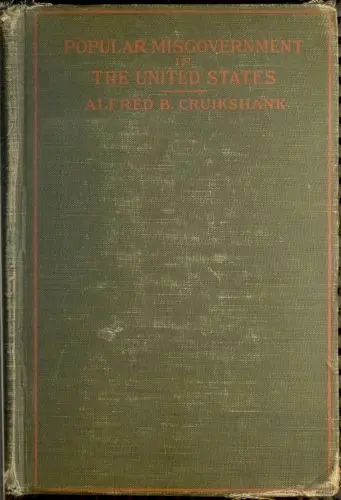
"Popular Misgovernment in the United States" by Alfred Byron Cruikshank is a political critique written in the early 20th century. The work discusses the perceived failures of popular governance in the United States, particularly focusing on the concept of universal suffrage and its implications for political corruption and inefficiency. Cruikshank argues that the unrestricted right to vote has led to the dominance of less qualified individuals in political office, leading to a governance that he views as ineffective and often corrupt. The opening of the book establishes a sense of urgency regarding the state of the American political system, highlighting the perceived threats of radical ideologies like Bolshevism, which he sees as a consequence of the failures of an unqualified electorate. Cruikshank emphasizes that the founding principles of governance should prioritize property ownership and societal contribution as qualifications for voters. He asserts that past political decisions, particularly the adoption of unqualified suffrage, have deteriorated American democracy, leading to governance characterized by inefficiency, corruption, and a disconnect from the virtues of the American foundations.
Introduction adapted from the source catalogue; source summaries may be automatically generated.
Free to read · English · 155,007 words · No account needed
MAKE TIME FOR A GOOD BOOK
On by default. Untick to stop anonymous reading totals. Each page counts after 10 seconds in view. How this works.
Anonymous counting is on unless you have switched it off.
No one can doubt that a similar feeling of political disappointment with the workings of our government, of hatred and contempt for our oligarchy of politicians, of want of faith in the honesty, integrity, ability and earnestness of those in power, is largely responsible for the progress of American socialism, for other organized protests against the democratic system and for that phenomenon frequently referred to as “popular unrest.”
Elihu Root in the North American Review for December, 1919, refers to Roosevelt, when president about twelve years ago, as recognizing the existence of this popular dissatisfaction, that “a steadily certainly growing discontent was making its way among the people of our country” and that millions were “then beginning to feel that our free institutions were failing.” But Roosevelt was too much of a politician himself to dare to touch the real sore spot, or to propose to cut out the cancer, and neither Root nor Roosevelt, nor any other noted politician has assigned any adequate cause for the unrest of these times. The fact is that the public has come to despise in its heart a political system in which weakness and rascality are so prominent. Roosevelt went up and down, says Root, making frantic appeals for obedience to law. The American people, of whom there are millions just as honest and common-senseful as Roosevelt, know that the law must be obeyed as a practical rule of business; but they refuse to implicitly believe in the wisdom, honesty or sanctity of statutes and ordinances promulgated by an oligarchy of place-hunting politicians. There is no substantial difference between the attitude towards this oligarchy taken by the thrifty honest working class and that of the honest mercantile or professional class; they are all dissatisfied with our governmental system for the same reason; namely, because it is morally and intellectually unworthy of the American people. Jealousy of great fortunes has been mentioned as a possible cause of the popular discontent. But the bulk of the American people are not so meanly and stupidly envious as that suggestion would imply. They are no more inclined to envy a man his honestly acquired wealth than his superior health, strength, musical talent or the acquisition of a foreign language. The honest rich live plainly; they work hard and they give munificently and wisely; they are not in power; the people know it and would much prefer them to the ruling horde which now afflicts us. Roosevelt himself was in the eyes of the masses a rich man, but he was very popular and all the more so because he was known to be pecuniarily independent. The cause of the public dissatisfaction is not the doings of the rich, but the misdoings of the grafting politicians. The latter go about wondering at the cause of what they call “unrest,” when they themselves are that cause. The intelligent workers of modest incomes, farmers, mechanics, traders, professional men, clerks, etc., see with their own eyes a lot of ignorant, sordid knaves obtain undeserved public offices and honors and graft themselves into wealth, and they partly envy and completely dislike and despise the whole lot. Thence it follows that transactions between the politicians and business men of all kinds become distrusted by the public, who are ready to suspect all railroad and other corporations, all importing and manufacturing interests which are affected by legislation or governmental action, whether tariff, taxation, rate regulation or otherwise, of bribery, fraud and corruption in all transactions with government or wherein government officials are concerned. The people are also dissatisfied because the office-holding class is weak and lacking in dignity and firmness. The attitude of a public official with his ear to the ground is low and brings him into contempt. The public finds too much smartness and cleverness and too little manly pride and directness in our machine-made rulers. They find that they lack courage to do affirmative justice with due speed; that they are able to do nothing without first being assured of a majority at their backs. Their decisions are governed not by the application of principles but by a process of additions and subtractions; they are not leaders of the people but followers of the rabble. And this slavish cowardice has been increased since the votes of women are being sought by new forms of pandering. If we want the people to respect and love the government we must give them one worthy of respect and love. To ensure the loyalty and devotion of the immigrant as well as of the native, we must make our political institutions as nearly perfect as possible; we must offer for the support of the American people a government like that of the Fathers; pure, patriotic and efficient, one that can command respect as well as enforce obedience.
Your reading position is saved on this browser. Take it to another device with a library code. Reading pages adapt to text, rather than matching a printed edition.
BEHIND THE BOOK
This eBook is for the use of anyone anywhere in the United States and most other parts of the world at no cost and with almost no restrictions whatsoever. You may copy it, give it away or re-use it under the terms of the Project Gutenberg License included with this eBook or online at www.gutenberg.org. If you are not located in the United States, you will have to check the laws of the country where you are located before using this eBook. Read the source licence.
The original source file, including credits and licence, is retained by this library. Request an original-format copy at no charge. Please include the book title and Project Gutenberg identifier #57862.
KEEP YOUR CURIOSITY GOING
Cécile Tormay

Moritz Busch
John L. Ransom
Frances Wright
Cécile Tormay

Mabel Potter Daggett