THE CLASSIC COLLECTION✦An outlaw’s diary: the CommuneCLASSIC FREE BOOKS
An outlaw’s diary: the Commune
Cécile Tormay
THE CLASSIC COLLECTION · 1920
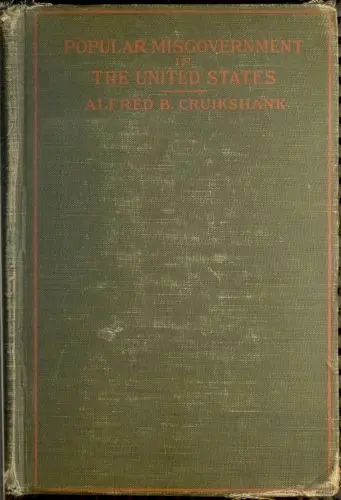
"Popular Misgovernment in the United States" by Alfred Byron Cruikshank is a political critique written in the early 20th century. The work discusses the perceived failures of popular governance in the United States, particularly focusing on the concept of universal suffrage and its implications for political corruption and inefficiency. Cruikshank argues that the unrestricted right to vote has led to the dominance of less qualified individuals in political office, leading to a governance that he views as ineffective and often corrupt. The opening of the book establishes a sense of urgency regarding the state of the American political system, highlighting the perceived threats of radical ideologies like Bolshevism, which he sees as a consequence of the failures of an unqualified electorate. Cruikshank emphasizes that the founding principles of governance should prioritize property ownership and societal contribution as qualifications for voters. He asserts that past political decisions, particularly the adoption of unqualified suffrage, have deteriorated American democracy, leading to governance characterized by inefficiency, corruption, and a disconnect from the virtues of the American foundations.
Introduction adapted from the source catalogue; source summaries may be automatically generated.
Free to read · English · 155,007 words · No account needed
MAKE TIME FOR A GOOD BOOK
On by default. Untick to stop anonymous reading totals. Each page counts after 10 seconds in view. How this works.
Anonymous counting is on unless you have switched it off.
The success of the Revolution in no way affected the suffrage. It had not been a democratic movement nor intended as such. At first it was designed to merely curtail without actually terminating British interference in American affairs; later as the estrangement increased it was determined to entirely get rid of British rule. But the Revolution was in spirit a conservative movement, whereby it was not intended to interfere with existing colonial laws relating to suffrage nor to alter the political or social structure of society nor to materially change aught in government beyond terminating the British connection. In this respect it materially differed from the French Revolution which developed into an attempt to completely reorganize the social and political fabrics. The American revolutionists were well satisfied with their local laws and customs, and the separation from Great Britain once accomplished, the conservative policy adopted at the beginning of the struggle still continued till the generation which had carried through the Revolution had finally passed away.
The Declaration of Independence has nothing to say about the right of suffrage. Although composed by Jefferson, who was influenced by the sentimentalities of the French theorists of the time it contains only two brief statements which can possibly be quoted as favoring the principle of manhood suffrage. One is “that all men are created equal.” This statement could not have been intended to be understood without qualification because it is notoriously false. Men are not created equal either in size, health, affections, virtues, social station, capacity, prospects in life, opportunities, nor in anything else. In his own country thousands were then held in bondage, some by Jefferson himself, and a considerable part of the colonial population were without political rights. He could not therefore have even meant that all men were entitled to be considered as politically equal unless he intended merely to express a private opinion of his own. Public opinion as expressed in the laws and customs of the time was exactly to the contrary. The other statement of the Declaration that governments “derive their just powers from the consent of the governed,” is equally absurd, if applied to individuals. It may be that a government is a usurper if it exists in defiance of society at large, but it may properly dispense with the consent of an unlimited number of the individuals whom it governs. It cannot be supposed that Jefferson and his associates intended to imply that none of the governmental powers on the earth including those of the colonies themselves were just; yet none of them derived their powers from the consent of all those under their authority. Most of the colonies were founded on charters granted by the British crown. The consent of the native Indians, of aliens, women, minors, negroes and the unpropertied class had not been given to any government in this country, nor was it proposed at that time that any such consent should be asked for. More than this, neither Jefferson nor any one else proposed that the consent of the minority at any election, even were it forty-nine per cent of the whole, should be required to establish the new government. The most that Jefferson pretended to mean by these fine phrases was to claim that a majority of the qualified voters of the colonies should govern the country through their representatives duly elected. But in practice even this was a sham; the Revolutionists were probably in a minority of from one-fifth to a third of the whole people; they never troubled themselves to obtain the consent of the Tories or the indifferent; and what Jefferson really intended was to get his faction together on the basis of that Declaration as a party platform, to fight for the result and to beat or intimidate the majority into subjection or acquiescence. This is what was actually done; both sides resorted to force, the neutrals were silenced, and the Americans of tory principles were soon taught to their sorrow that Jefferson and his associates intended to govern them with or without their consent and pretty harshly at that. No vote was ever taken on the question of separation from Great Britain, and the consent of the objectors to what was done was rendered unnecessary by the efficient process of killing them or driving them into exile and confiscating their property.
Your reading position is saved on this browser. Take it to another device with a library code. Reading pages adapt to text, rather than matching a printed edition.
BEHIND THE BOOK
This eBook is for the use of anyone anywhere in the United States and most other parts of the world at no cost and with almost no restrictions whatsoever. You may copy it, give it away or re-use it under the terms of the Project Gutenberg License included with this eBook or online at www.gutenberg.org. If you are not located in the United States, you will have to check the laws of the country where you are located before using this eBook. Read the source licence.
The original source file, including credits and licence, is retained by this library. Request an original-format copy at no charge. Please include the book title and Project Gutenberg identifier #57862.
KEEP YOUR CURIOSITY GOING
Cécile Tormay

Moritz Busch
John L. Ransom
Frances Wright
Cécile Tormay

Mabel Potter Daggett