THE CLASSIC COLLECTION✦An outlaw’s diary: the CommuneCLASSIC FREE BOOKS
An outlaw’s diary: the Commune
Cécile Tormay
THE CLASSIC COLLECTION · 1920
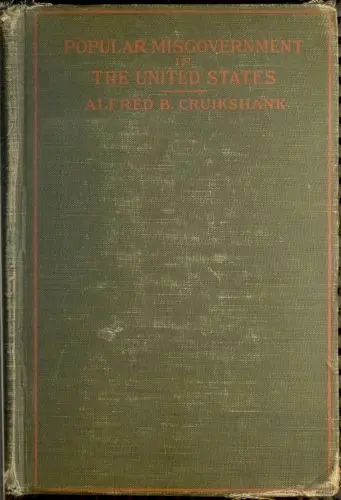
"Popular Misgovernment in the United States" by Alfred Byron Cruikshank is a political critique written in the early 20th century. The work discusses the perceived failures of popular governance in the United States, particularly focusing on the concept of universal suffrage and its implications for political corruption and inefficiency. Cruikshank argues that the unrestricted right to vote has led to the dominance of less qualified individuals in political office, leading to a governance that he views as ineffective and often corrupt. The opening of the book establishes a sense of urgency regarding the state of the American political system, highlighting the perceived threats of radical ideologies like Bolshevism, which he sees as a consequence of the failures of an unqualified electorate. Cruikshank emphasizes that the founding principles of governance should prioritize property ownership and societal contribution as qualifications for voters. He asserts that past political decisions, particularly the adoption of unqualified suffrage, have deteriorated American democracy, leading to governance characterized by inefficiency, corruption, and a disconnect from the virtues of the American foundations.
Introduction adapted from the source catalogue; source summaries may be automatically generated.
Free to read · English · 155,007 words · No account needed
MAKE TIME FOR A GOOD BOOK
On by default. Untick to stop anonymous reading totals. Each page counts after 10 seconds in view. How this works.
Anonymous counting is on unless you have switched it off.
This feeling of American distrust of our own public servants is frequently apparent in legislation enacted as a result of agitation following one of the numerous revelations of official misconduct. Thus, in some cities the police power has been taken entirely out of the hands of the local authorities and lodged in the government of the state. One reform city charter of St. Louis provided that the mayor elected for four years could not remove any official till his own third year in office. These and many similar statutes are in effect formal assertions of the complete breakdown of manhood suffrage; that the elected municipal officials cannot be trusted either to police the city or to remove or appoint subordinate officers. The mayor under such a system has to manage the best he can with deputies over whom he has little or no control. It seems as if political imbecility could go no farther than to create a system under which the mayor of the city is certain to be untrustworthy and must therefore be deprived of power to control his subordinates. And yet no doubt these provisions were but the recognition of the desperate situation of a manhood suffrage municipality. In one of the instances just referred to the object of the city charter seems to have been to vary the misery; two years chaos and two years ring-rule, turnabout.
This feeling of despondent suspicion is constantly being voiced by the middle-class newspapers and by groups of prominent citizens, by committees of fifty, of one hundred, etc., in circular appeals distributed by the ten thousand to all men of any standing in the community, urging them to “fight” as it is called, day and night, to save the town, city, county, state and nation from disaster. A stranger reading one of these urgent calls would naturally ask with curiosity for the names of the enemies to be thus attacked; are they Huns, Bolsheviki, hoodlums, gunmen, rioters or what? The grotesquely pathetic answer is that they are all our neighbors, our fellow citizens, nay, our “Honorable” fellow citizens; elected by ourselves by large majorities last year, last month, or yesterday perhaps, or appointed by men whom we have ourselves recently elected; they are his honor the mayor; honorable members of the city or state legislature; of boards of supervisors; of Congress; of this and that public commission; of the state governments; officials of every class, both elective and appointed, county, city, state, and federal. It is not against hostile outsiders or natural adversaries, but against our own manhood suffrage officials that we have to “fight”; it is these officials and their associates, agents, and party superiors or “bosses” who we are told by press and pulpit, in newspaper, book and magazine, in private conversation and in public address, and above all at the meetings of independent citizens and reformers, are the actual or potential enemies, furtive or open, conscious or unconscious, of good government, of our pocket-books, our health, our comfort, and our lives. We are urgently reminded that our manhood suffrage government is by no means to be trusted; that the only hope of tolerable government is to arouse every good citizen to an attitude and a habit of constant distrust of our chosen representatives and rulers and to regard them with sleepless jealousy and suspicion. It is not enough to vote; you must attend primaries; nay more, you must anticipate the primaries and plan to elect certain primary candidates and to defeat others; even when your own men are chosen, you cannot safely trust them; you must doubt every member of Congress, every legislator and every official, including those just seated by your own vote; you must suspect every new proposal, every legislative bill, every municipal ordinance; a good citizen will watch them all; he will at private expense procure advance copies of all of them; he will if he can employ a lawyer to study them; he will join all kinds of political organizations and attend all their meetings, and will use constant vigilance to see that these organizations are not “captured” or purchased by the politicians, and that he himself is not captured without suspecting it, so wily are these political experts and so cunning and numerous are the snares and temptations of political life. Nor is even this all; he must work up and join deputations to the sessions of the municipal administration and to those of the town and county authorities, to the state capitol, to Washington; he must write to the newspapers, he and others must at times bombard Congress and the state legislature and their committees with letters and telegrams. In short the system is this: you select the incapable and worthless for office and then wear your soul out in efforts to keep them from blundering and plundering. Common sense would suggest the selection in the first place of men who could be trusted; and if the method of selection failed, to replace it by a better one; but this cannot be done; manhood suffrage though rotten is sacred, and those who have the patience and courage continue their endeavors to make a marble temple of justice out of a mud electorate.
Your reading position is saved on this browser. Take it to another device with a library code. Reading pages adapt to text, rather than matching a printed edition.
BEHIND THE BOOK
This eBook is for the use of anyone anywhere in the United States and most other parts of the world at no cost and with almost no restrictions whatsoever. You may copy it, give it away or re-use it under the terms of the Project Gutenberg License included with this eBook or online at www.gutenberg.org. If you are not located in the United States, you will have to check the laws of the country where you are located before using this eBook. Read the source licence.
The original source file, including credits and licence, is retained by this library. Request an original-format copy at no charge. Please include the book title and Project Gutenberg identifier #57862.
KEEP YOUR CURIOSITY GOING
Cécile Tormay

Moritz Busch
John L. Ransom
Frances Wright
Cécile Tormay

Mabel Potter Daggett