THE CLASSIC COLLECTION✦An outlaw’s diary: the CommuneCLASSIC FREE BOOKS
An outlaw’s diary: the Commune
Cécile Tormay
THE CLASSIC COLLECTION · 1920
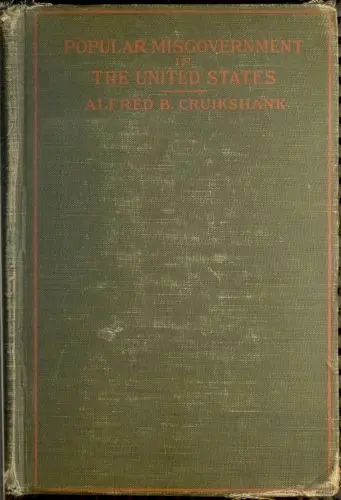
"Popular Misgovernment in the United States" by Alfred Byron Cruikshank is a political critique written in the early 20th century. The work discusses the perceived failures of popular governance in the United States, particularly focusing on the concept of universal suffrage and its implications for political corruption and inefficiency. Cruikshank argues that the unrestricted right to vote has led to the dominance of less qualified individuals in political office, leading to a governance that he views as ineffective and often corrupt. The opening of the book establishes a sense of urgency regarding the state of the American political system, highlighting the perceived threats of radical ideologies like Bolshevism, which he sees as a consequence of the failures of an unqualified electorate. Cruikshank emphasizes that the founding principles of governance should prioritize property ownership and societal contribution as qualifications for voters. He asserts that past political decisions, particularly the adoption of unqualified suffrage, have deteriorated American democracy, leading to governance characterized by inefficiency, corruption, and a disconnect from the virtues of the American foundations.
Introduction adapted from the source catalogue; source summaries may be automatically generated.
Free to read · English · 155,007 words · No account needed
MAKE TIME FOR A GOOD BOOK
On by default. Untick to stop anonymous reading totals. Each page counts after 10 seconds in view. How this works.
Anonymous counting is on unless you have switched it off.
“Does it require argument to prove to thoughtful people that wise choice is not likely to be made in the midst of the revel of hysteria, sham, demagogy, falsehood and ignorance, which we call a direct popular election of administrative officers? Is choice likely to be wise when nine out of ten of those who make it know nothing of the candidates they support or oppose, and are equally ignorant of the work the candidates ask the privilege of doing?”
Thus arises a question difficult to decide, between appointments by a machine, and those of a machine-directed populace.
The immense importance of scientific management of cities is so obvious as not to need discussion. It is set forth in detail in a book published in 1918 by M. L. Cooke, Director of Public Works in Philadelphia, to which the reader is referred. The author states that “Governmental work, Federal, State and Municipal, is still almost exclusively in the unsystematized stage.”
Here is an extract from a competent writer, a man of actual experience
in city matters:
“When the Public Builds Buildings. Twenty-seven million dollars for a City Hall that was to have cost $7,000,000; no water on the second floor of a public bath because the water mains were made too small; an emergency order, without competitive bids, for repairing a police precinct, given to a contractor sixteen miles away; $20,000 for cleaning a City Hall that could be kept clean for $2,000; fifteen employees dead from tuberculosis in one germ-infested, dark, unclean room. What’s the use of multiplying examples?” (Woman’s Part in Government, by W. H. p. 330.)
The lack of efficiency in Federal administration which has been notorious for ninety years is due to the malign influence of manhood suffrage which renders it impossible to enforce standards of capacity. What Faguet calls “the religion of incompetency” is displayed even in the presidential appointments where men are moved about from office to office like checkers on a board, and put in places for which they have had no previous training whatever. This method of appointment is in itself convincing proof, not merely of the unfitness of the appointments, but of the vice of the whole system of selection. A jack of all trades is master of none. What would be said of the fitness of a man to superintend a watch-making establishment who had never worked at the trade or business of maker or of dealer in watches, and whose entire experience had consisted of one or two years in each of the employments of carpenter, dentist, cook and piano tuner? Yet the practice of politics sanctions just such appointments as that would be. Even for great offices requiring the highest skill, preparatory training or experience is rarely required. Looking back from 1918; out of forty-four United States Secretaries of State from the beginning of our history, thirty-three were lawyers; only three or four had any previous diplomatic experience; out of the sixteen last Secretaries of the Treasury, twelve were lawyers and only four bankers; out of the last thirteen Postmasters General, only one had ever before been in the Post Office Department; of forty-nine Secretaries of War in our history thirty-five were lawyers; the others were editors, bankers, etc., and only three or four had any previous military experience; out of thirty-eight Secretaries of the Navy twenty-seven were lawyers, three authors, and seven were business men. Not one of them all had any naval experience prior to taking control of the United States Navy. A former Secretary of the Navy gave the writer to understand that he had been appointed principally to distribute the patronage and to hold the state politically in line. Now, while it is quite true that a knowledge of the law and a training in the art of reading and understanding law is extremely important to any cabinet official, yet surely a lawyer cannot be expected to build ships, conduct a post-office business, direct the diplomacy of a great nation or carry on war properly without any appropriate previous training whatever. Yet under a system of government by manhood or universal suffrage untrained men are sure to get these high appointments because they are vote-getters and can obtain the support of the controllable class for the party in power; in short because they are machine men and the needs of the machine are first and imperative.
Your reading position is saved on this browser. Take it to another device with a library code. Reading pages adapt to text, rather than matching a printed edition.
BEHIND THE BOOK
This eBook is for the use of anyone anywhere in the United States and most other parts of the world at no cost and with almost no restrictions whatsoever. You may copy it, give it away or re-use it under the terms of the Project Gutenberg License included with this eBook or online at www.gutenberg.org. If you are not located in the United States, you will have to check the laws of the country where you are located before using this eBook. Read the source licence.
The original source file, including credits and licence, is retained by this library. Request an original-format copy at no charge. Please include the book title and Project Gutenberg identifier #57862.
KEEP YOUR CURIOSITY GOING
Cécile Tormay

Moritz Busch
John L. Ransom
Frances Wright
Cécile Tormay

Mabel Potter Daggett